
Moen Flo Smart Water Monitor and Shutoff vs Flume 2: Built-In Automatic Shutoff or Easier Water-Use Monitoring?
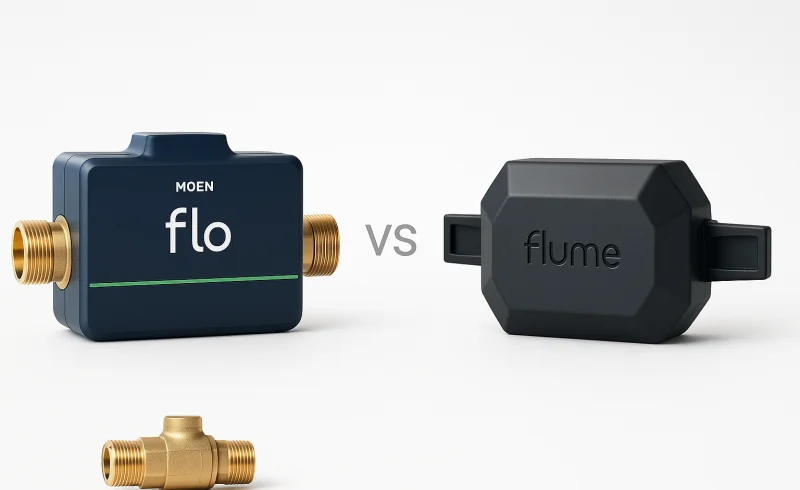
Explore the key differences between Moen Flo Smart Water Monitor and Shutoff and Flume 2 Smart Home Water Monitor. Discover which device offers automatic leak prevention, water usage insights, and ease of installation for your home or rental property.
TL;DR
- Moen Flo is the stronger fit when the main goal is automatic damage containment. It sits in the main water line, monitors flow, pressure, and temperature, and can close its own valve when it detects a critical abnormal event.
- Flume 2 is the stronger fit when installation simplicity and detailed consumption data matter more. Its battery-powered sensor straps to a compatible water meter, while its app provides minute-level usage history and Detail+ appliance/fixture categorization.
- Flume 2 by itself does not close the water. Flume now supports YoLink shutoff valves, however, so selected Flume leak rules can trigger an automatic shutoff when a compatible YoLink valve and hub are added.
- Flume is not automatically the right answer for every renter or condo. It still requires access to a compatible water meter, and a shared meter cannot separate one unit's usage from another. Some utilities also restrict access to meter boxes.
- Neither system should be treated as a precise leak locator. Moen detects abnormal behavior in the plumbing system; Flume's Detail+ can classify usage by likely fixture or appliance, but classification is not the same as identifying the physical location of a leak.
| Feature | Flume 2 Smart Home Water Monitor | Moen Flo Smart Water Monitor and Shutoff |
|---|---|---|
| Power | ||
| System power architecture | Battery-powered water sensor with plug-in Wi-Fi bridge | In-line device powered by AC adapter |
| Nearby AC outlet at sensing location | Not required | Required |
| General | ||
| Product type | Smart home water monitor and leak detector | Smart home water monitoring and leak detection system with shutoff |
| Features | ||
| Leak notifications | App, text, and/or email alerts | App, phone call, and email alerts |
| Water usage monitoring | Supported | Supported |
| Water shutoff capability | No water shutoff capability | Remote, automatic, and manual water on/off |
| Automatic shutoff on leak | Not supported | Supported |
| Real-time flow or usage data | Down-to-the-minute water use data and real-time GPM | Real-time flow, pressure, and temperature readings |
| Connectivity | ||
| Wi-Fi required | Required | Required |
| Supported Wi-Fi band | 2.4 GHz | 2.4 GHz |
| Mobile app device required | iOS or Android device | iPhone or Android device |
| Installation | ||
| Installation method | Strap-on sensor fastened to the water meter | In-line device installed on the main water line |
| Installation target | Water meter | Main water supply line |
| Compatibility requirement | Compatible with about 95% of water meters in the United States | Model 900-001: 0.75 inch main water supply line (can be installed on 1.25 inch diameter or smaller) |
📑 Table of Contents
Leak Detection & Response
The fundamental difference is not whether these systems can notice unusual water use. Both can. It is what happens after they notice it.
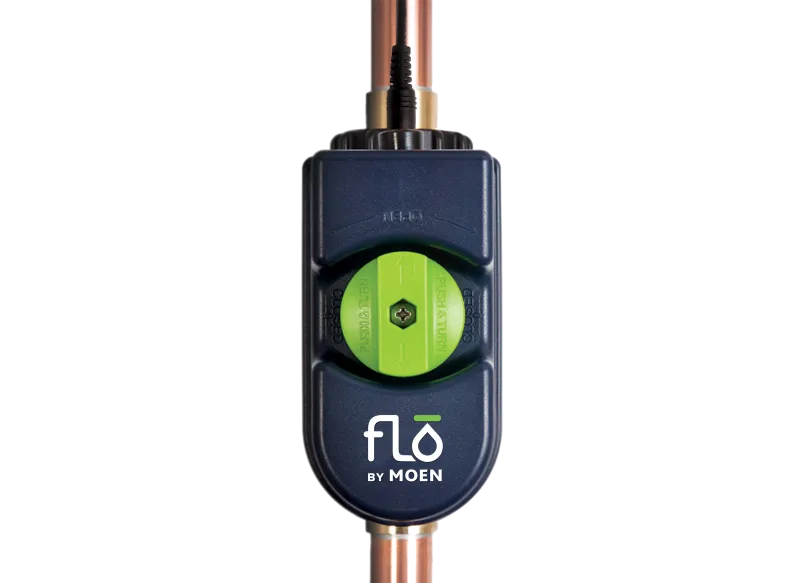
Moen Flo Smart Water Monitor and Shutoff is an in-line valve as well as a monitor. Moen says its FloSense software learns a home's water-use patterns and watches for unusual flow rate, duration, timing, and overall usage. If the system determines that an event is critical, it can close the main valve automatically; the valve can also be operated remotely through the app or manually at the device.
There is an important qualification that is easy to miss in a spec-sheet comparison: a newly installed Moen Flo enters a Learning Mode that typically lasts 14 to 28 days. During that period it records water use to establish a baseline, but Moen says unusual-usage alerts and automatic shutoff protection are not yet active. Once learning is complete, the shutoff sensitivity can be adjusted from Standard to more aggressive settings.
Moen also performs a different kind of check that Flume cannot replicate from outside the pipe. Its automatic MicroLeak Test temporarily closes the valve and watches for pressure loss in the plumbing. Moen says the test normally runs automatically once per day and can also be started manually. That makes Flo useful for detecting small pressure losses that may not look like an obvious high-flow event.
Flume 2 Smart Home Water Monitor watches the water meter rather than controlling the pipe. Its default Smart Leak Alert is designed to flag sustained flow, while a separate High Flow Alert can catch larger events; those rules can be customized. In a standard Flume 2 setup, an alert still requires someone to respond because the sensor has no valve of its own.
That last point is no longer the whole story, though. Flume now integrates with YoLink shutoff valves. With a supported valve and YoLink Hub added, individual Flume usage-alert rules can be configured to close the water automatically. That makes Flume expandable into a containment system, but it is a multi-device arrangement rather than the self-contained architecture of Moen Flo.
For a standalone installation, Moen Flo has the clearer leak-response advantage: the monitor, decision logic, and shutoff valve are already part of one system. Flume's advantage is that it can begin as a non-invasive monitor and add shutoff hardware later if the home supports it.
Installation & Setup

Installation is where the two products diverge most sharply.
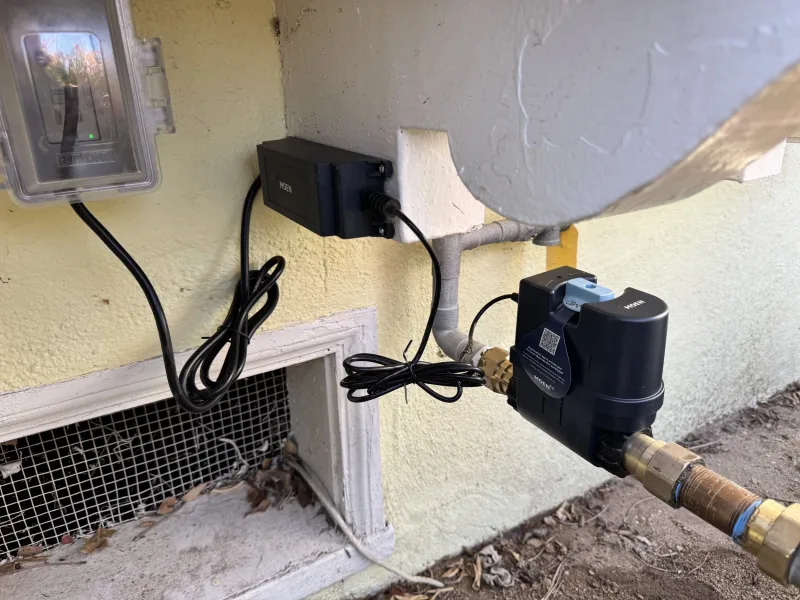
Moen Flo becomes part of the main supply line. Moen currently offers 3/4-inch, 1-inch, and 1-1/4-inch versions and recommends installation by a licensed professional plumber. The unit can be mounted horizontally or vertically as long as the flow direction is correct, but installing it still means shutting down the water supply, modifying the line, and planning for power.
Moen's current support documentation specifies a standard 120V outlet for the shutoff. It also requires a 2.4 GHz Wi-Fi network for connected features. For a new installation, Moen's setup flow has the user pair the device to the app before the plumber installs it on the main line. That sequence is worth planning for: the device needs temporary access to power and Wi-Fi before it reaches its final plumbing position.
Flume 2 avoids pipe work. Its Water Sensor straps to the outside of a compatible meter and communicates by RF with a Bridge inside the home. The sensor is battery-powered, so there is no need for an outlet or Wi-Fi at the meter itself; the Bridge is the component that plugs into power and connects to the home network.
Flume says most installations take less than 15 minutes, but compatibility matters more than the stopwatch. The company says Flume works with about 95% of U.S. residential water meters, while also listing specific incompatible models and noting that ultrasonic and multijet meters are not supported. It recommends confirming the exact meter before installation. Some water utilities also have rules that restrict opening a meter box or attaching equipment inside it.
That makes Flume 2 substantially easier to install when the meter is compatible and accessible. It is also the more realistic option when altering the supply line is off limits. But "non-invasive" does not mean universally deployable: meter type, meter ownership, physical access, and building layout can still rule it out.
Water Monitoring & Data Insights
This is the section where the original "shutoff versus monitoring" framing becomes too simple. Moen has broader plumbing telemetry, while Flume has a more developed view of where household water is going.
Moen Flo reports water flow along with pressure and temperature at the main line. That combination is useful because the device is not merely estimating consumption; it is watching conditions inside the plumbing system. Its usage history, abnormal-activity detection, and MicroLeak Test all serve the same general purpose: deciding whether the home's water behavior looks normal.
What Moen does not do is tell you which toilet, shower, dishwasher, or irrigation zone generated a particular event. A pressure drop or abnormal flow can tell you that something needs investigation without telling you exactly where to look.
Flume 2 is more consumption-oriented. It provides real-time flow information and historical water use down to minute-level detail. More importantly, Flume 2 supports Detail+, a machine-learning feature that categorizes water events by likely fixture or appliance, including categories such as toilets, showers, dishwashers, water softeners, and sprinkler systems.
That is a meaningful difference from simply watching a whole-home flow graph, but it needs the right caveat. Detail+ is classification, not direct sensing at each fixture. Flume allows mislabeled events to be corrected, and its support documentation explicitly addresses cases where one type of water use is classified as another. It therefore helps answer "what kind of use is this?" more often than "where exactly is the leak?"
For plumbing-state telemetry, Moen has the advantage because it adds pressure, temperature, and a valve-based pressure-loss test. For household consumption analysis, Flume 2 is more informative because it combines minute-level history with appliance/fixture categorization.
Power, Connectivity & Placement
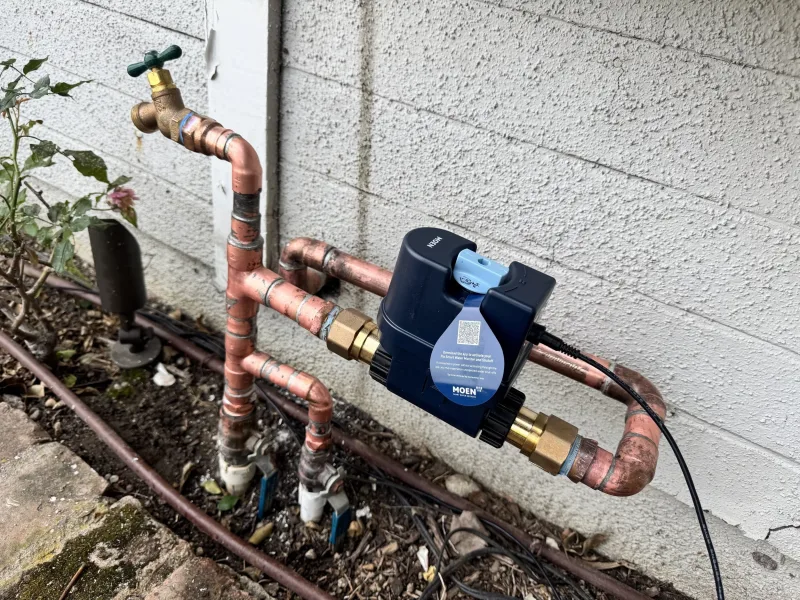
Moen Flo must be plugged into a standard 120V outlet. Moen offers a purpose-built extension cable for installations where the outlet is farther away, and an optional lithium-ion battery backup can keep the shutoff powered for up to four hours during an outage.
Without backup power, an electrical outage does not automatically close the valve; Moen says water remains available, and the valve can still be operated manually. The practical trade-off is that smart monitoring and powered shutoff functions depend on electricity. That matters most in the same scenarios where automatic protection is most valuable, such as an unattended property during severe weather.
Flume 2 separates the outdoor or meter-side sensor from the powered network component. The Water Sensor runs on batteries that Flume says can last up to about a year under favorable connection conditions. The Bridge stays indoors, plugged into power and connected to Wi-Fi. The sensor-to-Bridge link uses RF, which is why the meter itself does not need a Wi-Fi signal.
That architecture solves one placement problem but not every resilience problem. Flume's own installation guidance says the Bridge must remain powered and connected to Wi-Fi for the system to operate normally and deliver leak notifications. In other words, the battery at the meter does not make the complete system independent of household power or connectivity.
There is no universal winner here. Flume is more flexible at the sensing point, while Moen integrates the shutoff and sensors at the main line and offers an optional short-duration battery backup.
Smart Features & Ecosystem
The ecosystem comparison is more balanced than a simple "Moen integrates, Flume does not" claim.
Moen Flo integrations
Moen's current support material lists integrations with Ring, Google Home, Control4, NICE, and Alarm.com. Those connections are relevant because Flo is not just a sensor: supported platforms can expose device status and, in some cases, valve or system-mode controls.
Moen also offers its own app-based modes, shutoff-sensitivity controls, remote valve operation, usage history, and alert management. FloSense is the manufacturer's machine-learning layer for recognizing unusual household water behavior.
Flume 2 integrations
Flume currently lists integrations with Amazon Alexa, Google Assistant, Rain Bird, Orbit B-hyve, and YoLink, and it also provides an open API. The irrigation integrations fit Flume's consumption-analysis focus, while YoLink is the important exception to the idea that Flume can never participate in automatic shutoff.
Flume does not currently list Apple HomeKit or SmartThings support. Its main software strengths remain usage analysis, configurable alert rules, budgets, and Detail+ categorization.
Ongoing fees
Neither product requires a recurring fee for its core monitoring features. Moen says its standard Flo features and data are available without a required monthly subscription, although it also offers an optional FloProtect plan with supplemental features and benefits. Flume states that it no longer has a subscription or recurring fee for its feature set.
The ecosystem result is therefore a tie with different emphases. Moen is more tightly centered on plumbing protection and valve control; Flume has broader water-management integrations, an open API, and a supported path to a separate shutoff valve.
Use Cases & Long-Term Suitability
The clearest way to separate these products is by the problem the home actually needs solved.
For an unattended home
Moen Flo is the more direct fit when the goal is to limit water flow during a serious event without waiting for someone to see an alert. The shutoff is built in, and once Learning Mode is complete the system can respond automatically according to its settings. The important caveats are power availability, Wi-Fi, installation on the main line, and the initial 14-to-28-day learning period before automatic protection becomes active.
For detailed conservation and usage analysis
Flume 2 is the more capable of the two at breaking consumption into understandable patterns. Minute-level history and Detail+ make it easier to distinguish routine household use from toilets, showers, dishwashers, irrigation, and other categories. That can be more useful than pressure telemetry when the main question is where water is being used rather than whether the plumbing system is under abnormal conditions.
For renters, condos, and homes where pipe work is restricted
Flume 2 often has the structural advantage because it does not require cutting into the main line. But the dwelling still needs a compatible, accessible meter. In a multi-unit property with one shared meter, Flume records the combined usage and cannot separate one unit from another. Permission from the property owner or water utility may also matter.
For homes that want non-invasive monitoring now and shutoff later
Flume's YoLink integration changes the long-term equation. A Flume 2 installation can remain monitoring-only, or it can be paired later with a supported YoLink shutoff valve and hub so selected alert rules can close the water. That modular route adds hardware and setup complexity, but it means Flume no longer has to remain an alert-only system.
For homes where plumbing diagnostics matter more than fixture labels
Moen Flo is the better fit when pressure, temperature, and a daily pressure-loss test are more useful than appliance-level consumption categories. It still will not identify the physical location of a leak, but it provides a broader view of main-line plumbing conditions.
The Bottom Line
There is no meaningful "overall" winner without first deciding whether the job is containment or visibility.
For a home that needs a self-contained system capable of automatically closing the main water line,
has the more direct architecture. Its main advantages are the integrated motorized valve, abnormal-use detection, pressure and temperature telemetry, and automatic MicroLeak testing. Its trade-offs are equally concrete: professional plumbing work is recommended, continuous power is required, 2.4 GHz Wi-Fi is part of the connected setup, and automatic protection is unavailable during the initial learning period.Flume 2 is the more flexible monitoring platform. It leaves the plumbing line untouched, works from the water meter, and gives substantially more detail about consumption through minute-level history and Detail+ fixture/appliance classification. Its standalone limitation is that it cannot close the water itself. A supported YoLink valve can add that function, but at that point the system is no longer the simple sensor-and-Bridge setup that makes Flume attractive in the first place.
The practical distinction is straightforward: Moen Flo is centered on automatic main-line intervention; Flume 2 is centered on detailed water-use intelligence with a modular path to shutoff.
FAQ
Do I need a plumber to install Moen Flo?
Can Flume 2 automatically shut off my water?
Does either device have a monthly subscription fee?
How long do Flume 2 batteries last, and are they replaceable?
Are these devices compatible with my water meter or pipe size?
Can Moen Flo tell me which fixture is leaking?
What smart home platforms does Moen Flo work with?
How quickly can I install Flume 2?
"Images are used for editorial and informational purposes only. All trademarks and images belong to their respective owners."