
Mammotion YUKA 2000 vs LUBA mini AWD 800H: Coverage Champion vs Terrain Tackler
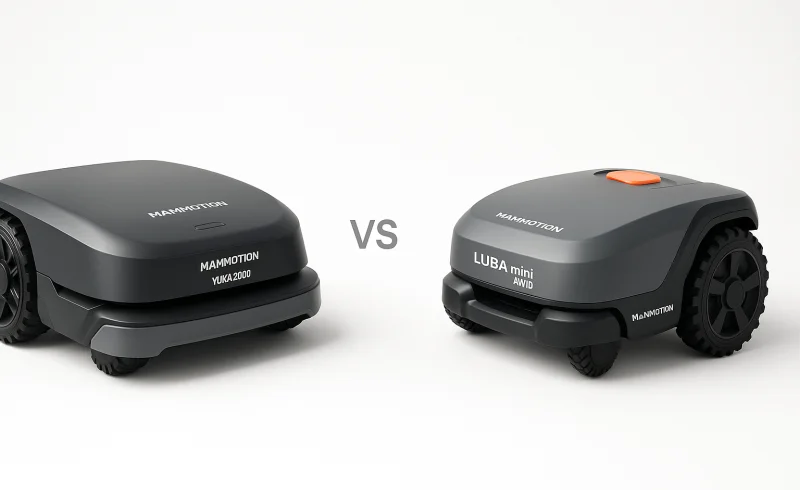
This article provides a detailed comparison of Mammotion's YUKA 2000 and LUBA mini AWD 800H robotic mowers. It explores their unique features, including coverage capabilities, terrain handling, and multi-functionality options, helping you decide which model su...
TL;DR
- If you want the most ground covered for your money and optional debris cleanup → choose Mammotion YUKA 2000.
- If your yard has steep slopes, soft soil, or frequent traction trouble → choose Mammotion LUBA mini AWD 800H.
- If your lawn is mostly flat, open, and under 0.2 acres → either works, but YUKA delivers better value and a wider cut.
The YUKA 2000 covers 2.5× more area (2000m² vs 800m²) at roughly one-third the cost per m², plus its optional sweeper turns mowing into a yard-maintenance routine. The trade-off: it’s rear-wheel drive and maxes out at 45% slopes, so it needs cleaner, flatter yards to shine. The LUBA mini AWD 800H, with all-wheel drive and an 80% slope rating, is built for problem terrain and stays out of trouble more often—but you pay a premium for less coverage and a narrower deck that means more mowing passes.
If your priority is automated collection of wet leaves or heavy fallen fruit, the YUKA’s sweeper isn’t reliable enough for that, and the LUBA doesn’t offer it at all. Consider a dedicated leaf-management system instead.
| Feature | Mammotion YUKA 2000 | Mammotion LUBA mini AWD 800H |
|---|---|---|
| Cutting | ||
| Cutting Width | 320mm (12.59 inches) | 8 in |
| Cutting Height | 20mm-90mm (0.78 in.-3.54 in.) | 2.2 in.-4.0 in. |
| General | ||
| Product Type | Perimeter wire-free robot lawn mower | Perimeter wire-free robot lawn mower |
| Capacity | ||
| Max Lawn Coverage | 2000m² (0.5 Acre) | 0.2 acre |
| Max Zone Management | 20 zones | 20 zones |
| Features | ||
| Sweeper / Self-Emptying Support | Optional sweeper kit with auto-emptying | Not supported |
| Terrain & Drive | ||
| Max Slope | 45% (24°) without sweeper attachment | 80% (38.6°) |
| Drive System | Rear-wheel-drive | All-wheel-drive (AWD) |
| Navigation & Connectivity | ||
| GPS Tracking | Yes | Yes |
| Built-in 4G Module | Yes; 1-year free 4G service | Yes; 1-year free 4G service |
| Positioning & Navigation | 3D vision & RTK | UltraSense AI Vision + NetRTK (iNavi) |
| Live Streaming for Yard Monitoring | Yes | Yes |
📑 Table of Contents
Terrain Handling & Traction
Max slope rating (what it can climb on paper)
Mammotion YUKA 2000 is rated for a 45% (24°) max slope—and that rating is explicitly without the sweeper attachment. Combined with its rear-wheel-drive layout, it’s better matched to moderate inclines than sustained steep sections where traction and stability become limiting factors.
Mammotion LUBA mini AWD 800H is rated for 80% (38.6°) max slope, a major step up on steep terrain. Its all-wheel-drive (AWD) system is designed specifically to keep grip when climbing and traversing uneven ground.
Conclusion: On pure climbing capability, LUBA mini AWD 800H clearly wins with an 80% vs 45% slope rating and the drivetrain to support it.
Drive system & «getting stuck» risk on transitions and soft ground
Mammotion YUKA 2000 uses rear-wheel-drive, which can be perfectly adequate on flatter, predictable lawns but is inherently more prone to wheel slip when conditions change (wet grass, soft patches, or uneven transitions). Editorial guidance also flags that YUKA needs more careful mapping on inclines, which is consistent with a platform that benefits from avoiding traction edge-cases rather than powering through them.
Mammotion LUBA mini AWD 800H, with AWD, is positioned for «problem yards»—uneven terrain, traction-limited areas, and tricky transitions where robots commonly hang up. In real-world terms, that tends to translate into fewer rescues and a higher chance the mower finishes unattended when the lawn isn’t perfectly firm or level.
Conclusion: For traction stability and recovery on tough terrain, LUBA mini AWD 800H has the edge—AWD is a practical advantage that directly targets the most common failure mode (loss of grip).
Battery note (relevant to steep-terrain workload)
Mammotion YUKA 2000 is listed with a 4.5Ah battery, or 9Ah with the sweeper. While battery capacity doesn’t equal traction, higher workload scenarios (climbing, frequent course corrections) can expose limits faster—especially if you’re also running multi-function routines.
Mammotion LUBA mini AWD 800H lists a 5200mAh (5.2Ah) battery. That’s a modest step up versus YUKA’s 4.5Ah baseline, but not enough by itself to outweigh the primary terrain differentiators (slope rating + AWD).
Conclusion: Battery capacity is not the deciding factor here; LUBA mini’s advantage is mainly AWD plus a much higher slope rating, not a dramatic battery gap.
Winner: Mammotion LUBA mini AWD 800H
Cutting Performance
Mammotion YUKA 2000 is built to cover ground faster per pass with a 320mm (12.59in) cutting width, which reduces the number of lanes it needs to mow the same area. In practice, that wider deck is most noticeable on open lawns where route efficiency matters as much as raw cutting power.
Mammotion LUBA mini AWD 800H uses an 8in (203mm) cutting width, so it will typically take more passes to finish an equivalent zone. That narrower swath can be advantageous in tighter spaces, but it’s still a clear throughput disadvantage when you’re optimizing for time-to-finish.
Conclusion: For pure mowing efficiency and faster coverage per pass, YUKA 2000 wins on cutting width (320mm vs 203mm).
Mammotion YUKA 2000 offers a 20–90mm (0.78–3.54in) cutting-height range, giving it a notably lower minimum height for closer, more «manicured» settings. The trade-off is its 90mm cap, which can be limiting if you deliberately keep grass longer or need to recover from very high growth without scalping.
Mammotion LUBA mini AWD 800H adjusts from 2.2–4.0in (56–102mm), which starts higher than YUKA at the low end but reaches a taller 102mm maximum. That extra top-end height is helpful for rougher «let it grow» lawns or initial passes on overgrown sections before stepping down.
Conclusion: No single winner on height adjustment—YUKA 2000 is better if you want lower cuts (20mm vs 56mm min), while LUBA mini AWD 800H is better if you need taller settings (102mm vs 90mm max).
Winner: Mammotion YUKA 2000
Sweeper & Multi-Functionality
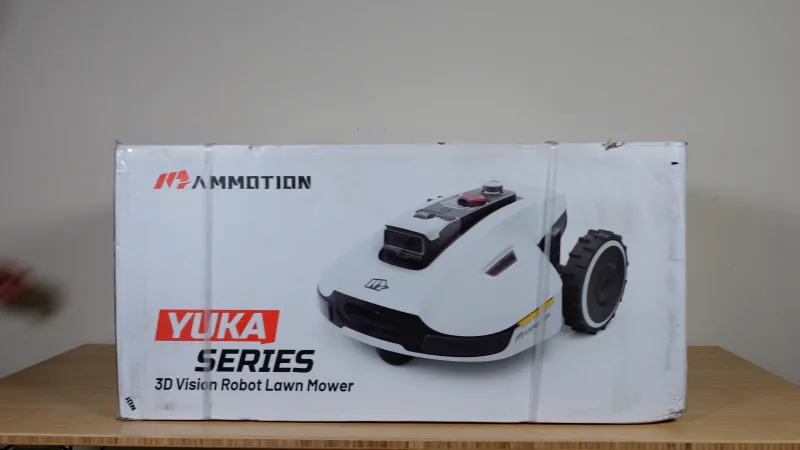
Mammotion YUKA 2000 is the only one of the two that supports an optional sweeper kit with auto-emptying. That changes the product’s job from «mow the grass» to a broader light debris collection workflow—useful for routine pickup of leaves, twigs, and seed pods alongside mowing. In practical terms, it can reduce separate yard passes with a blower or rake when debris is predictable and the yard is relatively open and tidy.
Mammotion LUBA mini AWD 800H has no sweeper/self-emptying support (not supported), so it remains a single-purpose mower. Its feature set is therefore centered on mowing completion rather than combining mowing with cleanup tasks. If your goal is to automate debris collection as part of weekly yard maintenance, there’s no equivalent add-on path here based on the provided specs.
Conclusion: YUKA 2000 clearly wins on multi-functionality because it’s the only model with optional sweeper + auto-emptying; LUBA mini doesn’t compete on this specific capability.
Complexity, upkeep, and «how often you’ll actually use it»
Mammotion YUKA 2000’s sweeper workflow is also where the trade-offs show up: adding collection increases setup variables (where it collects, where it empties, how it behaves in narrow routes) and adds more upkeep than a pure mower. The editor notes that wet leaves, dense piles, larger debris, and clutter can reduce reliability and increase interventions, and that «automation complexity scales fast» once you add a second job. That makes YUKA’s value highest when the environment is kept «robot-ready» and the debris is consistently light.
Mammotion LUBA mini AWD 800H avoids those extra failure modes simply because it doesn’t try to do collection—daily use is more about whether it finishes the mowing plan without supervision. The editor’s guidance frames it as a better fit for owners who want predictable mowing rather than feature breadth, which often translates to fewer exceptions to manage day-to-day. You still have normal wire-free setup work (mapping, no-go zones), but there’s no sweeper-specific workflow to tune or maintain.
Conclusion: No clear overall winner on «ownership friction»—YUKA 2000 offers more capability but with more complexity and upkeep, while LUBA mini is simpler because it’s mowing-only. The right choice depends on whether debris collection would be used often enough to justify the added workflow.
Winner: Mammotion YUKA 2000
Navigation & Software
Mammotion YUKA 2000 uses «3D vision & RTK» positioning and navigation, and it layers in smart features like voice control (Alexa/Google Assistant) plus live streaming for yard monitoring. It also includes a built-in 4G module with 1 year of free service, which can help keep tracking and control available when Wi‑Fi coverage is weak.
Mammotion LUBA mini AWD 800H pairs UltraSense AI Vision + NetRTK (iNavi) for navigation, and it also supports live streaming and a built-in 4G module with 1 year free. In practice, it’s positioned as a mowing-first platform, so the software experience tends to focus more on reliable completion than on expanding into extra workflows.
Conclusion: On paper, both deliver wire-free RTK + vision navigation with similar connectivity fundamentals (including 1-year included 4G and live streaming). YUKA 2000 has the clearer feature advantage for smart-home control (Alexa/Google Assistant) and explicitly marketed 3D vision—but neither has enough provided evidence here to claim a decisive reliability win.
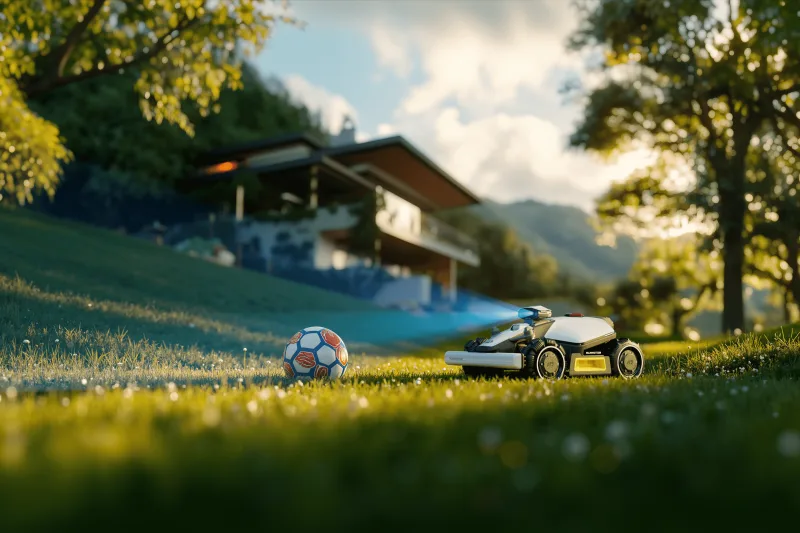
Mammotion YUKA 2000 typically requires iterative setup: even though it’s wire-free, you should expect time mapping zones and refining boundaries after early runs—especially if you expand beyond «just mowing.» Some users report connectivity issues despite support for Bluetooth/Wi‑Fi/4G, which can translate into more troubleshooting during setup or remote monitoring.
Mammotion LUBA mini AWD 800H also isn’t «hands-off» out of the box; boundary refinement and no-go tuning are part of normal onboarding, particularly in tight corridors or areas with weaker satellite visibility. Its narrower, single-purpose focus can mean fewer workflow variables to debug day-to-day, even if the app still requires periodic adjustments as the yard changes.
Winner: Tie — YUKA 2000 wins on extra smart features (notably Alexa/Google voice control), while LUBA mini AWD 800H counters with a simpler, mowing-focused software mission that can be preferable if you prioritize predictability over feature breadth.
Lawn Coverage & Zones
Mammotion YUKA 2000 is rated for up to 2000m² (0.5 acre) of maximum lawn coverage, which puts it in range for many medium-to-larger properties that want one robot to handle most (or all) of the yard. It also supports up to 20 zones, so you can split mowing between front/back lawns, side strips, and separated areas without collapsing everything into one map.
Mammotion LUBA mini AWD 800H is specced for up to 800m² (0.2 acre), which is better aligned to smaller lots or owners who can keep the mowing plan compact. Like YUKA, it also supports up to 20 zones, so multi-area mapping isn’t the limiting factor—total capacity is.
Conclusion: On pure coverage, YUKA’s 2000m² vs LUBA mini’s 800m² is a substantial gap, and both top out at 20 zones, so YUKA is the more scalable choice for bigger properties, while LUBA mini fits smaller lawns that still need flexible zoning.
Winner: Mammotion YUKA 2000
Build & Maintenance
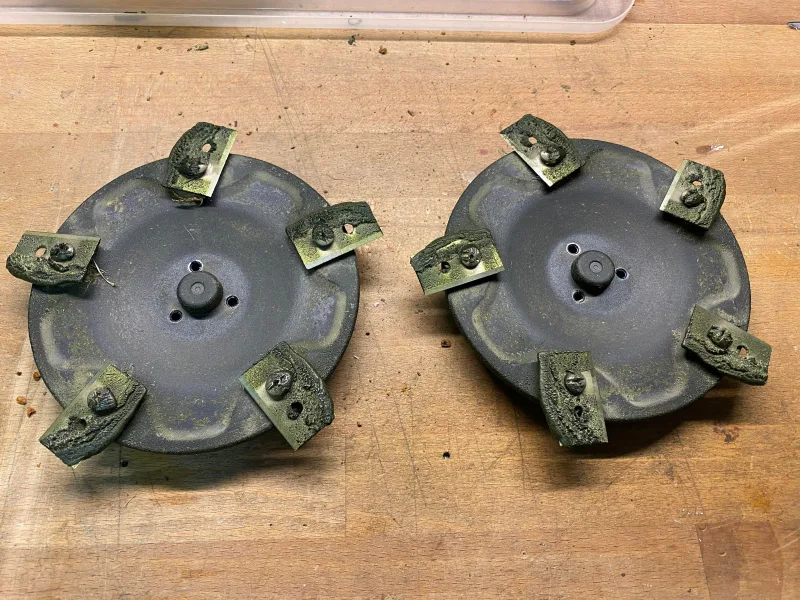
Mammotion YUKA 2000 has a clearly stated water-resistance spec: IPX6 for the mower and charging dock, plus IPX7 for the RTK station. For cleaning, Mammotion’s own guidance calls out that maintenance involves removing the top shell and avoiding abrasive materials, which hints at a more involved «deep clean» than a quick hose-down.
Mammotion LUBA mini AWD 800H is positioned as an all-terrain machine with all-wheel drive (AWD) and a much higher slope spec (80% / 38.6°) than YUKA’s 45% / 24° (without the sweeper). That kind of intended use typically means more exposure to mud and grit during normal operation, but an equivalent IP rating isn’t provided in the supplied specs to verify water/dust protection at the same level as YUKA.
Conclusion: YUKA is the safer pick on paper for water resistance (IPX6 mower/dock, IPX7 RTK), while LUBA mini’s AWD/steep-slope focus implies more frequent cleaning in harsh conditions even if it’s built tough. Neither has a decisive advantage in overall upkeep: YUKA’s optional sweeper/self-emptying support adds parts and maintenance tasks, while LUBA mini’s terrain mission can mean more dirt exposure—so the «easier to own» choice depends on whether you want multi-function capability or a simpler mowing-first system.
Winner: Tie
Pricing & Value

Mammotion YUKA 2000 lists at $1,299 for up to 2,000 m² (0.5 acre) of coverage, which works out to roughly $0.65 per m². That’s unusually strong area-for-money, and it’s paired with an optional sweeper kit with auto-emptying (not mandatory) that can expand what the platform does beyond mowing. Value here is primarily driven by how much ground it’s rated to handle for the entry price.
Mammotion LUBA mini AWD 800H lists at $1,599 for up to 800 m² (0.2 acre), or about $2.00 per m²—roughly triple the cost-per-area on paper. There’s no sweeper/self-emptying support, so the value proposition is not about multi-function upgrades, but about a mowing-first machine. In other words, you’re paying more per square meter for capability rather than capacity.
Conclusion: On pure price-to-coverage, YUKA 2000 is the clear value leader ($0.65/m² vs ~$2.00/m²), and its optional sweeper adds upside for owners who’ll actually use it—YUKA wins this sub-point.
Mammotion YUKA 2000’s value is strongest on more straightforward lawns where its rear-wheel-drive design and 45% (24°) max slope rating are sufficient. Editor guidance also flags YUKA as a better fit when you want a «yard maintenance platform» (mowing plus light debris cleanup), but that benefit depends on your debris type and how «robot-ready» you keep the yard. The moment you add a collection workflow, you’re trading simplicity for features.
Mammotion LUBA mini AWD 800H justifies its higher price in «problem yard» conditions: it’s AWD and rated for 80% (38.6°) slopes, a big spec gap over YUKA. That terrain headroom can translate into fewer interruptions on uneven ground, soft patches, or steep sections—situations where cheaper, higher-coverage robots can lose time (and your patience) even if the map says they should fit. If the yard’s limiting factor is traction rather than acreage, the premium can be defensible.
Conclusion: If your yard is defined by terrain difficulty, LUBA mini AWD 800H can deliver better real-world value despite the higher cost-per-area—LUBA wins this sub-point.
Winner: Mammotion YUKA 2000 — It delivers a much stronger coverage-per-dollar baseline (2,000 m² for $1,299 vs 800 m² for $1,599) and adds optional multi-function upside, while LUBA mini’s value edge is narrower and mainly applies when you truly need AWD/80% slope capability.
The Bottom Line
With the feature-by-feature breakdown done, the decision comes down to whether your yard’s limiting factor is terrain difficulty or how much ground (and cleanup) you want automated per week.
Best for Challenging Terrain: The Mammotion LUBA mini AWD 800H is the right pick thanks to AWD and its 80% slope rating, which directly addresses the traction and «getting stuck» risks that rear-wheel-drive models face on steep or soft ground.
Best for Multi-Function Yard Maintenance: The Mammotion YUKA 2000 wins because it’s the only one that supports the optional sweeper with auto-emptying—ideal when your yard is kept robot-ready and debris is light and predictable.
Best for Large Lawns: The Mammotion YUKA 2000 is the clear choice with 2000m² coverage (vs 800m²) and a wider cutting deck that finishes big, open areas with fewer passes.
Overall,
: it combines far better coverage-per-dollar with faster mowing efficiency and the unique option to add light debris collection. The trade-off is simple—if your property has extreme slopes or frequent traction trouble, LUBA mini AWD 800H does that one job better.If your lawn is typical in size and terrain, buy the YUKA 2000 and only add the sweeper if you’ll truly use it; if your yard routinely challenges traction, prioritize AWD and go LUBA mini.
FAQ
Which mower handles steeper slopes?
Does YUKA 2000 support self-emptying?
Which is easier to set up?
Which has better navigation?
How much area can the YUKA 2000 cover?
Is the YUKA 2000 waterproof?
Does the LUBA mini AWD 800H have rain sensors?
"Images are used for editorial and informational purposes only. All trademarks and images belong to their respective owners."