
Mamibot W120-DP vs TOSIMA W3: Operator Tool vs Appliance Routine
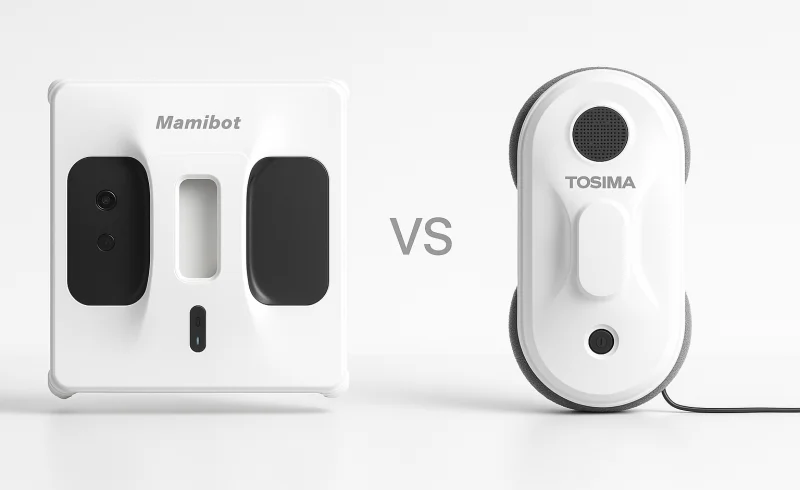
Compare Mamibot W120-DP and TOSIMA W3 robot window cleaners. Discover which model offers more flexibility with cleaning modes and spray systems, and which one suits routine maintenance with a larger tank and slimmer design for narrow windows.
TL;DR
- If you want maximum control over cleaning paths (N, Z, X2 modes) and a 4-nozzle spray system that lets you revisit stubborn areas → choose Mamibot W120-DP
- If you want a predictable, repeatable routine with a slim body that fits narrow windows and a larger 80 ml tank for longer sessions → choose TOSIMA W3
- If you clean large panes occasionally and enjoy tinkering with modes, either works—but the experience will feel very different
Key differentiators: The W120-DP gives you three automatic path options plus a motor-driven 4‑nozzle spray for more even wetting on big glass. The W3 keeps it simple with one S‑path and 2 nozzles, but its 140 mm width and 300×300 mm minimum surface let it handle tight casement windows that the bulkier W120-DP can’t reach. The real trade-off is tweakability (W120‑DP) vs. sheer predictability (W3) in day-to-day use.
Who should skip both: If your windows routinely have baked-on grime, insect residue, or paint mist that needs edge-to-edge detailing, or if you’re expecting fully unsupervised exterior cleaning, look at a manual squeegee system or a professional service instead—neither robot replaces that kind of hands-on work.
| Feature | TOSIMA W3 | Mamibot W120-DP |
|---|---|---|
| Power | ||
| Rated power | 90W | 72W |
| UPS backup time | Approx. 20 minutes | 20-30 minutes |
| Operating voltage | 24V | 24V |
| Built-in battery capacity | 650mAh | 500mAh |
| Recommended initial charge before first use | 3 hours | About 2 hours |
| Safety | ||
| Safety rope | Included | Included |
| Edge detection | Supported | Supported |
| General | ||
| Product type | Window cleaning robot | Window cleaning robot |
| Capacity | ||
| Water tank capacity | 80ml | About 60 ml |
| Cleaning | ||
| Spot cleaning | Supported | Supported |
| Spray nozzles | 2 | 4 |
| Water spray system | Dual direction auto-spray | Dual-direction motor-driven water spray |
| Repeated cleaning mode | Cleaning twice | X2 mode |
| Automatic cleaning path | S-shaped | N-shaped / Z-shaped / X2 (Z+N) |
| Directional manual control | Up / Down / Left / Right | Up / Down / Left / Right |
| Physical | ||
| Dimensions | 278*140*80mm | 229*229*69 mm |
| Minimum working surface | 300*300mm | 60 x 40 cm |
| Performance | ||
| Working noise | 70db | <75dB |
| Connectivity | ||
| App control | Supported | Optional |
| Companion app | Tuya Smart | Smart Life |
| Remote control | Included | Included |
| Bluetooth pairing | Yes | Yes |
📑 Table of Contents
Cleaning Performance
Cleaning paths and coverage consistency
Mamibot W120-DP offers N-shaped, Z-shaped, and X2 (Z+N) automatic paths, plus spot cleaning. That mix matters in practice because you can use a faster pattern for routine dust, then switch to X2 for a more methodical second pass on hazy panes or smears. The added flexibility also fits mixed window layouts where you may want to «steer first, then re-run» for a cleaner finish.
TOSIMA W3 relies on an S-shaped automatic cleaning path and also supports spot cleaning, with a cleaning twice repeated mode. The S-path tends to align with a «start it and let it finish» workflow, which matches W3’s positioning as a routine-maintenance robot rather than a highly configurable tool. You’ll typically improve tough areas by running the repeat cycle again, rather than changing how it traverses the glass.
Conclusion: On path control and the ability to tailor coverage, Mamibot W120-DP has the edge because it gives you three path modes (N/Z/X2) vs W3’s S-path, which is more adaptable when window conditions vary.
Spray system and re-wetting effectiveness
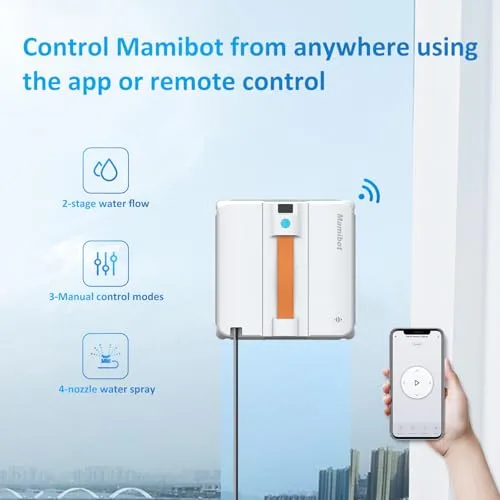
Mamibot W120-DP uses a dual-direction motor-driven water spray system with 4 spray nozzles, and it pairs that with multiple cleaning paths to revisit sections with fresh solution. With more nozzles distributing moisture, it’s better positioned to maintain an even wet edge across the pad track—useful when you’re trying to reduce streaking on larger panes. The trade-off is a smaller tank: about 60 ml.
TOSIMA W3 also offers dual-direction auto-spray, but with 2 spray nozzles and a larger 80 ml tank. Manufacturer specs add that it sprays every 5 seconds during operation, which can help keep the pads from drying out over longer runs. However, fewer nozzles generally means less spray distribution across the cleaning width unless the robot compensates by path overlap or slower passes.
Conclusion: For spray coverage on the glass, Mamibot W120-DP wins with 4 nozzles vs 2, even though TOSIMA W3’s larger 80 ml tank vs ~60 ml can be an advantage for longer single-session runs.
Winner: Mamibot W120-DP
Power & Battery
Mamibot W120-DP is rated at 72W and runs on 24V power. Its built-in backup battery is listed at 500mAh, intended primarily as an emergency «keep suction / prevent falls» UPS rather than for untethered cleaning.
TOSIMA W3 is rated higher at 90W and also operates at 24V. The extra rated wattage suggests more headroom for maintaining suction and motion under load (e.g., heavier wet pads or slightly rougher glass), though neither spec sheet provides a direct suction rating for W3 to quantify the gap.
Conclusion: On raw power, TOSIMA W3 wins with 90W vs 72W, which is the clearer of the two «power» indicators given.
Mamibot W120-DP lists a UPS backup time of 20–30 minutes from its 500mAh battery. That wider range can be useful in real homes where battery health and load vary, and it signals Mamibot is at least allowing for longer hold-time under lighter conditions.
TOSIMA W3 has a larger battery at 650mAh, but its UPS backup is specified more narrowly at ~20 minutes. It also recommends 3 hours of initial charging before first use (vs ~2 hours for Mamibot), which doesn’t affect daily runtime but does slightly lengthen first-time setup.
Conclusion: For backup time specifically, Mamibot W120-DP has the edge on paper (20–30 min vs ~20 min), while TOSIMA W3 leads on capacity (650mAh vs 500mAh) without translating that into a longer stated UPS window.
Winner: TOSIMA W3 — its higher rated power (90W) plus larger battery (650mAh) is the more defensible overall advantage for power delivery and battery reserves, even though Mamibot’s stated UPS duration can be longer in best-case conditions.
Safety Features
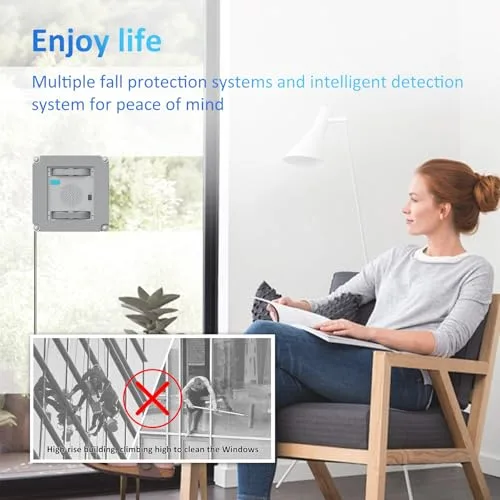
Mamibot W120-DP covers the baseline safety kit with edge detection and an included safety rope. For power-loss scenarios, it specifies 20–30 minutes of UPS backup, giving it a bit more margin for finishing a pass or pausing safely than units capped at ~20 minutes.
TOSIMA W3 also includes edge detection and a safety rope, so it meets the same minimum «don’t fall off the glass» requirements. It lists approx. 20 minutes of UPS backup and markets a «triple safety system» that includes an anti-drop sensor alongside edge detection (as described by retailers), but the spec sheet doesn’t quantify how that differs in practice versus a standard edge-detection setup.
Conclusion: Both are fundamentally safe by category standards (edge detection + tether + UPS), but Mamibot W120-DP has the clearer spec advantage on backup runtime (20–30 min vs ~20 min), while TOSIMA W3’s extra «triple safety» claim is harder to validate without detailed, measurable specs.
Winner: Mamibot W120-DP
Controls & App
Mamibot W120-DP supports Bluetooth pairing and includes a remote, with app control listed as «optional» via Smart Life. That «optional» framing matches the way it tends to be used in practice: you can treat the app as an extra control surface, but the product is designed to accommodate more hands-on operation choices (remote steering plus picking between multiple cleaning behaviors).
TOSIMA W3 also supports Bluetooth pairing, ships with a remote, and offers app control through Tuya Smart. Compared with Mamibot’s «optional app» positioning, W3’s control experience typically reads as simpler: choose a pattern, start the run, and intervene only when needed, with the app often being secondary to the remote for day-to-day use.
Conclusion: On core control methods (remote + Bluetooth + app), they’re functionally equivalent; neither has a spec-backed advantage.
Mamibot W120-DP is the more «tweakable» option once you’re actually controlling how it behaves, thanks to its broader set of cleaning-path choices: N-shaped / Z-shaped / X2 (Z+N) plus manual directional control (Up/Down/Left/Right). This aligns with the real-world positioning that it suits users who want more control over repeat passes and don’t mind a more device-like workflow.
TOSIMA W3 focuses on fewer decisions, pairing manual directional control (Up/Down/Left/Right) with a single S-shaped automatic path and a straightforward «cleaning twice» option. In practice, that tends to benefit people who want repeatable, routine runs without experimenting with modes—at the cost of fewer levers to pull when a pane’s layout or grime pattern calls for a different approach.
Conclusion: Mamibot W120-DP has the edge for customization and operator control, while TOSIMA W3 has the edge for simplicity and predictability.
Winner: Tie
Design & Build
Mamibot W120-DP uses a more symmetrical, square footprint at 229 × 229 × 69 mm, which tends to «fill» a pane more evenly but can feel bulky on narrow glass. Its minimum working surface is 60 × 40 cm, so it’s clearly aimed at larger panes rather than tight, small window segments.
TOSIMA W3 goes with a more elongated rectangle at 278 × 140 × 80 mm, trading extra length and thickness for a noticeably narrower body. Its minimum working surface is 300 × 300 mm, which is substantially smaller than 60 × 40 cm and is a practical advantage for small windows and tighter layouts.
Conclusion: On physical adaptability, TOSIMA W3 has the edge—its 300 × 300 mm minimum surface and 140 mm width make it easier to fit into narrower window areas than the W120-DP’s 60 × 40 cm requirement and square footprint.
Mamibot W120-DP leans into a more «tool-like» build concept: it pairs optional app use (Smart Life) with a remote and is positioned for users who may manually steer and then run more methodical passes. Manufacturer materials also highlight functional upkeep features like self-cleaning driving belts, which supports the idea of more hands-on ownership.
TOSIMA W3 is positioned closer to an appliance-style experience—remote-first control with app support (Tuya Smart) and an emphasis on repeatable, routine runs. In day-to-day handling, that simpler operational model generally reduces the amount of «pre-flight» decision-making compared with more mode- and intervention-oriented workflows.
Conclusion: For design-as-experience, it depends on your preference: Mamibot W120-DP better matches users who want more operator control and maintenance-minded features, while TOSIMA W3 better suits people prioritizing a more predictable, repeatable routine.
Winner: TOSIMA W3
Water Tank & Spray
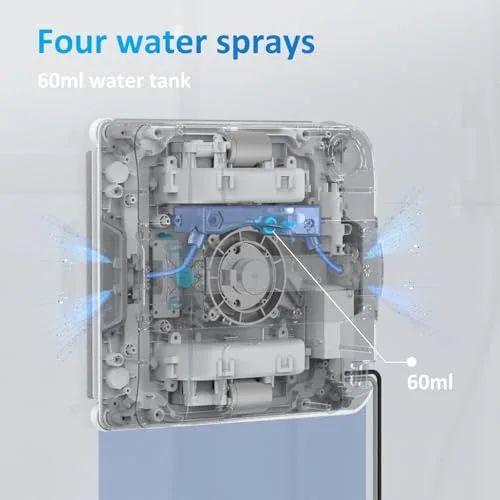
Mamibot W120-DP uses an ~60 ml tank paired with a dual-direction motor-driven spray system and 4 spray nozzles. The four-nozzle layout is designed to spread moisture across a wider cleaning swath, which can help keep pads consistently wetted on larger panes and during repeat passes. Manufacturer materials explicitly call out its dual-direction water spraying technology with four spray nozzles, aligning with the spec sheet.
TOSIMA W3 pairs a larger 80 ml «smart water tank» with dual-direction auto-spray and 2 spray nozzles. Per the manufacturer spec, it sprays every 5 seconds during operation, which supports a more hands-off, maintenance-style workflow where the robot handles its own re-wetting cadence. With fewer nozzles, coverage can be less distributed per spray event, though the larger tank helps sustain longer sessions without refills.
Conclusion: On paper, Mamibot W120-DP has the stronger spray delivery hardware (4 nozzles and motor-driven dual-direction spray), while TOSIMA W3 counters with more onboard water (80 ml vs ~60 ml) and a clearly defined auto-spray interval (every 5 seconds). Winner: Mamibot W120-DP for more even, controllable wetting potential—especially valuable when you’re trying to improve coverage on bigger panes or stubborn sections rather than just extending runtime between refills.
The Bottom Line
Now that the feature-by-feature differences are clear, the real decision comes down to whether you want maximum cleaning control or a simpler, budget-friendlier routine cleaner.
For Busy Homeowners (Routine Maintenance): The TOSIMA W3 is the better pick thanks to its lower price positioning, straightforward S-shaped routine, and «start it and let it finish» predictability.
For Deep-Clean Enthusiasts: The Mamibot W120-DP is the clear choice with more cleaning modes (N/Z/X2 plus spot) and a four-nozzle spray setup that’s better suited to targeted re-runs on stubborn haze and smears.
For Small Windows or Apartments: The TOSIMA W3 fits better because its narrower rectangular body and smaller minimum working surface make it more practical on tighter panes and frames.
For most people, this is a true «it depends»: Mamibot W120-DP leads on cleaning versatility and spray distribution, while TOSIMA W3 does better on simplicity, power-on-paper, and small-window adaptability—without asking you to manage multiple path modes.
If your priority is thoroughness and control, go Mamibot W120-DP; if you want a more straightforward, cost-conscious helper you can run often, choose TOSIMA W3.
FAQ
Which window robot has better suction power?
Can I control these robots with an app?
Which machine is better for small windows?
What is the operating temperature range of the Mamibot W120-DP?
Does the Mamibot W120-DP have self-cleaning belts?
What safety features does the TOSIMA W3 have?
Which robot has better spray coverage?
Which robot has longer battery backup time?
"Images are used for editorial and informational purposes only. All trademarks and images belong to their respective owners."