
Levoit Core 600S vs Winix AM90: Higher CADR vs a Slimmer, Odor-Sensing Design
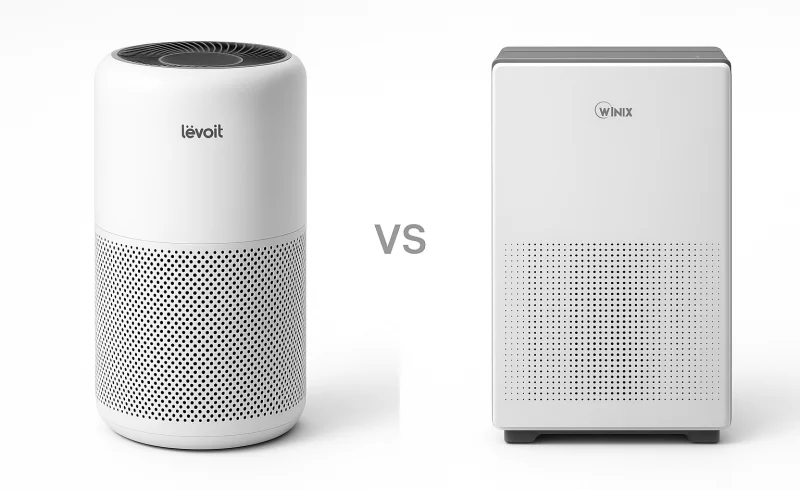
Explore the features and performance differences between the Levoit Core 600S and Winix AM90 air purifiers. Learn how their smart features, noise levels, and filtration systems impact effectiveness and user experience in managing indoor air quality.
TL;DR
Quick decision
- Levoit Core 600S is the stronger fit for larger rooms and faster particle removal. The current U.S. Core 600S-P listing rates smoke CADR at 391 CFM, versus 233 CFM for the Winix AM90, and the gap is similarly large for dust and pollen.
- Winix AM90 makes more sense when a shallow cabinet, a washable pre-filter, and automatic behavior tied to odor and room light matter more than maximum clean-air delivery.
- Both models support app schedules. The Levoit adds a 1–12 hour on-device timer, more advanced app-based auto modes, and Alexa + Google Assistant support; the AM90 has no hardware timer and lists Alexa as its voice platform.
- If the main problem is persistent VOCs, solvent fumes, or heavy cooking odors, neither is built around the kind of large sorbent bed used by gas-focused purifiers.
The most important correction to the usual comparison is that the AM90's automatic sensing is not a broader version of Levoit's PM2.5 sensing. Levoit uses a laser particle sensor to drive Auto Mode, while the AM90 manual describes an odorous-gas sensor plus a light sensor. That makes the two products respond to different signals.
| Feature | Winix AM90 | Levoit Core 600S |
|---|---|---|
| Power | ||
| Rated Power | 65 W | 49W |
| Power Supply | AC 120 V / 60 Hz | AC 120V, 60Hz |
| Overview | ||
| Model | AM90 | LAP-C601S-WUS |
| Product Type | Air Purifier | Air Purifier |
| Physical | ||
| Weight | 15.8 lbs | 13.7 lb |
| Dimensions | 14.9 x 7.8 x 23.6 in | 12.3 x 12.3 x 23.6 in |
| Filtration | ||
| Pre-Filter | Yes | Yes |
| HEPA Filtration | 99.99% True HEPA | True HEPA |
| Filtration Stages | 4-Stage | 3-stage |
| Activated Carbon Filter | Yes | Yes |
| Performance | ||
| CADR | 233 / 240 / 230 | 410 CFM |
| Timer | No | 1–12 hours |
| Auto Mode | Yes | Yes |
| Sleep Mode | Automatic Sleep Mode | Yes |
| Noise Level | 27 dB | 26–55 dB |
| Air Quality Sensor | Dual Smart Sensors | AirSight Plus Laser Dust Sensor |
| Air Quality Indicator | LED (3 Color) | Air Quality Indicator Rings |
| Filter Replacement Indicator | Yes | Yes |
| Connectivity | ||
| Wi-Fi | Supported | Supported |
| Mobile App | Winix Smart App | VeSync App |
| Voice Assistant Support | Amazon Alexa | Amazon Alexa, Google Assistant |
| Certifications | ||
| Certifications | AHAM, UL, CARB, Prop65 | Energy Star, CARB |
📑 Table of Contents
Air Cleaning Performance
CADR is the clearest performance difference
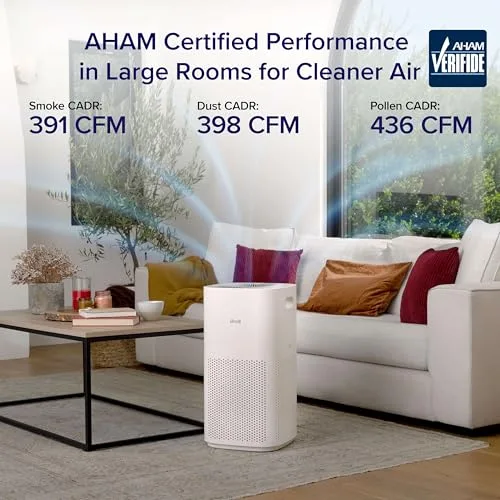
Levoit's current U.S. listing for the Core 600S-P (model LAP-C601S-WUS) gives CADR figures of 391 CFM for smoke, 398 CFM for dust, and 436 CFM for pollen. The Winix AM90 is rated at 233 CFM for smoke, 240 CFM for dust, and 230 CFM for pollen.
That is not a small gap. For smoke—the most useful apples-to-apples CADR figure here—the Levoit delivers roughly two-thirds more clean air per minute. In the same room, that generally means faster dilution of airborne particles from smoke, dust, pollen, or other particulate events, assuming similar placement and operating conditions.
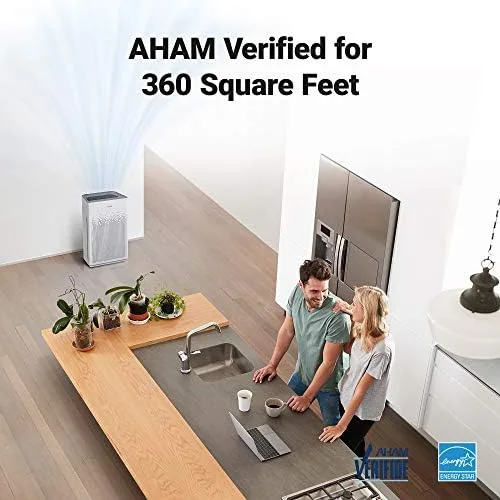
Room-size claims can make the comparison look more confusing than it is. Levoit advertises very large coverage at one air change per hour, and Winix also publishes a much larger one-hour coverage figure. Those numbers describe slow whole-room turnover, not aggressive cleaning. At roughly 4.8 air changes per hour, Levoit's current specification is 606 sq ft, while Winix lists the AM90 at about 360 sq ft. Those figures are much more useful when comparing the two on equivalent assumptions.
Edge: Levoit Core 600S. Its advantage is primarily airflow and particle-clearing speed, not a more elaborate filter stack.
Their Auto modes are watching different things
The Core 600S uses Levoit's AirSight Plus laser dust sensor to estimate PM2.5 and adjust fan speed in standard Auto Mode. That means a rise in fine airborne particles is directly relevant to how the purifier responds.
The AM90 manual describes its Smart Sensor as detecting odorous gas. A separate light sensor changes nighttime behavior. That can be useful around odor events, but it is not the same as a particle sensor, and it should not be described as a dual particle-and-odor sensing system.
There is another practical wrinkle: neither purifier's basic Auto Mode automatically uses its highest Turbo setting. Levoit's standard Auto Mode stops below Turbo, while Winix Auto Mode adjusts among low, medium, and high. Levoit does offer an Efficient Auto Mode in VeSync that can run Turbo for a calculated period based on room size before returning to sensor-based control.
For a sudden smoke or dust event, manual Turbo remains the most direct route to maximum airflow on either model.
Edge: Levoit Core 600S for automatic particulate response and overall clean-air delivery. The AM90's odor sensing is a different capability, not a substitute for PM2.5 sensing.
Filtration System
Physical filtration: similar goals, different claims
The Core 600S uses a three-part filter: an outer pre-filter, a main particle filter, and an activated-carbon layer. Levoit's current U.S. product page describes the particle stage simply as a Main Filter, while ENERGY STAR categorizes the model as HEPA-Type. That is more precise than repeating older "True HEPA" language that Levoit no longer uses on the current product page.
Winix describes the AM90 as a 4-stage system: washable pre-filter, activated-carbon filter, True HEPA filter, and PlasmaWave. Winix states that its True HEPA filter captures 99.99% of airborne particles down to 0.003 microns under its cited laboratory test conditions.
The important distinction is that filter-efficiency percentages and CADR answer different questions. A high-efficiency filter can capture a very large share of particles passing through the media, while CADR reflects how much cleaned air the complete machine actually delivers. The AM90 has the more explicit filter-efficiency claim, but the Core 600S has much higher whole-unit particle CADR.
PlasmaWave does not automatically make the AM90 stronger on VOCs
Winix counts PlasmaWave as the fourth filtration stage. It is an active treatment stage that is enabled by default but can be switched off; the AM90 manual also says Sleep Mode disables it unless it is turned back on. ENERGY STAR's AM90 listing reports 7 ppb ozone emissions, while the current Core 600S-P listing reports 0.0 ppb.
That difference is worth knowing for anyone who specifically prefers a filter-only design. It is not, by itself, evidence that the AM90 removes household VOCs more effectively than the Levoit.
Both machines rely on activated carbon for routine odor and gas adsorption. Levoit uses carbon pellets inside its combined filter, while the AM90 uses a replaceable carbon filter. Neither manufacturer provides a standardized gas-removal CADR or enough carbon-mass information here to support a broad claim that one is decisively stronger for persistent VOCs.
Edge: scenario-dependent. Winix provides the clearer True HEPA efficiency claim and adds an optional active stage. Levoit keeps the air path simpler and still delivers substantially higher particle CADR.
Noise Levels
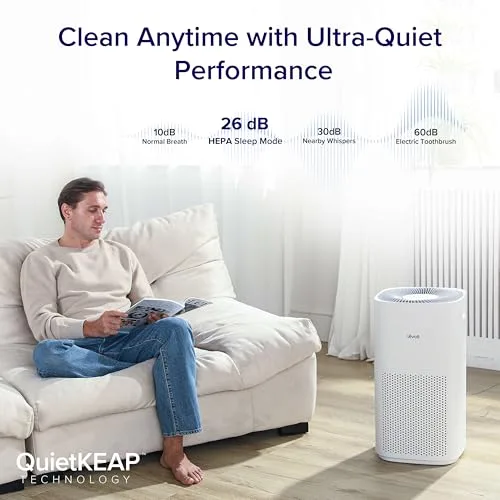
Levoit specifies a 26–55 dB operating range for the Core 600S. Winix publishes a 27 dB minimum for the AM90 but does not provide a directly comparable maximum figure on its current product page, so there is not enough manufacturer data to declare one quieter across the full fan range.
At the low end, the difference between 26 and 27 dB is negligible. Both also have Sleep modes that use a fan speed below their normal Low setting.
Their nighttime logic differs more than their minimum noise numbers. On the AM90, the light sensor can automatically move the purifier into Sleep Mode when Auto Mode is active and the room becomes dark. On the Core 600S, optional Light Detection turns the display off in darkness and prevents Auto Mode from using high or Turbo while the room is dark; a dedicated Sleep Mode is also available.
That makes both suitable for low-noise overnight operation, but in different ways: Winix more explicitly automates the transition into Sleep Mode, while Levoit gives more ways to shape nighttime behavior through its controls and app.
Edge: Tie. The published minimums are effectively the same, and the available specifications do not support a reliable maximum-noise comparison.
Smart Features & Automation
Both have schedules; only the Levoit has an on-device timer
The Core 600S works with the VeSync app, which provides remote control, PM2.5 readings, four weeks of air-quality history, schedules, filter-life information, and additional Auto modes. Its physical controls include a 1–12 hour timer, while VeSync extends the timer range to 1–24 hours.
The AM90 also supports remote control through the Winix Smart App. Winix documents app controls for power, fan speed, Auto and Sleep modes, air-quality history, filter life, and schedules. So the absence of a timer in the AM90's hardware specification should not be interpreted as an absence of scheduling altogether.
The practical difference is that the Levoit can run a simple countdown without the app, and VeSync exposes more specialized automation choices such as Quiet Auto, Efficient Auto, and ECO Auto.
Voice control is broader on the Core 600S
Levoit supports Amazon Alexa and Google Assistant. Winix lists Alexa for the AM90.
That distinction matters mainly in households already built around Google Assistant. For Alexa-based control, both models cover the basic voice-control use case.
Neither purifier depends on the cloud for basic cleaning
Both can be operated from their physical controls without Wi-Fi. Losing an app connection removes remote features and schedules, not the core ability to run the fan, select a mode, and filter air.
That is a more useful way to think about long-term reliability than labeling one model "app-first" and the other "offline-first." The Core 600S simply offers a deeper software layer on top of conventional local controls.
Edge: Levoit Core 600S. The advantage comes from richer automation, a physical timer, PM2.5 history, and broader voice-platform support—not from the AM90 lacking app scheduling.
Design & Placement
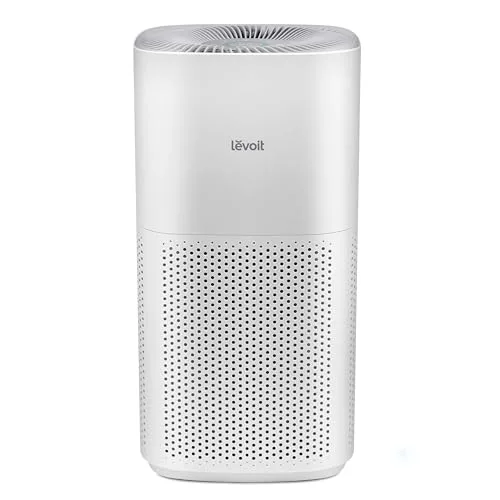
The Core 600S measures 12.3 × 12.3 × 23.6 in and weighs 13.7 lb. Its square footprint is easy to understand spatially, and the lower weight helps if the purifier is moved between rooms.
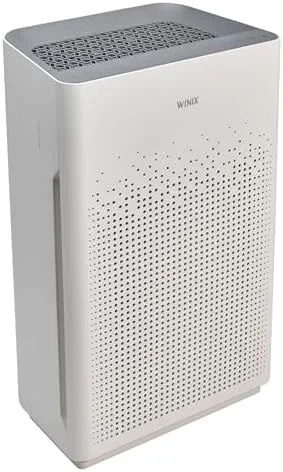
The AM90 measures 14.9 × 7.8 × 23.6 in and weighs 15.8 lb. Its shallow 7.8-inch depth gives it a smaller floor footprint and can be helpful where a deep cabinet would intrude into a walkway.
But "slim" should not be confused with "flush against the wall." Winix instructs users to leave roughly 12–18 inches of space from walls for airflow, while Levoit's manual calls for about 15 inches of clearance on all sides. Placement therefore depends on both cabinet dimensions and the breathing room each unit needs.
Edge: Winix AM90 for the shallower cabinet; Levoit Core 600S for lower weight. Neither has a universal placement advantage.
Maintenance & Energy Use
The Core 600S pre-filter should be cleaned with a soft brush or vacuum every 2–4 weeks. Levoit specifically says not to clean the filter with water or other liquids. The combined main filter and carbon filter are typically replaced every 6–12 months, depending on use and conditions.
The AM90 has a genuinely washable pre-filter. Winix recommends regular cleaning and allows it to be rinsed when heavily soiled, provided it dries fully before reinstallation. Its activated-carbon filter is listed for replacement about every 3 months, while the True HEPA filter is rated for roughly 12 months.
So maintenance is not a simple tie. Winix gives you a reusable pre-filter but asks for more frequent carbon-filter attention. Levoit has fewer separate replacement intervals, but its outer pre-filter is vacuum/brush only.
Rated power is 49W for the Core 600S and 65W for the AM90. The Levoit therefore carries the lower manufacturer-rated draw even though its CADR is substantially higher. That does not mean every household will use less electricity with it: nameplate wattage is not an annual-use estimate, and real consumption depends on fan speed, Auto behavior, room conditions, and operating hours.
Edge: Levoit Core 600S on the published rated-power figure. Maintenance is preference-dependent: simpler combined-filter replacement on Levoit versus a washable pre-filter but more frequent carbon changes on Winix.
The Bottom Line
The decisive difference between these two is not "smart controls versus set-and-forget operation." Both have apps, schedules, local controls, Auto modes, and nighttime automation. The real split is clean-air delivery and particle sensing versus a slimmer cabinet and odor-oriented sensing.
The Levoit Core 600S is the stronger all-around fit when the job is clearing airborne particles in a larger room. Its smoke CADR is 391 CFM versus 233 CFM, its Auto Mode is driven by a PM2.5 sensor, and VeSync adds unusually flexible automation. It also supports Google Assistant in addition to Alexa.
The Winix AM90 remains distinct in a few practical ways. Its body is much shallower, its pre-filter is washable, its Auto Mode reacts to an odorous-gas sensor, and its light sensor can automatically trigger Sleep Mode. It also gives users the option to run PlasmaWave or disable it.
For particle-heavy problems such as smoke, dust, and pollen, the Core 600S's higher CADR is the more consequential difference. For persistent gases and odors, neither model should be treated as a substitute for a purifier designed around a substantial adsorbent bed.
The Core 600S earns the overall edge because its advantages affect the purifier's primary job: moving more particle-cleaned air through the room, while also providing PM2.5-based automation and broader smart-home control. The AM90 is more compelling when its shallower shape, washable pre-filter, odor-sensing behavior, or optional PlasmaWave stage better matches the room and routine.
FAQ
Is the Levoit Core 600S’s CADR significantly better than the Winix AM90?
Does the Winix AM90’s PlasmaWave feature actually help with odors?
Can I use the Levoit Core 600S without the VeSync app?
Which purifier is quieter for bedroom use?
Does the Levoit Core 600S have a timer function?
Which air purifier is more energy efficient, Levoit Core 600S or Winix AM90?
How large a room can the Winix AM90 effectively clean?
📄 Used Manuals & Documentation
Levoit Core 600S
"Images are used for editorial and informational purposes only. All trademarks and images belong to their respective owners."