
Kidde COPDLQW vs X-Sense XC0M-iR: Plug-In IAQ Monitoring or Battery-Powered Voice Alerts?
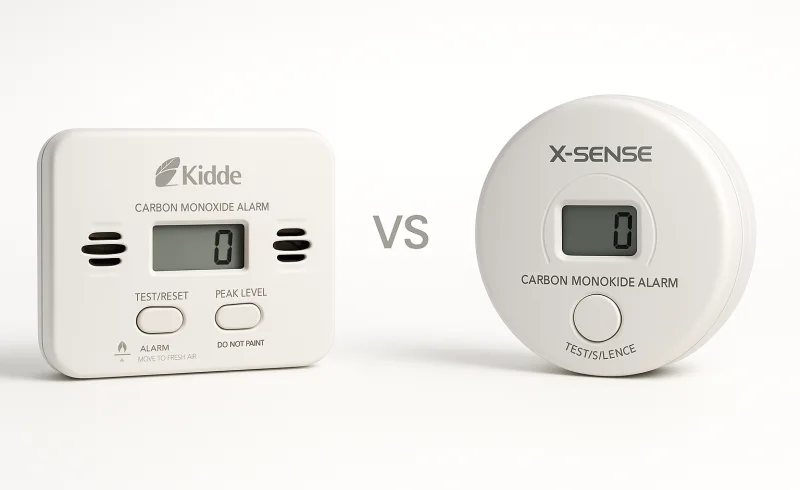
Compare Kidde COPDLQW and X-Sense XC0M-iR for carbon monoxide detection and installation flexibility. Discover which device offers better indoor-air monitoring, battery operation, and whole-home safety via interconnect features in various residential scenarios...
TL;DR
- Kidde COPDLQW makes more sense when a suitable wall outlet is available and you want a CO alarm that also tracks temperature, humidity, and TVOCs. It also adds a separate low-level CO alert feature.
- X-Sense XC0M-iR is easier to position because it runs on a replaceable CR123A battery, and its spoken alerts can announce both the CO hazard and a preset room location.
- Do not choose the XC0M-iR on the assumption that multiple units will all sound together. X-Sense’s current product page contains an “Interconnected Alarm” bullet, but its current manual describes the XC0M-iR as a standalone Wi-Fi alarm, provides no interconnection procedure, and X-Sense’s main CO catalog places it in the “Wi-Fi (App)” category rather than its interconnected category. :contentReference[oaicite:0]{index=0}
- If synchronized alarms throughout the home are a requirement, neither model is a clean fit based on the current documentation. The U.S. Consumer Product Safety Commission recommends CO alarms on every level and outside sleeping areas and notes that interconnected CO alarms are preferable because all units sound when one detects a hazard. :contentReference[oaicite:1]{index=1}
That correction changes the comparison substantially. The XC0M-iR is not best understood as a whole-home interconnect system; it is a battery-powered smart CO alarm with app connectivity, temperature and humidity monitoring, and unusually informative voice alerts. The COPDLQW is a plug-in CO alarm with battery backup, broader indoor-air monitoring, a documented UL 2034 listing, and a separate low-level CO alert.
Neither device detects smoke. Both rely on a local audible alarm for the actual life-safety function; Wi-Fi and phone notifications are supplementary features, not substitutes for the alarm itself.
| Feature | Kidde COPDLQW | X-Sense XC0M-iR |
|---|---|---|
| Power | ||
| Battery Backup | 2 AA backup batteries | Not applicable (battery-only) |
| Maximum Service Life | 10 years | 10 years |
| Primary Power Source | 120VAC, 60Hz, 50mA plug-in | 3 V CR123A lithium battery x1 (replaceable) |
| Detection | ||
| Sensor Type | Electrochemical | Electrochemical |
| Detection Type | Carbon monoxide | Carbon monoxide |
| CO Alarm Response Time | 70 ppm: 60-240 min; 150 ppm: 10-50 min; 400 ppm: 4-15 min | 70 ppm: 60-240 minutes; 150 ppm: 10-50 minutes; 400 ppm: 4-15 minutes |
| Monitoring | ||
| Monitored Parameters | CO, temperature, relative humidity, TVOCs | CO, temperature, humidity |
| Connectivity | ||
| Wi-Fi | 2.4 GHz Wi-Fi | 2.4 GHz Wi-Fi |
| Mobile App | Kidde app | X-SENSE Home Security app |
| Interconnect Capability | Not supported | Supported |
| Environmental | ||
| Operating Temperature | 40 °F (4.4 °C) to 100 °F (37.8 °C) | 40-100°F (4.4-37.8°C) |
| Operating Relative Humidity | 10 to 95% relative humidity (RH), non-condensing | 10%-85% RH (non-condensing) |
| Display & Alerts | ||
| Display | Digital display | LCD |
| Alarm Sound Level | 85 dB at 10 ft | ≥ 85 dB at 10 ft (3 m) @ 3.2 ± 0.3 kHz pulsing alarm |
📑 Table of Contents
CO Detection and Safety Documentation
Both models use electrochemical carbon monoxide sensors, and their current U.S. documentation lists the same standard alarm-response windows:
- 70 ppm: 60–240 minutes
- 150 ppm: 10–50 minutes
- 400 ppm: 4–15 minutes
That means there is no published response-time advantage at those concentrations. It does not, however, mean the safety documentation is identical.
Kidde’s current product data sheet explicitly states that the COPDLQW conforms to UL 2034 and lists the same 70/150/400 ppm response windows. :contentReference[oaicite:2]{index=2}
X-Sense’s current U.S. XC0M-iR manual also lists those response windows, but the current U.S. manual and product page do not state an equivalent UL 2034 listing in their technical specifications. That absence should not be interpreted as proof that the alarm lacks a certification; it does mean the two products should not be described as having identical documented certifications merely because their published response times match. :contentReference[oaicite:3]{index=3}
Kidde also provides a separate low-level CO alert in addition to the normal CO alarm. Its documentation explicitly distinguishes that early alert from the full alarm event. This matters because the device can call attention to elevated CO before the exposure-duration requirement for the standard alarm has been reached. :contentReference[oaicite:4]{index=4}
X-Sense takes a somewhat different approach. Its app can issue a CO Alarm Precaution when potentially dangerous CO is present but has not yet persisted long enough to trigger the audible alarm. The manual specifies that the device can display CO at 30 ppm and above and describes a precaution state when concentrations in the alarm range have been detected for less than the required alarm period. :contentReference[oaicite:5]{index=5}
The practical distinction is that Kidde documents a dedicated local low-level alert mode, while X-Sense documents an app-based precaution state before the full alarm timing has elapsed.
Assessment: The two alarms publish the same primary CO response windows, but Kidde has the stronger documented safety feature set because it pairs a stated UL 2034 conformity claim with a separate low-level CO alert.
Power and Placement


The Kidde COPDLQW runs from a 120VAC non-switched outlet and includes two AA backup batteries. Its plug rotates 90 degrees, which makes vertical and horizontal receptacles easier to accommodate. CO detection continues on backup power during an outage, although Kidde states that its Wi-Fi features require AC power. :contentReference[oaicite:6]{index=6}
That architecture is convenient when the right outlet already exists. It becomes restrictive when the available receptacle is behind furniture, too close to a cooking or heating appliance, or simply not where the alarm should be located.
The X-Sense XC0M-iR uses a single replaceable CR123A lithium battery. X-Sense rates that battery for one year, while the alarm itself has a 10-year maximum service life. The unit can be mounted on a wall or placed directly on a flat surface such as a shelf or desktop. X-Sense specifically advises against ceiling installation for this model. :contentReference[oaicite:7]{index=7}
That gives X-Sense a genuine placement advantage, but battery operation does not mean that any location is appropriate.
The original comparison overstated the usefulness of battery power in garages and immediately beside fuel-burning appliances. X-Sense’s own manual says not to install the XC0M-iR in garages or extremely dusty, dirty, or greasy areas, advises keeping it away from normal smoke or fume sources, and specifies separation from cooking appliances, high-humidity sources, and extreme temperatures. Kidde likewise advises against garage installation and locations too close to heating or cooking appliances. :contentReference[oaicite:8]{index=8}
For household coverage, the more important question is whether the alarm can be positioned according to the manufacturer’s instructions while still being heard from sleeping areas.
Assessment: X-Sense has the advantage in physical placement freedom. Kidde has the advantage in primary-power convenience once an appropriate outlet is available.
Interconnect and Whole-Home Coverage
This is where the original comparison needs its largest correction.
The Kidde COPDLQW is not interconnected. Kidde lists its interconnect specification as N/A, so one COPDLQW does not cause other Kidde alarms to sound when it detects CO. :contentReference[oaicite:9]{index=9}
The X-Sense XC0M-iR should not currently be presented as an interconnected alarm either.
X-Sense’s product page includes an “Interconnected Alarm” feature bullet, but the rest of X-Sense’s documentation points in the opposite direction. The current manual instructs users to add the XC0M-iR under “Wi-Fi CO Alarms (Standalone, working without Base Station)”, contains no procedure for pairing alarms with one another, and describes the device as standalone when it is disconnected from its Wi-Fi network. X-Sense’s current CO catalog separately labels true interconnected models as “Base Station Interconnected (App)” or “Interconnected Alarm,” while the XC0M-iR is categorized simply as “Wi-Fi (App).” :contentReference[oaicite:10]{index=10}
Because this is a life-safety feature, an isolated marketing bullet is not enough to justify telling readers that multiple XC0M-iR units will all sound together. Until X-Sense reconciles the conflicting documentation, whole-home alarm propagation should be treated as unsupported for this model.
That distinction matters. App notifications sent to several household members are useful, but they are not the same thing as one alarm triggering every alarm in the building. Phone connectivity can be interrupted by a router, internet connection, cloud service, notification permissions, or a silenced phone; direct alarm interconnection is designed for a different purpose.
The CPSC recommends CO alarms on every level and outside sleeping areas and specifically notes the advantage of interconnected alarms. :contentReference[oaicite:11]{index=11}
Assessment: Neither model has a verified interconnect advantage. For a home where synchronized audible alarms are a requirement, a model with explicitly documented interconnection is the more appropriate category.
Environmental Monitoring
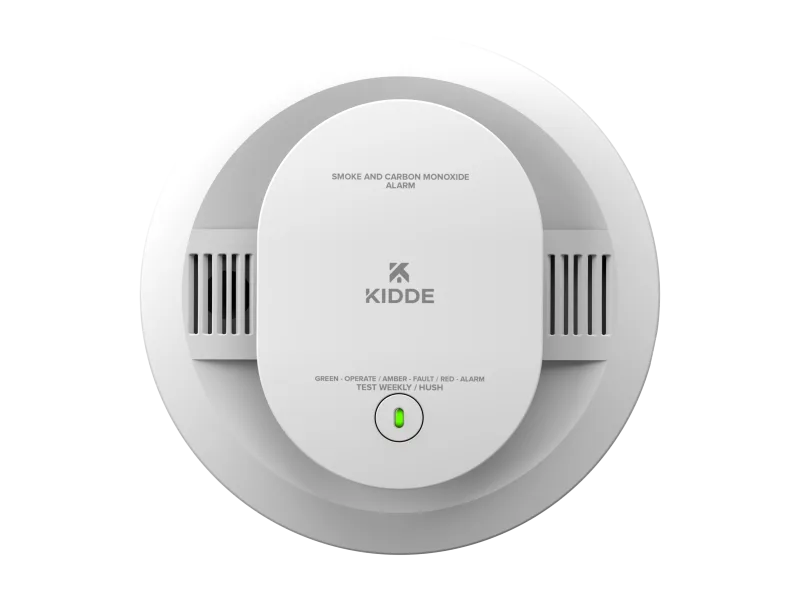
Environmental monitoring is where the Kidde COPDLQW creates the clearest separation.
Kidde monitors:
- carbon monoxide
- temperature
- relative humidity
- total volatile organic compounds (TVOCs)
The Kidde app can show indoor-air information and send alerts when its IAQ readings move outside the ranges defined by the system. Kidde also uses a dedicated air-quality status LED on the alarm. :contentReference[oaicite:12]{index=12}
There are two important limitations.
First, Kidde explicitly says that the indoor-air-quality sensors are not life-safety sensors and are not UL- or OSHA-certified. They do not change the certified CO-alarm function. Kidde also says that IAQ data is available after a short warm-up but that the device may require up to four days to achieve full accuracy. :contentReference[oaicite:13]{index=13}
Second, TVOC is a broad aggregate measurement rather than an identification of a specific chemical or a direct measure of health risk. The EPA cautions that a lower total VOC value does not automatically mean that an indoor environment is safer because individual VOCs vary substantially in toxicity. :contentReference[oaicite:14]{index=14}
In practice, Kidde’s TVOC channel is most useful as a trend and ventilation signal. A sudden change after painting, cleaning, cooking, or introducing new furnishings may be informative. It should not be interpreted as a laboratory analysis of the air.
The X-Sense XC0M-iR monitors CO, temperature, and humidity, but not TVOCs. Its manual specifies temperature accuracy of ±0.9°F (0.5°C) and humidity accuracy of 5%, and the app can display historical temperature and humidity charts. On the alarm itself, those readings rotate on the LCD while CO remains below 30 ppm; when CO reaches 30 ppm or higher, the display stops rotating and prioritizes the CO reading. :contentReference[oaicite:15]{index=15}
That is a sensible emergency-oriented display behavior: comfort information disappears when the CO number becomes more important.
Assessment: Kidde provides substantially broader environmental context because of TVOC monitoring. X-Sense covers temperature and humidity well enough for basic room-condition tracking but is not a broader IAQ monitor.
Display and Emergency Alert Clarity
Both alarms have digital displays and audible alarms in roughly the same loudness class.
Kidde specifies an 85 dB alarm at 10 feet. During a full CO event, its display alternates between the CO concentration and a CO indication, while LEDs provide additional status information. :contentReference[oaicite:16]{index=16}
X-Sense specifies at least 85 dB at 10 feet and adds something Kidde does not: a spoken alert with a preset location.
The XC0M-iR lets the user assign one of several room names, including entryway, basement, living room, kitchen, hallway, bedrooms, office, workshop, and utility room. During a CO alarm it announces the hazard, inserts that saved location, and instructs occupants to move to fresh air. :contentReference[oaicite:17]{index=17}
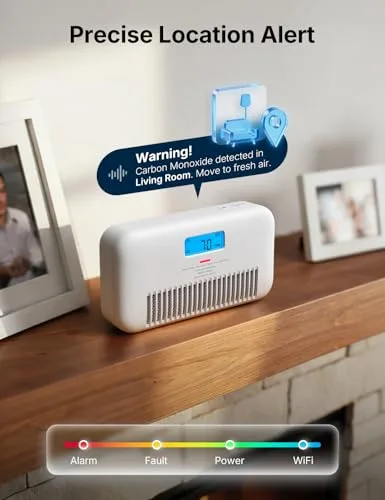
That voice layer is more than cosmetic. A generic four-beep CO pattern requires occupants to recognize what the pattern means; a spoken announcement identifies the hazard directly. The location announcement can also provide context when more than one standalone alarm is installed, even though the devices themselves are not documented as interconnected.
The limitation is important: the voice identifies the location of the alarm that is speaking. It does not turn separate XC0M-iR units into a synchronized alarm network.
Assessment: X-Sense has the clearer local emergency interface because voice and location information supplement the siren and display.
App Features and Smart-Home Integration
Both models use 2.4 GHz Wi-Fi, but their software features are organized differently.
The Kidde COPDLQW connects to the Kidde app for CO and IAQ notifications. Kidde documents remote testing and remote hush when the user is physically near enough to hear the alarm, and device access can be shared with other users. Kidde also documents compatibility with Amazon Alexa and Google Home. :contentReference[oaicite:18]{index=18}
Kidde is explicit that phone notifications are ancillary and depend on a stable Wi-Fi connection. Its Wi-Fi features also stop functioning when AC power is absent, even though the backup batteries maintain the alarm’s core CO function during a power interruption. :contentReference[oaicite:19]{index=19}
The X-Sense XC0M-iR connects directly to the X-SENSE Home Security app without an SBS50 base station. The app supports:
- CO alarm and status notifications
- temperature and humidity history
- night mode
- device sharing
- notification history
- low-battery, malfunction, and end-of-life notifications
- offline notifications
- remote silence under the conditions specified in the manual
X-Sense notes that an offline notification may not arrive immediately because the alarm reports its status to the cloud at intervals. It also warns that enabling more push notifications increases power consumption and can shorten battery life. :contentReference[oaicite:20]{index=20}
The XC0M-iR is explicitly incompatible with the SBS50 base station, and X-Sense does not position it in the same interconnected product category as its base-station models. :contentReference[oaicite:21]{index=21}
That makes the ecosystem distinction straightforward: Kidde offers broader documented smart-home integration; X-Sense offers a feature-rich standalone alarm app with particularly good device-status and environmental-history tools.
Neither app should be treated as the primary emergency-warning channel. The local siren remains the critical function.
Battery Maintenance, Testing, and Service Life
Neither model is maintenance-free.
The X-Sense XC0M-iR has a 10-year maximum device life, but its replaceable CR123A battery is rated for approximately one year. X-Sense instructs users to test the alarm weekly and vacuum the alarm cover every three months. :contentReference[oaicite:22]{index=22}
The Kidde COPDLQW also requires regular testing and uses two replaceable AA batteries for backup power. Kidde says fresh backup batteries should last at least one year under normal conditions, although AC power handles normal operation. The alarm has a 10-year limited warranty and is designed to signal end of unit life. :contentReference[oaicite:23]{index=23}
Kidde also includes No Chirps At Night, which uses the local internet-connected clock to postpone certain low-battery or end-of-life chirps during the night cycle. It does not suppress an actual CO alarm. :contentReference[oaicite:24]{index=24}
The practical difference is therefore not “battery maintenance versus no battery maintenance.” It is annual primary-battery dependence on X-Sense versus backup-battery maintenance on a primarily AC-powered Kidde.
Assessment: Kidde requires less dependence on battery power during normal operation, while X-Sense accepts more routine battery responsibility in exchange for outlet-independent placement.
The Bottom Line
The most important conclusion is different from the one suggested by the original specification comparison: the XC0M-iR should not be treated as a whole-home interconnected alarm on the basis of the current documentation.
For a single location where an appropriate non-switched outlet is available, the Kidde COPDLQW has the more complete standalone feature set. It combines documented UL 2034 conformity, a separate low-level CO alert, AC power with battery backup, temperature and humidity monitoring, TVOC monitoring, app alerts, and documented Alexa and Google Home compatibility. Its main limitation is physical placement: the receptacle has to be in a location that also makes sense for CO detection.
The X-Sense XC0M-iR is more compelling when cordless placement and spoken emergency information matter more. It can be mounted on a wall or placed on a suitable flat surface, announces the hazard and saved room location, shows temperature and humidity, maintains environmental history in the app, and can issue precaution notifications before the exposure-duration requirement for the full alarm has been met. The trade-offs are a roughly annual CR123A battery cycle and the absence of verified alarm-to-alarm interconnection in the current manual.
For broader indoor-air monitoring, Kidde has the stronger feature set, primarily because of TVOC sensing. That TVOC measurement is contextual rather than diagnostic and should remain separate in the reader’s mind from the certified CO alarm.
For emergency-message clarity and outlet-independent placement, X-Sense has the advantage.
For synchronized audible coverage across several rooms or floors, neither model is the appropriate conclusion from this comparison. Current safety guidance favors interconnected alarms for that scenario, so the relevant specification should be explicit alarm-to-alarm interconnection rather than merely Wi-Fi connectivity or shared phone notifications. :contentReference[oaicite:25]{index=25}
There is therefore no useful universal winner here. The decision turns on a concrete installation question: if a correctly located outlet is available and broader monitoring is useful, the Kidde COPDLQW is the more capable standalone device; if the outlet is the constraint and spoken location alerts matter, the X-Sense XC0M-iR is the more flexible standalone device.
FAQ
Can these alarms detect smoke or fire?
Do the smart features work without Wi-Fi?
How do I prevent false CO alarms?
Can I interconnect the Kidde COPDLQW with other alarms?
What is the lifespan of these CO detectors?
How do I know if the backup battery in the Kidde COPDLQW is low?
Does the X-Sense XC0M-iR provide voice alerts?
How many units can be interconnected with the X-Sense XC0M-iR?
📄 Used Manuals & Documentation
Kidde COPDLQW
"Images are used for editorial and informational purposes only. All trademarks and images belong to their respective owners."