
Holy Stone HS210 vs DEERC D20: App-Free Indoor Trainer or 720p FPV Mini Drone?
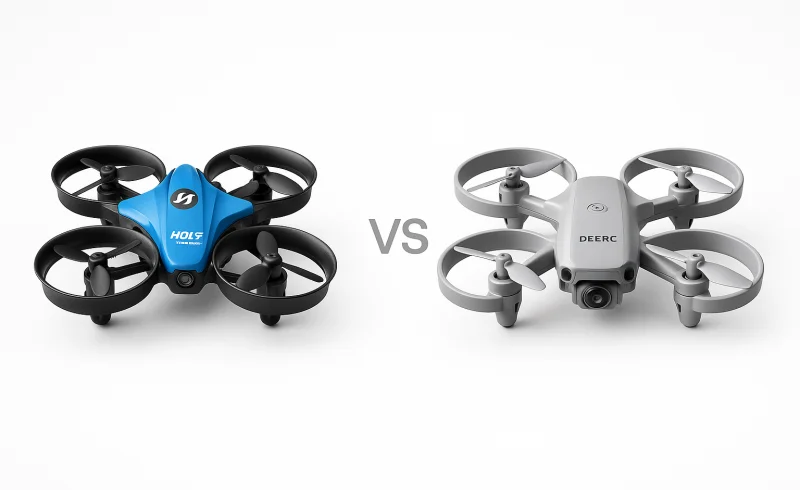
Explore the differences between the Holy Stone HS210 and DEERC D20 drones. The HS210 excels in indoor training with app-free simplicity and longer flight times, while the D20 captures moments with its 720p camera and FPV capability, ideal for outdoor use.
TL;DR
- Holy Stone HS210 fits screen-free indoor practice better. It has no camera or app layer, weighs just 24.8 g, and keeps the focus on line-of-sight stick control.
- DEERC D20 fits camera and FPV use better. Its 1280 × 720 camera sends a live view to the DE FPV app, with DEERC rating video transmission at up to 30 m in unobstructed outdoor conditions.
- The D20 does not require a phone for basic transmitter flying. The phone matters when you want the live camera view and app functions, so its setup is more involved only when using FPV.
- Battery life is closer than it first appears. Holy Stone currently rates the HS210 at up to 9 minutes per 250mAh battery; DEERC rates the D20 at up to 10 minutes per 500mAh battery. Included battery counts should be checked for the specific package rather than treated as a universal model difference.
- Neither should be treated as a wind-ready outdoor camera drone. Holy Stone recommends the HS210 outdoors only in calm, windless conditions, while DEERC's D20 manual explicitly warns against flying in wind.
The useful distinction is not really indoor drone versus outdoor drone. It is screen-free line-of-sight practice versus phone-assisted FPV and basic image capture. The HS210 strips the experience down to flying; the D20 adds a camera and live view without moving into the GPS, stabilized-camera class.
| Feature | DEERC D20 | Holy Stone HS210 |
|---|---|---|
| Power | ||
| Battery Type | Lithium-ion Polymer Battery | Lithium-ion Polymer Battery |
| Charging Time | about 80 minutes | 40–60 minutes |
| Battery Voltage | 3.7V | 3.7 V |
| Battery Capacity | 500mAh | 250 mAh |
| Controller Battery | 3 x 1.5V AA (Not included) | 1.5V AAA Battery (Not included) |
| Camera | ||
| Camera | HD Camera | No camera |
| FPV Transmission | FPV real-time transmission | Not supported |
| Video Resolution | HD1280 x 720P | No camera |
| Max Transmission Distance | 98 feet/30m (outdoors and unobstructed) | Not supported |
| Design | ||
| Weight | 69g/2.4oz | 24.8g / 0.87oz |
| Dimensions | 178*117*42 mm (Unfolded); 94*90*42 mm (Folded) | 80 × 80 × 30 mm |
| Features | ||
| 360° Flip | Supported | Supported |
| Speed Modes | 3 speed modes (Low/Medium/High) | 3-Speed Switch |
| Headless Mode | Supported | Supported |
| One-Key Takeoff/Landing | One Key Takeoff/Landing | One Key Start/Landing |
| Performance | ||
| Max Flight Time | 10 minutes (per battery) | 9 minutes (in a windless environment) |
| Max Flight Distance | 131 feet/40m (outdoors and unobstructed) | 50 m (outdoors and unobstructed) |
| Connectivity | ||
| App Support | DE FPV app | No app |
| Control Frequency | 2452-2474MHz | 2452–2474 MHz |
| Wi-Fi Connectivity | Own Wi-Fi network (DeercFPV-******) | Not supported |
📑 Table of Contents
Camera & FPV
This is the clearest difference between the two.
Holy Stone HS210 has no camera, no FPV feed, and no companion app. Everything happens through the controller and by watching the drone itself. For someone learning orientation, throttle, turns, and recovery, that removes the temptation to stare at a phone instead of following the aircraft.
The limitation is equally straightforward: the HS210 cannot provide a pilot's-eye view, record footage, or help with camera framing.
DEERC D20 adds a 1280 × 720 camera and phone-based FPV. DEERC specifies an 80° lens and a maximum video-transmission distance of 98 ft / 30 m outdoors in unobstructed conditions. The camera can also be tilted manually through a 90° range.
That manual adjustment is worth understanding. This is not a powered camera mount that can be aimed remotely while flying. The angle is set by physically moving the camera before or between flights, so framing remains basic.
The D20's live view requires the DE FPV app and a direct Wi-Fi connection to the drone. DEERC does not publish a latency specification, so the feed should be treated as a viewing and framing feature rather than as a guaranteed low-latency FPV system.
Its 720p specification also places expectations in the right category. The camera is useful for seeing from the drone's perspective and making simple clips or photos, but the documentation does not describe a powered gimbal or a stabilized imaging system comparable with dedicated aerial-camera drones.
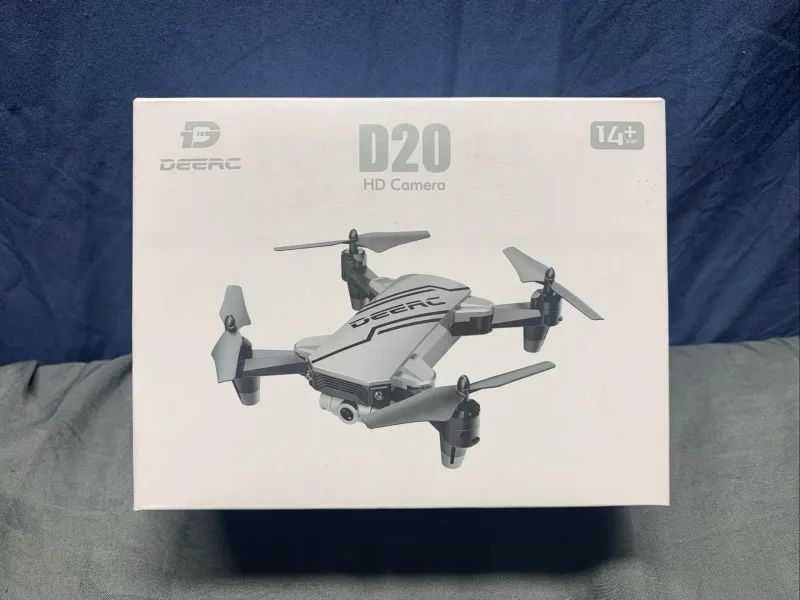
For camera use and FPV, the D20 has the meaningful advantage. For distraction-free flight practice, the HS210's lack of a camera is part of its purpose rather than a missing extra.
Flight Controls & Beginner Aids
The original comparison makes the two drones sound more different in basic flight behavior than they actually are.
Holy Stone lists Altitude Hold, Headless Mode, and three speed modes for the HS210. Those functions reduce the workload for a first-time pilot: altitude hold limits how much attention has to go into maintaining height, while the slower speed setting gives beginners more time to correct a mistake.
That also means the HS210 is not a bare-bones manual trainer. A beginner can use its assistance initially and rely less on it as orientation and stick control improve.
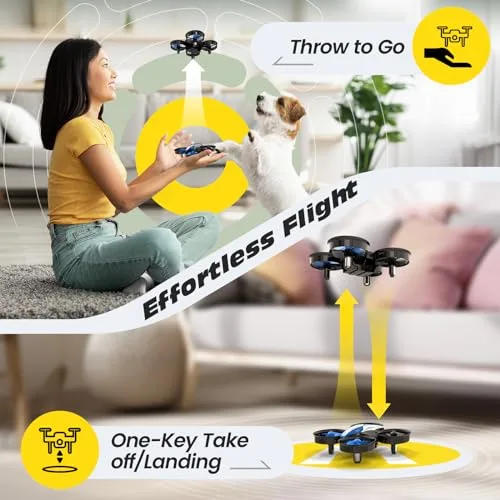
The DEERC D20 follows a similar beginner-oriented approach. Its manual documents one-key takeoff and landing, three speed modes, Headless Mode, trim adjustment, gyro calibration, and an automatic hover after one-key takeoff. DEERC also describes the model as having altitude-hold functionality.
So the D20's main advantage is not that it is dramatically easier to keep in the air. Both drones include assistance intended to make early flights less demanding.
The real behavioral difference is where the pilot's attention goes:
- With the HS210, flight is entirely visual line-of-sight.
- With the D20, the pilot can still fly from the transmitter but can also use the phone as a camera view.
For learning the relationship between stick inputs and the drone's physical orientation, the HS210 is the cleaner setup. For learning how a small camera drone combines controller inputs with a live view, the D20 adds that second layer.
Battery Life, Charging & Range
Battery endurance needs a more careful comparison than simply counting packs.
Holy Stone's current HS210 specifications rate the drone at up to 9 minutes per 250mAh battery in a windless environment, with a stated charging time of 40–60 minutes. Holy Stone's current package information lists three batteries in a typical HS210 package while also noting that accessories can vary by distribution channel.
That is different from older Holy Stone material, which described the HS210 as roughly 7 minutes per battery and 21 minutes across three batteries. Because Holy Stone's own published figures have changed across revisions, the safest comparison is the current per-battery rating, not an assumed total session length.
The D20 is rated at up to 10 minutes per 500mAh battery, with approximately 80 minutes of charging time.
DEERC's official manual identifies the battery specification but does not establish a universal package quantity. D20 packages have appeared in different configurations, so describing it categorically as a one-battery model can be misleading.
On the aircraft themselves, then, the endurance difference is small: up to 9 minutes for the HS210 versus up to 10 minutes for the D20 per battery.
The published range numbers are:
- HS210: up to 50 m control distance outdoors and unobstructed.
- D20: up to 40 m control distance outdoors and unobstructed.
- D20 camera feed: up to 30 m outdoors and unobstructed.
Those maximum figures matter less here than they would on a larger aircraft. Both drones are extremely small, and the HS210 in particular is difficult to treat as a distance platform because of its 24.8 g airframe and lack of a camera view. The D20's usable FPV area is also bounded by the shorter stated video-transmission range.
For either model, staying close enough to maintain clear awareness of the aircraft is more relevant than trying to approach the maximum radio specification.
Setup & Phone Dependency
Holy Stone HS210 has the simpler workflow. There is no app account, phone mount, Wi-Fi network, or video connection to configure. The controller and drone are paired directly, after which the flight experience stays self-contained.
That simplicity is especially useful when the goal is a few minutes of indoor practice rather than managing another connected device.
The D20's basic flight controls are also handled by its transmitter, so describing it as completely phone-dependent goes too far. The phone becomes relevant when the camera's live view is part of the session.
For FPV, DEERC's manual instructs the user to connect the phone to the drone's own DeercFPV-**** Wi-Fi network** and then open the DE FPV app. It also instructs users to disable Bluetooth, mobile data, and VPN during the connection process. The drone-created Wi-Fi network itself has no internet access.
That makes the practical trade-off easy to understand: the D20 can still function as a conventional small RC drone, but accessing the feature that distinguishes it from the HS210 requires several additional steps.
There is no need to treat those steps as evidence that the D20 is inherently unreliable. They are simply additional components in the workflow that the HS210 does not have.
For the shortest path from power-on to basic flying, the HS210 is simpler. For FPV, the D20 necessarily adds phone and Wi-Fi setup.
Size, Propeller Protection & Where They Make Sense
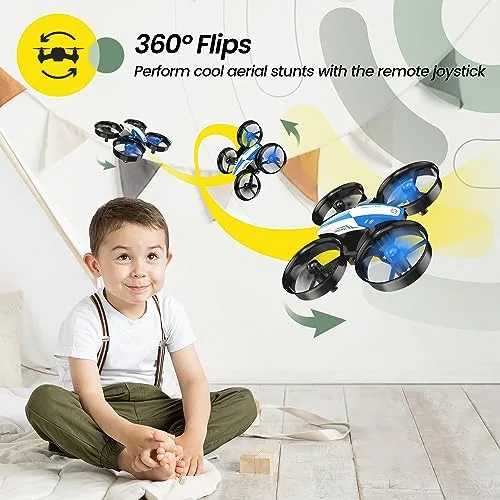
The HS210 weighs 24.8 g and measures 80 × 80 × 30 mm. Holy Stone equips it with propeller guards and describes the model primarily as an indoor beginner drone.
That combination matters more than the raw dimensions suggest. A very small aircraft occupies less space during turns and corrections, and its low mass reduces the energy involved in minor bumps. Propeller guards also add a layer of separation between the blades and nearby objects, although they do not make contact risk disappear.
The D20 weighs 69 g and measures 178 × 117 × 42 mm when unfolded. It folds to 94 × 90 × 42 mm, which is convenient for storage, although the folded D20 is still larger overall than the HS210.
DEERC also includes propeller guards in the D20 design, but its larger flying footprint makes it less natural for very tight rooms.
The D20's camera can make a calm outdoor flight more interesting because there is something to see and record, but that should not be confused with genuine outdoor capability. Its manual specifically says not to operate the drone in adverse conditions including wind, rain, snow, or fog.
Holy Stone is even more explicit about the HS210's role: the company describes it as primarily an indoor model and recommends outdoor operation only in calm, windless conditions.
So the environmental distinction is:
- HS210: strongly oriented toward indoor flight.
- D20: usable indoors and in suitable outdoor space, with a camera that makes calm outdoor use more relevant.
- Neither: intended as a wind-resistant or long-distance aerial platform.
The Bottom Line
These drones overlap as beginner mini quadcopters, but they solve different problems.
The Holy Stone HS210 makes more sense when the goal is straightforward indoor flying. It is dramatically smaller and lighter, needs no phone, and includes the same kinds of beginner aids that make this class approachable. Its entire experience is built around watching the aircraft and learning what the sticks do.
The DEERC D20 makes more sense when the camera is central to the experience. Its 720p camera, manually adjustable angle, and phone-based live view add an FPV dimension that the HS210 cannot provide. Basic flight still happens through a conventional transmitter, but using the camera feed introduces the app and Wi-Fi connection process.
Battery endurance is not a decisive model-level separator: the published maximum is 9 minutes per battery for the HS210 and 10 minutes for the D20, while package battery counts can depend on the specific configuration.
And the original indoor-versus-outdoor framing needs one final qualification: the D20 is a camera-equipped mini drone, not a wind-ready outdoor camera platform. Both manufacturers place clear limits around windy conditions.
For screen-free indoor control practice, the HS210 is the more focused design. For 720p capture and phone-based FPV, the D20 provides the capability that separates these two models.
FAQ
Does the Holy Stone HS210 have a camera?
Can the DEERC D20 be flown without a phone?
How many batteries come with the HS210 vs D20?
How long does it take to charge the Holy Stone HS210 battery?
Does the DEERC D20 have altitude hold?
"Images are used for editorial and informational purposes only. All trademarks and images belong to their respective owners."