
Garmin Instinct 3 vs Amazfit T-Rex 3: Rugged Watch Showdown – Outdoor Tool or Feature-Rich Smartwatch?
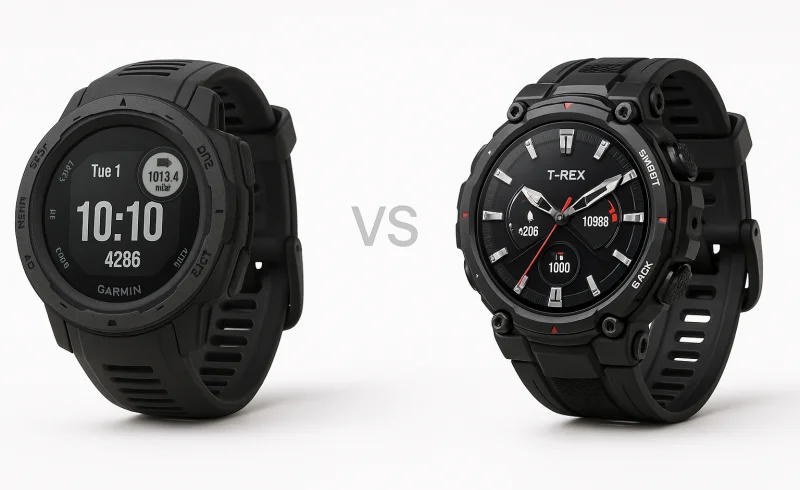
Explore the key differences between the Garmin Instinct 3 and Amazfit T-Rex 3, two rugged smartwatches designed for outdoor enthusiasts. From training analytics and battery life to display quality and navigation features, find out which watch suits your advent...
TL;DR
Quick Decision
- If you want a dependable outdoor instrument with deep training analytics and button-first control → choose Garmin Instinct 3.
- If you prioritize a larger AMOLED display, offline maps, and broader feature set at a lower price → choose Amazfit T-Rex 3.
- If battery life and charging convenience are your top concerns → either works, but Amazfit leads on paper (with real-world update caveats to watch for).
Key Differentiators
The Instinct 3 leans into Garmin’s mature training ecosystem and physical button reliability, making it ideal for backcountry users who want consistent, instrument-like behavior. The T-Rex 3 counters with a bigger, sharper screen and built-in offline maps for phone-free navigation, though its training analytics and long-term software stability are less rigorous. Battery life favors Amazfit on spec sheets, but Garmin’s real-world predictability is the safer bet for multi-week trips.
Who Should Skip Both
If you need rich smartwatch interactions (messaging, third-party apps) or a polished touch-first experience for everyday wear, consider a full-featured smartwatch like the Apple Watch or Samsung Galaxy Watch instead.
| Feature | Amazfit T-Rex 3 | Garmin Instinct 3 |
|---|---|---|
| Power | ||
| Charging method | Magnetic charging base | Garmin proprietary plug charger |
| GPS battery life | Up to 42 hours (Accuracy GPS Mode) | Up to 40 hours (GPS Only) |
| Battery saver mode | Up to 40 days | Up to 30 days |
| Smartwatch battery life | Up to 27 days | Up to 24 days (9 days always-on) |
| Display | ||
| Display size | 1.5" | 1.3" (33 mm) diameter |
| Display type | AMOLED | AMOLED (always-on) |
| Display resolution | 480*480 | 416 x 416 pixels |
| General | ||
| Band width | 22mm | 26 mm |
| Button count | 4 | 5 |
| Product type | Rugged GPS smartwatch | Rugged outdoor GPS smartwatch |
| Physical size | 48.5x48.5x13.75mm | 50 x 50 x 14.4 mm |
| Wrist fit range | 145mm-210mm | 141-213 mm |
| Water resistance | 10 ATM | 10 ATM |
| Bezel / case material | Stainless steel bezel, Polymer middle frame | fiber-reinforced polymer/aluminum bezel; fiber-reinforced polymer case |
| Display cover material | Gorilla Glass | Chemically Strengthened Glass |
| Connectivity | ||
| Positioning | Dual-band & 6 satellite positioning systems | GPS, GLONASS, Galileo, SatIQ Technology |
| Phone music control | Bluetooth Phone Music Control: Support | Controls smartphone music |
| Smart notifications | Phone Call Notifications, SMS Notifications, App Notifications | Smart Notifications |
| Wireless connectivity | WiFi 2.4GHz, Bluetooth 5.2, BLE | Bluetooth, ANT+ |
| Smartphone compatibility | Android 7.0 and above, iOS 14.0 and above | iPhone, Android |
| Environmental | ||
| Charging temperature range | -10℃~45℃ | From 0º to 45ºC (from 32º to 113ºF) |
| Operating temperature range | -30°C~45°C | From -20º to 60ºC (from -4º to 140ºF) |
| Health & Sensors | ||
| Sleep tracking | Sleep Quality Monitoring: Sleep stages (including REM), Daytime naps, Sleep breathing quality, Sleep score | Sleep (advanced), Sleep coach, Nap detection |
| Stress monitoring | 24H Monitoring: Stress level | All-day stress |
| Temperature sensor | Temperature sensor | Thermometer |
| Barometric altimeter | Barometric altimeter | Barometric altimeter |
| Heart rate monitoring | 24H Monitoring: Heart rate | Wrist-based heart rate (constant, every second) |
| Blood oxygen monitoring | 24H Monitoring: Blood-oxygen saturation | Pulse Ox Blood Oxygen Saturation Monitor |
📑 Table of Contents
Display & Optics
Screen size & usable area
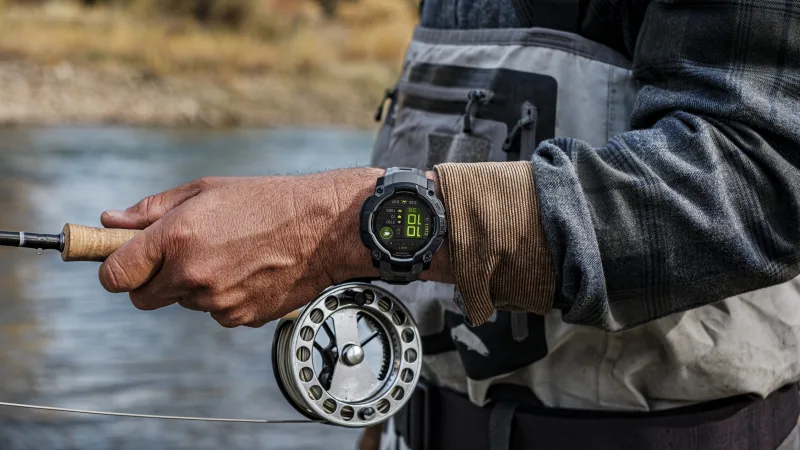
Garmin Instinct 3 uses a 1.3" AMOLED panel (33 mm diameter). That smaller canvas can limit how much you can see at once—especially if you prefer multiple data fields or larger text during an activity.
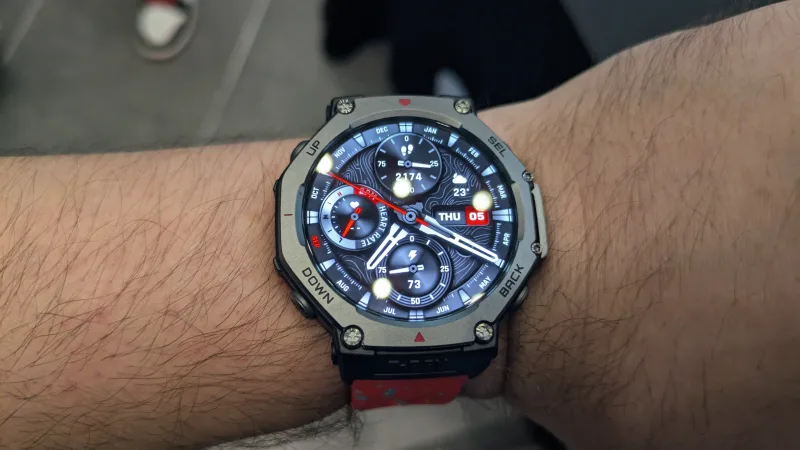
Amazfit T-Rex 3 steps up to a 1.5" AMOLED display. In practical terms, that extra screen real estate helps with on-watch readability for widgets and workout screens, and it pairs well with the T-Rex 3’s offline-map capability noted in listings.
Conclusion: Amazfit T-Rex 3 wins on screen size, with a meaningfully larger 1.5" vs 1.3" display.
Resolution & sharpness
Garmin Instinct 3 runs at 416 × 416 pixels. That’s plenty for crisp watch faces and clear text, but finer UI elements (small icons, dense metric layouts) have less pixel headroom.
Amazfit T-Rex 3 increases resolution to 480 × 480, which should translate to sharper edges and slightly cleaner typography—especially noticeable when you pack more information on-screen.
Conclusion: Amazfit T-Rex 3 wins on resolution, delivering 480×480 vs 416×416 for higher on-wrist clarity.
Winner: Amazfit T-Rex 3
Battery Life & Charging
Rated battery life (smartwatch + battery saver)
Garmin Instinct 3 is rated for up to 24 days in smartwatch mode, with a separate figure of 9 days always-on listed in the same spec line. Its battery saver claim is up to 30 days, which is strong for an AMOLED rugged watch but clearly positions it as «multi-week,» not «month-plus,» in the most conservative mode.
Amazfit T-Rex 3 is rated a bit higher at up to 27 days in smartwatch mode, and stretches further in battery saver at up to 40 days. On paper, that’s a clean advantage in both everyday endurance (+3 days) and low-power longevity (+10 days) over Garmin.
Conclusion: Amazfit T-Rex 3 wins on rated longevity, especially if you expect to lean on battery saver mode for long stretches.
GPS endurance + real-world stability
Garmin Instinct 3 quotes up to 40 hours (GPS Only), which is competitive for long activities. In real-world ownership, some users report 16–28 days depending on usage, which roughly aligns with Garmin’s multi-week positioning and suggests the «up to» rating isn’t wildly detached from typical outcomes.
Amazfit T-Rex 3 is rated for up to 42 hours (Accuracy GPS Mode)—a small but measurable lead over Garmin’s 40 hours. However, multiple reviewers report post-update battery drain where typical 2–7% daily loss can shift to 5–10% after updates, which can meaningfully erode its headline advantage if you’re unlucky with firmware/app behavior.
Conclusion: Amazfit T-Rex 3 still leads on GPS hours (42h vs 40h), but Garmin Instinct 3 looks more predictable in day-to-day battery consistency based on the provided real-world reports.
Charging method convenience
Garmin Instinct 3 uses a Garmin proprietary plug charger, which is dependable but adds a «special cable» dependency—easy to misplace and less convenient if you travel light or want to share chargers across devices.
Amazfit T-Rex 3 uses a magnetic charging base, which tends to be faster to dock and simpler to align at a desk or bedside. That convenience can matter as much as raw battery life when you’re topping up between workouts or before trips.
Conclusion: Amazfit T-Rex 3 wins on charging convenience thanks to the magnetic base, while Garmin’s proprietary connector is a usability compromise.
Winner: Amazfit T-Rex 3 — it has higher rated battery life in smartwatch (27 vs 24 days), GPS (42 vs 40 hours), and battery saver (40 vs 30 days), plus a more convenient magnetic charger, even though update-related drain reports are an important caveat.
Navigation & GPS
Satellite systems & positioning accuracy
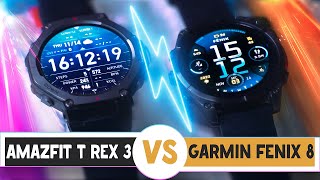
Garmin Instinct 3 supports GPS, GLONASS, and Galileo and adds SatIQ Technology, which is designed to adapt GNSS behavior to balance tracking performance and battery. On paper, that’s a strong foundation for reliable outdoor tracking, especially if you prioritize efficient operation over max-spec radio use.
Amazfit T-Rex 3 lists dual-band positioning plus 6 satellite positioning systems, which is the more advanced spec for challenging environments (trees, canyons, dense urban areas) where multi-path can degrade tracks. Dual-band is the standout differentiator here because it’s specifically aimed at improving positional robustness rather than just adding constellations.
Conclusion: Amazfit T-Rex 3 has the edge for raw positioning capability thanks to dual-band + 6 systems, while Garmin Instinct 3’s SatIQ reads more like an efficiency play than an accuracy upgrade based on the provided data.
On-watch navigation: maps vs no maps
Garmin Instinct 3 is positioned as a «rugged outdoor GPS smartwatch,» but in the provided specs and facts there’s no mention of offline map storage or on-watch map viewing. That typically means navigation is more about following routes/fields rather than visually referencing terrain on the watch itself.
Amazfit T-Rex 3, by contrast, explicitly supports offline maps, and SoT materials reiterate that offline maps are included for route viewing without a phone. That’s a tangible capability difference: maps on the wrist can reduce reliance on phone battery/cell service and make reroutes easier when you’re off-trail.
Conclusion: Amazfit T-Rex 3 clearly wins for navigation independence because it offers offline maps, a capability not evidenced for the Garmin Instinct 3 in the provided information.
GPS battery life (while recording)
Garmin Instinct 3 is rated up to 40 hours (GPS Only), which is competitive for long activities where you want straightforward recording without constantly managing power. If you’re already in Garmin’s outdoors/training workflows, that endurance aligns well with long hikes and multi-day trips with periodic charging.
Amazfit T-Rex 3 is rated slightly higher at up to 42 hours (Accuracy GPS Mode). The difference is modest (about 2 hours), but it’s notable that Amazfit pairs that endurance claim with higher-end positioning hardware (dual-band).
Conclusion: Amazfit T-Rex 3 has a small spec win on GPS runtime (42h vs 40h), but the bigger practical differentiator in this section remains its mapping and positioning stack rather than the marginal endurance gap.
Winner: Amazfit T-Rex 3 — dual-band GNSS + offline maps create a meaningful, defensible advantage for backcountry-style navigation without a phone.
Durability & Build
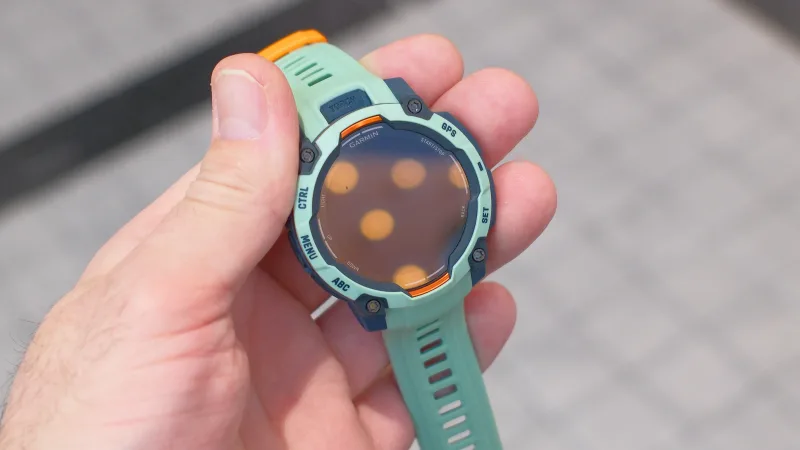
Garmin Instinct 3 uses a fiber-reinforced polymer case with an aluminum bezel, and it’s physically the larger watch at 50 x 50 x 14.4 mm. It’s rated to 10 ATM water resistance, positioning it as a watch you can confidently submerge and keep using in wet conditions. The Chemically Strengthened Glass cover is also consistent with a «tool-watch» approach focused on impact and scratch resilience.
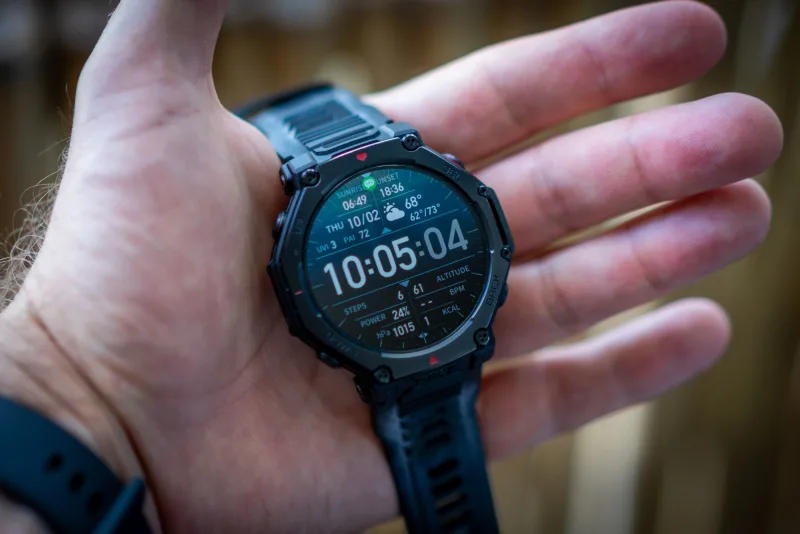
Amazfit T-Rex 3 pairs a stainless steel bezel with a polymer middle frame, and comes in slightly smaller at 48.5 x 48.5 x 13.75 mm. It also carries a 10 ATM rating (marketed as waterproof to 328 ft), so water exposure isn’t a differentiator on paper. The use of Gorilla Glass plus a steel bezel tends to read as more «premium» in-hand than all-polymer exteriors, even if it can pick up visible scuffs over time.
Conclusion: On core ruggedness, it’s effectively even—10 ATM vs 10 ATM with comparably protective materials—so neither has a decisive durability advantage purely from specs.
Garmin Instinct 3 leans into control reliability with 5 physical buttons, which aligns with Garmin’s button-first navigation philosophy in poor conditions (rain, sweat, gloves). That extra hardware control is also a practical hedge against touch input being finicky mid-activity. However, some users note issues like inconsistent button responsiveness and even display misalignment, which can undercut the «always dependable» promise in unlucky units.
Amazfit T-Rex 3 uses 4 physical buttons alongside an AMOLED touch interface, matching its more touch-forward, modern smartwatch feel. In clean, dry conditions that can be faster for menus, but it’s inherently more sensitive to moisture and glove use than a button-led workflow. Its four-button layout is confirmed in retailer documentation, but it simply offers fewer dedicated hardware shortcuts than Garmin.
Conclusion: For harsh-condition usability, Garmin’s 5-button layout has the edge (more direct control with gloves/wet hands), even if there are notable reports of button-related QC/firmware friction.
Winner: Tie — Amazfit looks and feels more premium with stainless steel + Gorilla Glass, while Garmin is more glove/wet-friendly thanks to 5 buttons vs 4; both match at 10 ATM and are built for rough outdoor use.
Health & Fitness Tracking
Core health metrics (HR, SpO2, stress, sleep basics)
Garmin Instinct 3 covers the essentials with wrist-based heart rate measured «constant, every second», Pulse Ox blood oxygen, and all-day stress tracking. For sleep, it lists Sleep (advanced) plus nap detection, pushing it beyond simple sleep staging in the spec sheet.
Amazfit T-Rex 3 also hits the core bases with 24H monitoring for heart rate, blood-oxygen saturation, and stress level. Its sleep stack is very explicit: sleep stages (including REM), daytime naps, sleep breathing quality, and a sleep score.
Conclusion: Both deliver strong baseline health tracking, but Amazfit is more explicit on sleep stage/breathing breakdowns, while Garmin emphasizes continuous HR sampling and «advanced» sleep—this point is close with a slight tilt to Amazfit for clearly defined sleep components.
Training depth: coaching, load, and structured workouts
Garmin Instinct 3 is positioned (and specced) as the more training-serious option, with Sleep coach and (per editorial guidance) stronger training status/training load trends and structured workout support inside Garmin’s ecosystem. In practice, Garmin Connect’s depth is geared toward long-range trends and athlete-style interpretation, even if it takes more setup to benefit from it.
Amazfit T-Rex 3 leans toward breadth: SoT notes it supports 170+ sports modes and even includes offline maps for activity variety and routing support. However, the provided context also flags a key limitation: it lacks advanced training load and recovery insights compared with Garmin’s more rigorous training framework.
Conclusion: On training analytics and coaching, Garmin Instinct 3 has the clear edge, because its feature set and ecosystem are oriented around workload/recovery interpretation rather than just recording lots of activity types.
Sports modes breadth and «good-enough» fitness tracking
Garmin Instinct 3 prioritizes a consistent, instrument-like workflow for outdoors and training, and it generally pairs well with Garmin’s sensor/training ecosystem for users who want continuity over time. The trade-off is that if you don’t use structured training metrics, that depth can feel like overhead rather than a benefit.
Amazfit T-Rex 3 makes its advantage simple to quantify: 170+ sports modes (SoT) and a more consumer-app-like approach in Zepp aimed at quick setup and broad feature access. The trade-off, per the same context, is that «feature breadth doesn’t always equal depth,» especially for athletes managing training load carefully.
Conclusion: For mode variety and broad fitness coverage, Amazfit T-Rex 3 wins, but for users who care about the meaning of training trends over months, Garmin’s approach is typically stronger.
Winner: Garmin Instinct 3 — it’s the more defensible pick for health + fitness tracking as a training system, thanks to deeper coaching/load-style analytics and ecosystem strength, even though Amazfit competes well on sleep detail and sports-mode breadth.
Software & Ecosystem
Training depth & data continuity
Garmin Instinct 3 centers on Garmin Connect, which is built for long-term training history, trend views, and sport-focused analysis. On the hardware side it also supports Bluetooth + ANT+, which matters if you use external sensors (common in Garmin training workflows) and want consistent pairing and data capture across years.
Amazfit T-Rex 3 uses the Zepp app, which is typically simpler for daily health summaries and basic workout review, but it’s less cohesive for deep training context over time. It does have broad platform support (Android 7.0+ / iOS 14.0+) and adds Wi‑Fi + Bluetooth 5.2, but those radios don’t inherently replace the training-centric ecosystem depth and continuity Garmin is known for.
Conclusion: For users who care about long-range training trends, sensor ecosystems, and «data meaning» over time, Garmin Instinct 3 has the more defensible advantage.
Feature breadth & watch-level capabilities vs ecosystem rigor
Garmin Instinct 3 emphasizes predictable, watch-forward workflows and structured sport profiles, which tends to reward users willing to configure data fields and activity screens up front. In practice, that orientation supports repeatable training and outdoor logging, but it can feel limiting if you want a «mini phone» experience with lots of app-like features.
Amazfit T-Rex 3 leans into breadth: it supports 170+ sports modes and includes offline maps, which is a lot of capability for the platform and can feel more immediately feature-rich. The trade-off is that a broader checklist doesn’t guarantee the same depth of coaching/training interpretation and long-term consistency that serious athletes typically look for in Garmin’s ecosystem.
Conclusion: Amazfit T-Rex 3 has the edge on headline feature breadth (e.g., 170+ modes + offline maps), but Garmin Instinct 3 remains stronger where ecosystem rigor and long-term training structure matter.
App stability & update consistency (real-world friction)
Garmin Instinct 3 generally benefits from a conservative, stability-first platform approach, which helps preserve muscle memory and reliability across updates. However, multiple reviewers report freezing/crash issues and inconsistent button responsiveness on the Instinct 3 (these claims are mentioned without links in the provided sources, so treat them as notable but not fully traceable here).
Amazfit T-Rex 3 tends to onboard faster and feels more consumer-app-like in Zepp, but it can be more phone/OS/version-dependent. Several owners report battery drain increasing after updates (e.g., from a typical 2–7% daily drain to 5–10%), which is the kind of «it changed after an update» friction that can affect confidence in the ecosystem.
Conclusion: Neither ecosystem is immune to real-world issues, but Garmin’s platform is the safer bet for predictable long-term ownership, while Amazfit’s update-to-update consistency is a clearer risk based on user reports.
Winner: Garmin Instinct 3
User Interface & Daily Use
Controls & in-workout reliability
Garmin Instinct 3 is built around 5 physical buttons and a button-first navigation style, which tends to be easier to operate consistently when your hands are wet, you’re wearing gloves, or you’re mid-activity and don’t want accidental taps. The UI is more «instrument-like,» prioritizing predictable menu logic over touch-driven fluidity, which aligns with its rugged outdoor positioning.
Amazfit T-Rex 3 uses 4 physical buttons plus a touchscreen, and its interface is generally more touch-forward and «phone-like» for widgets and menus. That makes everyday browsing feel straightforward, but touch-centric interaction is inherently more sensitive to moisture/sweat and can be easier to trigger accidentally during sport compared to a button-led flow.
Conclusion: For dependable control in messy conditions and during workouts, Garmin Instinct 3 has the clear edge thanks to its 5-button, less-touch-reliant UI approach.
Screen-first interaction and glanceability
Garmin Instinct 3 pairs its control scheme with an AMOLED (always-on) display at 416 × 416 on a 1.3" panel. That’s plenty sharp for data fields, but the smaller display size inherently limits how much you can comfortably scan at a glance.
Amazfit T-Rex 3 also uses AMOLED, but with a larger 1.5" display and a higher 480 × 480 resolution. In daily use, that extra screen real estate favors touch UI patterns—bigger tap targets, denser widgets, and easier reading of multi-field screens without relying as much on scrolling.
Conclusion: For a modern, display-centric daily UI, Amazfit T-Rex 3 wins on sheer screen usability with 1.5" / 480×480 vs 1.3" / 416×416.
Everyday consistency vs app/firmware sensitivity
Garmin Instinct 3 tends to reward time spent configuring data fields and activity profiles: once set up, daily navigation and workout flows remain consistent, and the broader Garmin platform is typically geared toward stable, repeatable behaviors over time. That said, some users note issues like inconsistent button responsiveness and occasional freezing/crashes, suggesting not every unit experience is perfectly friction-free.
Amazfit T-Rex 3 is often quicker to get to a «working baseline,» with a more consumer-app-style onboarding and lots of watch-side features. However, multiple reviewers report battery drain after updates, which is a practical day-to-day UX risk because it can change how reliable the watch feels between charges without any change in user habits.
Conclusion: If you prioritize long-term behavioral consistency, Garmin Instinct 3 has the advantage, while Amazfit T-Rex 3 can feel more modern but potentially more update-sensitive in real-world ownership.
Winner: Garmin Instinct 3 — its more reliable, button-driven interaction is the safer bet for rugged daily use, even though Amazfit T-Rex 3 is more enjoyable for screen-first, touch-centric navigation.
The Bottom Line
After breaking down screens, battery, navigation, durability, fitness depth, and day-to-day usability, the choice comes down to whether you value training ecosystem rigor or feature-rich adventure utility.
Best for Backcountry Hiking & Navigation: The Amazfit T-Rex 3 is the better pick thanks to offline maps and dual-band GPS for more phone-free route confidence, plus longer rated battery for multi-day trips.
Best for Serious Athletes & Training: The Garmin Instinct 3 wins on deeper training metrics, structured workouts, and the long-term analytical strength of Garmin Connect.
Best Budget-Friendly Rugged Watch: The Amazfit T-Rex 3 is the clear value play, delivering a bigger, sharper display and strong battery specs at roughly half the price.
Best for Glove-Friendly Use & Wet Conditions: The Garmin Instinct 3 is the safer choice with its 5-button, less-touch-reliant control scheme that stays usable when touchscreens get finicky.
With that in mind, this matchup is a
: the Garmin Instinct 3 is the more training-serious, button-first option with stronger ecosystem continuity, while the Amazfit T-Rex 3 counters with a larger, higher-res AMOLED, offline maps/dual-band GPS, and better rated battery—tempered by noted update-related battery-drain reports.Use your primary scenario as the tiebreaker: prioritize Garmin if performance tracking and rugged controls are non-negotiable, and pick Amazfit if maps, screen usability, and maximum value matter most on your next stretch outdoors.
FAQ
Which watch has better battery life?
Can I use offline maps on both watches?
Which is more durable for outdoor activities?
Is the Garmin worth the higher price?
Does the Amazfit T-Rex 3 have battery drain issues?
How many sports modes does the Amazfit T-Rex 3 have?
Does the Garmin Instinct 3 have a built-in flashlight?
📄 Used Manuals & Documentation
Garmin Instinct 3
"Images are used for editorial and informational purposes only. All trademarks and images belong to their respective owners."