
eufy Security E340 vs Arlo AVD4001: Dual-Camera Doorbell vs Affordable 2K Alternative
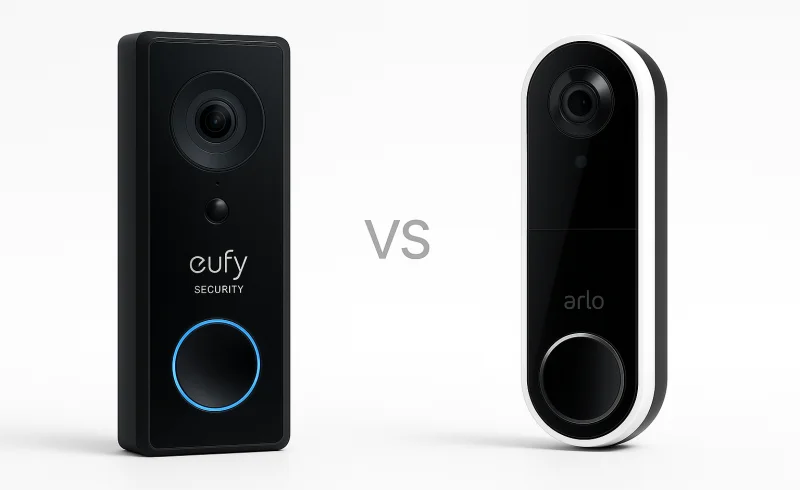
Discover the differences between the Eufy E340's dual-camera system with local storage and Arlo AVD4001's affordable 2K HDR features. Learn about their night vision capabilities, power options, installation requirements, and app experiences for informed decisi...
TL;DR
- If you want the best doorstep coverage with a second camera and zero monthly fees → choose eufy Security E340.
- If you want a capable 2K doorbell for under $50 and prefer a cloud-based security ecosystem → choose Arlo AVD4001.
- If you just need a reliable doorbell with minimal configuration → either works well, but eufy offers a more appliance-like experience out of the box.
The eufy E340’s dual-camera design (primary 2048×1536 + dedicated 1600×1200 ground lens) and color night vision deliver noticeably better visibility for packages and doorstep activity, all stored locally with no mandatory subscription. The Arlo AVD4001 undercuts it by roughly $100 and supports a wider voltage range (8–24V), but its single camera and infrared night vision can’t match the ground-angle advantage, and many of Arlo’s best features—like smart alerts and cloud recording—require an ongoing plan.
If you need deep integration with HomeKit Secure Video or a fully local NVR system, neither doorbell is ideal; consider a PoE model or a device that supports the protocol natively.
| Feature | Arlo AVD4001 | eufy Security E340 |
|---|---|---|
| Power | ||
| Battery design | Integrated rechargeable battery | Quick-release rechargeable battery pack |
| Power configuration | Battery-powered; optional hardwiring for continuous trickle charging | Battery-powered or hardwired |
| Battery required in wired mode | Yes | Yes |
| Existing doorbell wiring requirement | 8-24V AC | 16-24V AC, 10VA |
| Video | ||
| HDR | Yes | Yes |
| Two-way audio | Full duplex | Full duplex |
| Secondary camera | No secondary camera | 1600 x 1200 secondary camera |
| Night vision type | Infrared night vision | Color night vision |
| Primary video resolution | Up to 1944 x 1944 | 2048 x 1536 |
| General | ||
| Product type | Video doorbell | Video doorbell |
| Hub required for basic operation | No | No |
| Capacity | ||
| Battery capacity | 4730mAh | 5200mAh |
| Dimensions | ||
| Dimensions | 1.91 x 5.32 x 1.31 in (48.5 x 135.2 x 33.3 mm) | 5.4 x 2 x 1.1 in (138 x 50 x 27.5 mm) |
| Durability | ||
| Weather resistance | Weather-resistant | IP65 |
| Operating temperature | -4°F to 113°F (-20°C to 45°C) | -4°F to 122°F (-20°C to 50°C) |
| Connectivity | ||
| Wi-Fi | 2.4 GHz Wi-Fi | 2.4 GHz Wi-Fi (IEEE 802.11 b/g/n) |
| Compatibility | ||
| Digital chime support | Yes | No |
| Mechanical chime support | Yes | Yes |
📑 Table of Contents
Video & Image Quality
eufy Security E340 records at 2048 × 1536 on its primary camera and adds a 1600 × 1200 secondary camera aimed at the ground for package/doorstep coverage. That dual-camera design is purpose-built to keep the area right under the doorbell in frame—where packages and pets often fall outside a single camera’s view. It also supports HDR.
Arlo AVD4001 captures a square up to 1944 × 1944 image with HDR, and it’s positioned as a single-camera solution (there’s no secondary camera). The square frame can be practical for «head-to-toe» coverage without needing a second lens, especially when you want a balanced view of the visitor and the area immediately in front of them. However, it still can’t replicate the dedicated ground-angle perspective a second camera provides.
Conclusion: For doorstep/package monitoring specifically, eufy’s dual cameras (2048×1536 + 1600×1200) are a clear functional advantage over Arlo’s single 1944×1944 view.
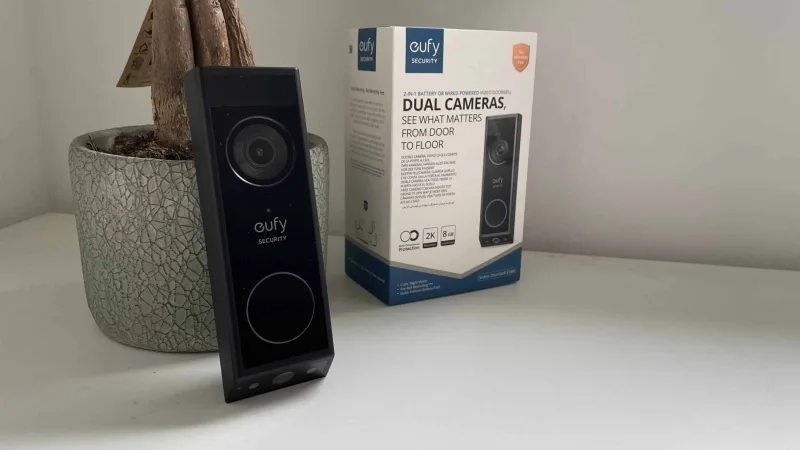
eufy Security E340 uses color night vision, which can preserve identifying details like clothing and package labels that often get lost in monochrome. In practice, color night vision can be especially valuable at the doorstep where subjects are close and lighting can be uneven (porch lights, sidelights, and shadows).
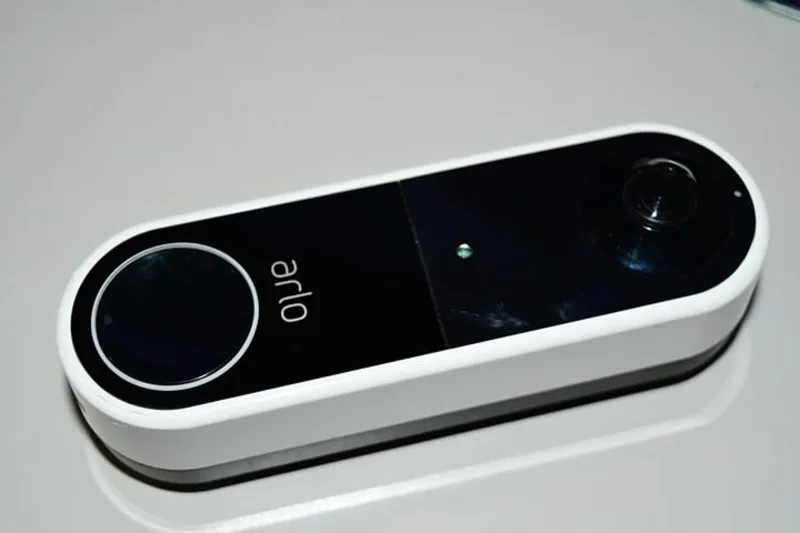
Arlo AVD4001 relies on infrared night vision, which is typically consistent in low light but renders scenes in black-and-white. That’s often enough for detecting a person and capturing motion reliably, but it generally provides less «at-a-glance» contextual detail than a good color night mode.
Conclusion: On night footage detail and context, eufy’s color night vision has the edge over Arlo’s infrared approach—assuming your porch lighting supports usable color.
eufy Security E340 includes full-duplex two-way audio, enabling talk/listen at the same time rather than taking turns. That matters for quick doorstep interactions (delivery instructions, confirming identity) where delays can create confusion.
Arlo AVD4001 also supports full-duplex two-way audio on paper, but some users note two-way audio issues (e.g., loud noise or no response). Even if not universal, it’s a relevant risk factor for a doorbell where audio is a core function.
Conclusion: Tie on specs (full-duplex on both), but eufy looks safer in practice given reported audio hiccups on the Arlo side.
Winner: eufy Security E340
Power & Battery Life
eufy Security E340 runs on a 5200mAh rechargeable battery and uses a quick-release battery pack, which makes it practical to keep a spare charged and swap it in minutes. It can also be hardwired, but it needs 16–24V AC (10VA) doorbell wiring to do so.
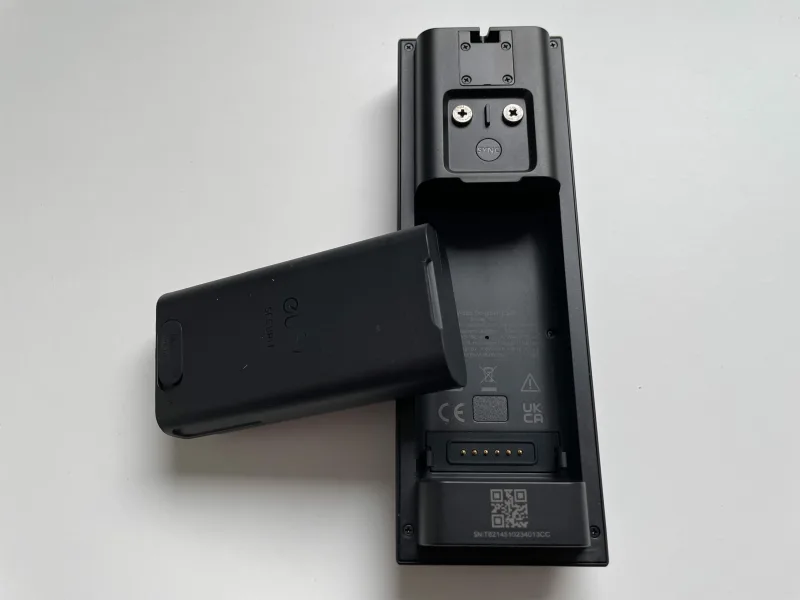
Arlo AVD4001 uses a 4730mAh integrated rechargeable battery, so recharging typically means taking the entire doorbell off the mount rather than swapping a pack. It supports optional hardwiring for continuous trickle charging and is compatible with a wider 8–24V AC range, and Arlo’s stated expectation is about 6 months of battery life under normal conditions.
Conclusion: For battery-centric ownership, eufy’s higher capacity (5200mAh vs 4730mAh) and quick-release design are a real usability advantage, especially if you don’t want downtime. Arlo’s edge is wiring flexibility (8–24V vs 16–24V) plus trickle-charging behavior, which can make it easier to integrate with older or lower-voltage doorbell transformers.
Winner: eufy Security E340
Installation & Compatibility
eufy Security E340 can be installed battery-powered or hardwired, but its existing-wiring requirements are narrower: it needs 16–24V AC and a transformer rated 10VA+. In practice, that means some older doorbell transformers may need upgrading before you can reliably use existing wiring.
Arlo AVD4001 is also battery-powered with optional hardwiring for continuous trickle charging, and it accepts a wider 8–24V AC range. That lower 8V minimum can make retrofits easier in older homes where doorbell circuits don’t meet newer transformer specs.
Conclusion: Arlo AVD4001 has the clearer compatibility edge on power because 8–24V AC vs 16–24V AC (10VA+) reduces the chances of needing electrical updates.
eufy Security E340 supports mechanical chimes but does not support digital chimes, and setup can require extra steps because the existing chime must be bypassed and the in-app chime option disabled for proper behavior. As a result, even when the wiring voltage is compatible, you may be doing more «retrofit work» than expected to get consistent ringing behavior.
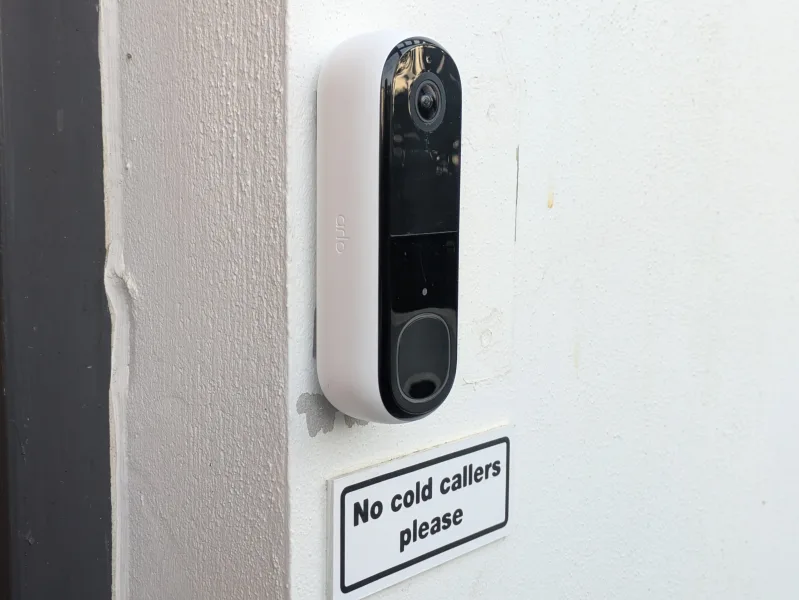
Arlo AVD4001 supports both mechanical and digital chimes, which reduces the odds you’ll need to rework your existing chime setup during installation. For many households, that broader chime compatibility is a practical time-saver and lowers install complexity.
Conclusion: Arlo AVD4001 wins on chime compatibility because it supports digital + mechanical chimes, while eufy E340 lacks digital chime support and may require bypassing the existing chime.
eufy Security E340 connects over 2.4 GHz Wi‑Fi and does not require a hub for basic operation. That aligns with a more device-first setup flow (add the doorbell, connect Wi‑Fi, mount, then tune motion), but note that some users report issues with live streaming and notifications, which can make Wi‑Fi quality and tuning more consequential.
Arlo AVD4001 also connects directly via 2.4 GHz Wi‑Fi with no hub required for basic operation. The setup is similarly app-guided, but tends to be more account- and permissions-oriented—especially if you’re plugging into Arlo’s broader «modes and rules» security structure.
Conclusion: Tie—both are hub-free 2.4 GHz Wi‑Fi doorbells, so compatibility here is more about your tolerance for each brand’s setup style than a hard spec advantage.
Winner: Arlo AVD4001
Smart Features & App Experience
eufy Security E340 is positioned as a local-first doorbell with no mandatory subscription, aiming for an «appliance-like» daily workflow: alerts, live view, talk, and event review without needing to opt into a service layer. It also adds practical capture features like pre-recording up to 120 seconds, which can help provide context before a motion event fully triggers. Some users note issues around live streaming, motion detection, and notifications not being received, which can undermine the «set it and forget it» promise when networks or settings aren’t dialed in.
Arlo AVD4001 offers free core functionality, but its experience is more explicitly cloud- and account-oriented, with a «security dashboard» feel built around modes/rules and (optionally) Arlo Secure features. This structure can be efficient in a multi-camera setup, but it also means the best experience may feel tied to plan choices and keeping settings aligned over time. Some users note two-way audio problems (e.g., loud noise or no response), which is particularly disruptive for a doorbell’s primary interaction feature.
Conclusion: eufy Security E340 has the edge for buyers who want smart features without ongoing fees and a simpler day-to-day app workflow, while Arlo AVD4001 fits users who value a system-style security app—especially if they already own Arlo devices—even if that often means leaning more on cloud services and settings complexity.
Winner: eufy Security E340
Build Quality & Durability
eufy Security E340 is explicitly rated IP65, meaning it has defined protection against dust and water jets—useful if your doorbell is mounted in a semi-exposed spot. It’s also specified to operate from -4°F to 122°F (-20°C to 50°C), giving it more headroom in hotter climates.
Arlo AVD4001 is described only as «weather-resistant» with no published IP rating in the provided specs, so you’re relying more on brand claims than a standardized ingress metric. Its operating range is -4°F to 113°F (-20°C to 45°C), which is slightly less tolerant of heat than the eufy on paper.
Conclusion: On measurable ruggedness, eufy Security E340 has the clearer durability case thanks to IP65 and a higher max operating temperature (122°F vs 113°F).
eufy Security E340 still benefits from careful placement: even with IP65, long-term exposure to direct rain and sun can accelerate wear, and the device may need occasional maintenance (like cleaning the lens area). The key practical point is that its protection level is stated and standardized, so you can assess risk more concretely.
Arlo AVD4001 similarly depends heavily on installation quality (angle, overhang coverage, and sun exposure), and its own documentation highlights that temperature extremes can affect performance within its -4°F to 113°F range. With «weather-resistant» as the durability claim, it’s harder to quantify how it compares in harsher installs.
Conclusion: Both require smart mounting choices, but eufy’s published IP rating reduces ambiguity, making it the safer pick when your doorbell will face tougher weather.
Winner: eufy Security E340
Value & Pricing
eufy Security E340 is positioned as a premium pick at $149.99 (Battery Powered) up to $169.99 (Black). At that price, you’re paying for tangible hardware upgrades like a dual-camera setup (including a 1600 × 1200 secondary camera) plus color night vision, which are features the spec sheet ties directly to better doorstep/package context. The higher upfront cost also aligns with the E340’s «self-contained» intent—more capability baked into the device rather than relying on add-on services.
Arlo AVD4001, by contrast, is dramatically cheaper at $49.75 (2nd Gen White) to $54.99 (White). Even at this entry pricing, it still checks key boxes like 2K-class video (up to 1944 × 1944) and HDR, which helps it avoid feeling «toy-grade» despite costing roughly a third of the eufy. The main value bet is that you get a functional 2K doorbell for minimal upfront spend.
Conclusion: Arlo AVD4001 clearly wins on upfront price—it’s about $95–$120 less than the eufy E340, a meaningful gap for budget-focused buyers.
eufy Security E340 can justify its premium if you specifically value hardware that reduces compromises at the doorstep: the secondary 1600 × 1200 camera adds a dedicated close-up view, and color night vision aims to preserve detail that infrared can lose. In other words, the extra money is paying for coverage and context, not just a minor resolution bump (its primary camera is 2048 × 1536).
Arlo AVD4001 offers fewer hardware «extras» (notably no secondary camera and infrared night vision), but its low buy-in cost makes it easier to deploy as part of a broader system—especially if you already use Arlo devices. Editor notes also flag that Arlo’s experience is often «shaped by the plan,» meaning some of the platform’s best features can be subscription-tied, which may affect perceived value depending on how you intend to use it.
Conclusion: eufy E340 has the stronger feature-per-dollar argument if you care about package/threshold visibility and subscription avoidance, but Arlo AVD4001 remains the better pure bargain if your priority is getting a capable 2K doorbell for the least money.
Winner: Arlo AVD4001
The Bottom Line
After breaking down video, power, compatibility, software, durability, and value, the choice comes down to whether you’re prioritizing hardware-driven coverage and independence—or a low-cost entry into a broader platform.
Best for Budget Shoppers: The Arlo AVD4001 is the easy pick thanks to its sub-$55 pricing while still delivering 2K-class video with HDR.
Best for Subscription-Free Users: The eufy Security E340 is the clear recommendation because it runs fully without a subscription, with local event storage and free alerts.
Best for Monitoring Packages: The eufy Security E340 wins on its dual-camera design, with a dedicated downward-facing lens that’s purpose-built for package and doorstep activity.
Best for Multi-Camera Ecosystems: The Arlo AVD4001 makes the most sense if you’re already in Arlo’s system, where its app integration, modes, and rules are the main advantage.
Overall, the eufy Security E340 is the stronger doorbell on the fundamentals this comparison prioritized—dual-camera package coverage, color night vision, subscription-free operation, a quick-release battery, and clearer durability specs—while the Arlo AVD4001 still leads on upfront cost and install friendliness (wider wiring and chime compatibility).
If video versatility and avoiding subscriptions matter most, go with the eufy Security E340; if price is your primary concern and you don’t mind leaning more on a subscription-centric ecosystem, the Arlo AVD4001 delivers excellent value.
FAQ
Which doorbell has better video quality?
Do I need a subscription for either doorbell?
Which is easier to install?
Which doorbell has longer battery life?
Can I hardwire these doorbells?
Are there any common issues with the eufy E340's performance?
How is the two-way audio on the Arlo AVD4001?
Which doorbell is more weather-resistant?
"Images are used for editorial and informational purposes only. All trademarks and images belong to their respective owners."