
ECOVACS WINBOT W2 PRO OMNI vs HUTT S7: Cordless Convenience or Scrubbing Performance?
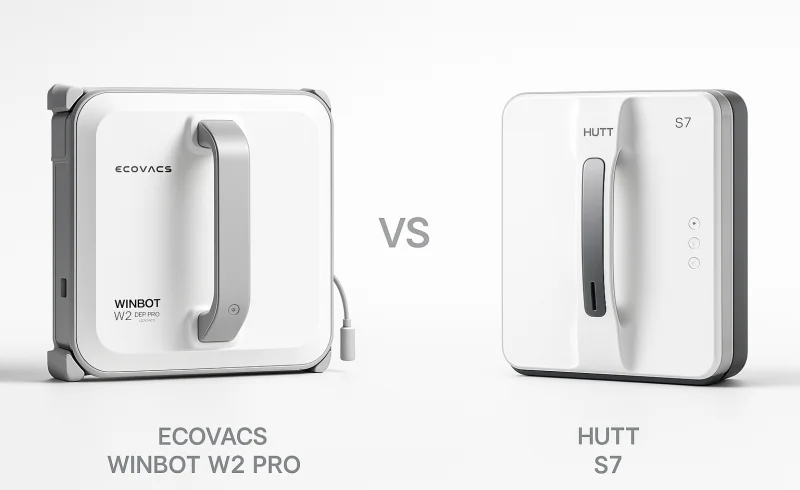
Explore the differences between the ECOVACS WINBOT W2 PRO OMNI and the HUTT S7 window-cleaning robots. The ECOVACS offers true cordless operation for extended sessions, while the HUTT delivers superior scrubbing performance with dual rotating pads.
TL;DR
- If you want a self-contained, multi-room workflow without cable management → choose ECOVACS WINBOT W2 PRO OMNI
- If you prioritize raw cleaning power for large, stubborn windows and prefer hands‑on offline control → choose HUTT S7
- If you only clean one or two small panes occasionally → either works, but neither will replace a manual deep clean.
The ECOVACS wins on autonomy with true cordless operation (up to 110 minutes / 55 m²) and a more guided, app‑supported process that reduces decision fatigue when moving between surfaces. The HUTT counters with stronger scrubbing—6500 Pa suction and dual 70 RPM rotating pads—plus a lighter build (1.18 kg) and physical remote control, but it requires a constant power cord and a disciplined routine to get consistent results.
If you expect completely hands‑off cleaning with perfect edges and zero pre‑work or touch‑ups, look instead at a professional window‑cleaning service.
| Feature | HUTT S7 | ECOVACS WINBOT W2 PRO OMNI |
|---|---|---|
| Power | ||
| Operation mode | Plugged-in operation with backup battery | Battery-powered operation / plugged-in operation |
| Power-off protection | Up to 25 min suction | 30 min |
| Cordless cleaning support | Not supported | Supported |
| Safety | ||
| Safety rope load rating | Up to 148 kg | Up to 100 kg |
| Control | ||
| Physical remote control | Included | Absent |
| General | ||
| Product type | Window cleaning robot | Window cleaning robot |
| Navigation system | SLAM 4.0 | WIN-SLAM 4.0 |
| Minimum glass size | >30 x 30 cm | 30 x 40 cm |
| Auto return to start | Yes | Yes |
| Capacity | ||
| Liquid tank capacity | Dual 110 ml water tanks | 230 ml cleaning solution reservoir |
| Dimensions | ||
| Product weight | 2.6 lb | 1.6±0.1 kg |
| Product dimensions | 13.9 x 7.3 x 8.6 in | 271 x 271 x 77 mm |
| Performance | ||
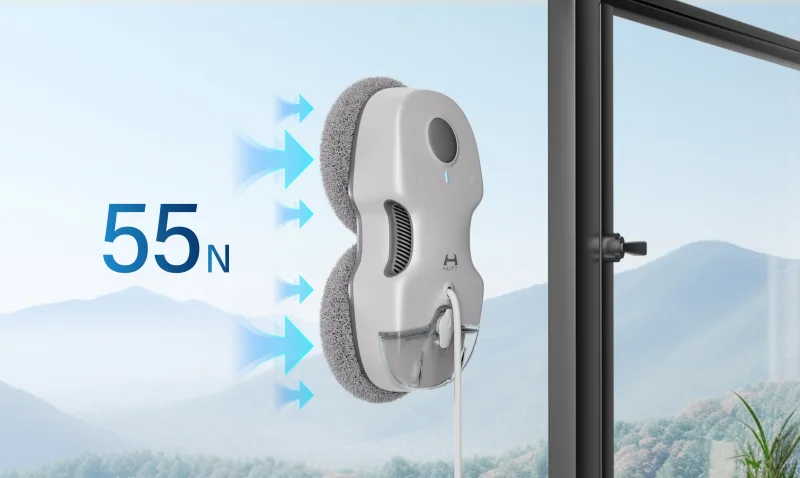
| Suction power | 6500 Pa | 5500±500 Pa (standard cleaning performance) |
| Spray technology | V-shape wide air-pressurized water spraying | Three-nozzle wide-angle spray atomization |
| Cleaning pad system | Two independently driven pads, 70 RPM | Wet mop pad |
📑 Table of Contents
Cleaning Performance
Adhesion & grime-handling (suction)
ECOVACS WINBOT W2 PRO OMNI is rated at 5500±500 Pa suction in standard cleaning performance. That’s a strong baseline for maintaining adhesion while it traverses glass, but the spec leaves a fairly wide variance band (down to ~5000 Pa). In practice, suction is only one part of «cleaning,» but it sets the ceiling for how confidently the robot can keep contact while dragging a wet pad over dusty or slightly uneven areas.
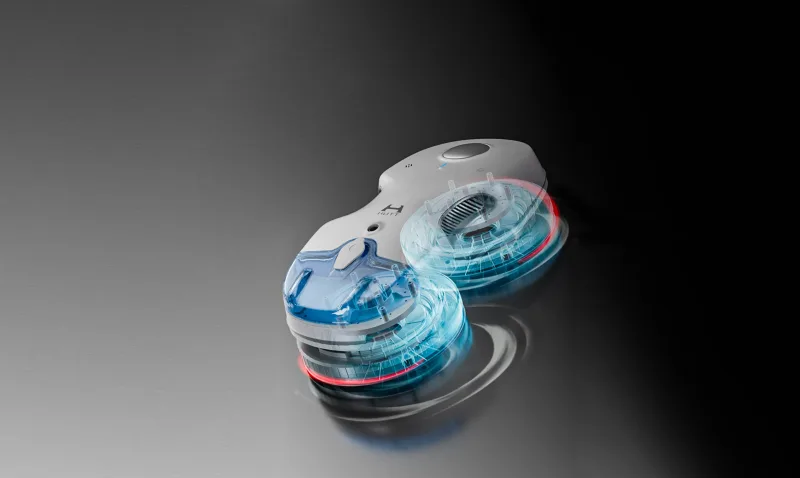
HUTT S7 is rated higher at 6500 Pa suction. That extra headroom can matter when the pads start loading up with residue or when glass has more friction (light mineral deposits, drier sections), because the robot has more margin to maintain seal and consistent contact pressure.
Conclusion: On pure suction and adhesion headroom, HUTT S7 has the edge (6500 Pa vs 5500±500 Pa), which is a meaningful advantage for tougher or less-uniform glass conditions.
Scrubbing action (pad system)
ECOVACS WINBOT W2 PRO OMNI uses a wet mop pad approach rather than an explicitly specified rotating dual-pad scrubbing system. This tends to align with maintenance cleaning—lifting fresh dust and light film—but it generally relies more on chemical help and repeat passes to break stubborn spots. As with most window robots, you should still expect occasional edge touch-ups on real windows with frames and seams.
HUTT S7 uses two independently driven pads rotating at 70 RPM, explicitly designed to «simulate hand-wiping motion.» A dual, driven pad system typically applies more active agitation than a passive mop-style wipe, which can translate into better removal of stuck-on grime and more consistent results on larger panes when you want the robot to «do the laps.»
Conclusion: For mechanical scrubbing, HUTT S7 wins thanks to its dual independently driven 70 RPM pads versus ECOVACS’ wet mop pad concept.
Wetting coverage & spray delivery
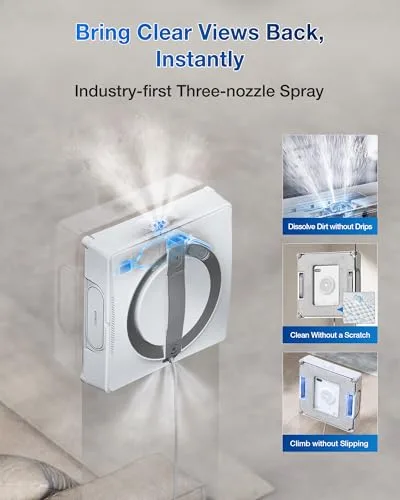
ECOVACS WINBOT W2 PRO OMNI uses three-nozzle wide-angle spray atomization, emphasizing even distribution and controlled misting. This can help reduce drips while keeping the pad supplied, which matters for streak control during maintenance cleaning. The approach is also consistent with ECOVACS’ more «appliance-like» workflow, where repeatability is prioritized across multiple relocations and sessions.
HUTT S7 uses V-shape wide air-pressurized water spraying, which is aimed at broader coverage in front of the cleaning path. With air pressurization and a V-pattern, the intent is to wet a wider swath so the rotating pads have more consistently conditioned glass to work on—useful when tackling larger panes or when you want fewer dry patches mid-run.
Conclusion: Both systems target coverage, but they optimize differently: HUTT S7’s V-shape pressurized spray pairs better with aggressive pad scrubbing, while ECOVACS’ three-nozzle atomization favors controlled, even misting. Advantage: HUTT S7 if you prioritize loosening and lifting more stubborn grime; ECOVACS if drip control is your main concern.
Cleaning fluid flexibility (ongoing performance consistency)
ECOVACS WINBOT W2 PRO OMNI has a 230 ml cleaning solution reservoir, but guidance indicates you should use WINBOT Cleaning Solution for optimal performance and that other solutions may damage the unit. That can improve consistency when you follow the intended chemistry, but it can also add cost/lock-in and reduces flexibility if you already have a preferred glass cleaner routine.
HUTT S7 uses dual 110 ml water tanks and is positioned around water-based spraying rather than a proprietary solution requirement. While you may still need pre-cleaning for oily film or seasonal deep cleans (a real limitation for both robots), a water-first design can make it simpler to keep the robot ready for frequent maintenance passes.
Conclusion: For fluid flexibility and low-friction refills, HUTT S7 has the advantage (dual 110 ml water tanks vs ECOVACS’ 230 ml solution reservoir with a recommended proprietary formula).
Winner: HUTT S7 — higher suction (6500 Pa), more active scrubbing (dual 70 RPM pads), and a spray system designed to feed that agitation give it a clearer performance advantage when «clean» means more than just dust removal.
Power & Autonomy
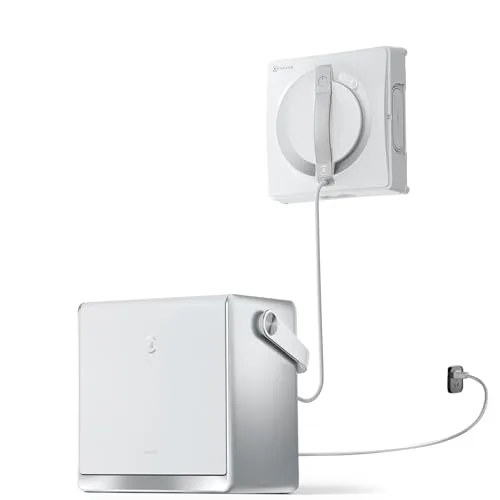
ECOVACS WINBOT W2 PRO OMNI is designed to run in two power modes: battery-powered or plugged-in, which enables genuinely cordless cleaning when you don’t want a cable trailing across frames or between rooms. A full charge is rated for up to 110 minutes of cleaning, or about 55 m² of coverage, which is substantial for multi-window sessions before needing a recharge. For safety and continuity, it also lists 30 minutes of power-off protection.
HUTT S7, by contrast, is primarily a plugged-in window robot with a backup battery rather than a cordless-first model. Its emergency battery is rated for 25 minutes of runtime during sudden power failure, aligning with the spec claim of up to 25 minutes suction for power-off protection. The spec sheet also explicitly notes cordless cleaning is not supported, which limits flexibility if your outlets are inconveniently placed or you’re moving across many panes.
Conclusion: On power and autonomy, ECOVACS has the clear functional advantage: true cordless support plus 110 minutes/55 m² is a different class of mobility than plugged-in operation with a 25-minute emergency battery on the HUTT. Winner: ECOVACS WINBOT W2 PRO OMNI.
Ease of Use & Workflow
Setup & onboarding (how «forgiving» the first run is)
ECOVACS WINBOT W2 PRO OMNI is built around a more guided workflow: it supports battery-powered or plugged-in operation, and the manufacturer explicitly calls out pre-run steps like charging until the safety battery is full. It also requires users to lock the safety tether to a strong indoor anchor point before use, reinforcing a structured, checklist-like start.
HUTT S7 leans more «tool-like» in setup, with fully offline operation and all controls available via physical buttons, which can reduce account/app friction. However, that also means fewer guardrails in the process; you’re more responsible for correct starting placement, pad condition, and cable management to avoid edge misses and inconsistent adhesion.
Conclusion: ECOVACS has the edge for onboarding and first-run recoverability, especially for households that want a repeatable, guided process; HUTT is simpler if you specifically want offline control, but it’s less forgiving when you rush setup.
Session workflow (moving room-to-room, managing refills and re-wetting)
ECOVACS WINBOT W2 PRO OMNI is better aligned to multi-surface cleaning sessions because it can run cordlessly and is specced for up to 110 minutes / 55 m² on battery (retailer claim), which supports a «place → run → relocate → run» cadence. Its 230 ml reservoir and three-nozzle wide-angle spray atomization also point toward fewer interruptions to re-wet compared with smaller, split tanks.
HUTT S7 is designed around a more hands-on routine: it’s plugged-in operation with a backup battery, and cordless cleaning is not supported, so your workflow is constrained by cable reach and outlet planning. Its liquid system is listed as dual 110 ml tanks (220 ml total), which is close to ECOVACS’ capacity, but the more manual, offline orientation tends to reward users who follow a consistent personal process on large panes rather than frequent repositioning.
Conclusion: For «clean a lot of glass in one go,» ECOVACS is meaningfully easier to live with thanks to true cordless support and long claimed battery runtime; HUTT can work well on big, predictable panes, but the plug-in-first workflow adds friction when moving between windows.
Controls philosophy (app dependence vs physical control)
ECOVACS WINBOT W2 PRO OMNI behaves more like an appliance ecosystem product: the broader ECOVACS app platform typically provides more structured device management and guidance, but it also means some of the experience is inherently app-mediated. That can be an advantage for clarity (status, prompts, error recovery), but it’s not ideal if you want zero software involvement.
HUTT S7 includes a physical remote control and is described as fully offline, with controls available through physical buttons—useful if you prefer direct control or have unreliable Wi‑Fi where you clean. The trade-off is that offline-first control doesn’t inherently make cleaning more automatic; it mainly reduces software dependency while placing more responsibility on user technique.
Conclusion: Neither approach is universally better: HUTT wins for offline/physical control, while ECOVACS wins for a more guided, app-supported workflow that tends to reduce «what do I do next?» moments.
Winner: ECOVACS WINBOT W2 PRO OMNI — it offers a more consistently low-friction workflow overall (notably cordless support and a more guided process), while HUTT’s main ease-of-use advantage is specifically for buyers who prioritize offline, physical controls over structured guidance.
Safety & Build Quality
ECOVACS WINBOT W2 PRO OMNI rates its safety rope for up to 100 kg, which is a solid baseline for preventing a drop if suction fails. It also includes power-off protection for 30 minutes, buying time to recover the robot after an outage.
HUTT S7, by comparison, specifies a higher tether load rating of up to 148 kg. Its backup battery is rated for up to 25 minutes of suction on power loss, which is slightly shorter than ECOVACS’ 30 minutes.
Conclusion: HUTT’s higher tether rating (148 kg vs 100 kg) is the clearer safety advantage, while ECOVACS counters with longer power-off protection (30 min vs 25 min).
ECOVACS WINBOT W2 PRO OMNI weighs 1.6±0.1 kg, which can make it feel less taxing to place and reposition across multiple windows. It also supports battery-powered operation and plugged-in operation, which can reduce cable handling during setup.
HUTT S7 is listed at 2.6 lb (1.18 kg), making it lighter on paper than ECOVACS. However, it’s plugged-in with backup battery (no cordless cleaning support), so cable management remains part of the safety routine.
Conclusion: HUTT is lighter (1.18 kg vs 1.6 kg), but ECOVACS is more flexible in use thanks to true battery mode.
ECOVACS WINBOT W2 PRO OMNI relies on its in-device/app workflow rather than a dedicated handheld controller (physical remote: absent). For safety basics, it still supports auto return to start: Yes, which can reduce risky manual intervention on tall panes.
HUTT S7 includes a physical remote control, and SoT notes it can operate fully offline with controls available through physical buttons. That can be a practical safety/control benefit when you want immediate inputs without depending on an app session.
Conclusion: HUTT’s physical remote/offline control is the more robust «in-the-moment» control setup, even though both offer auto-return.
Winner: HUTT S7
Software & Controls
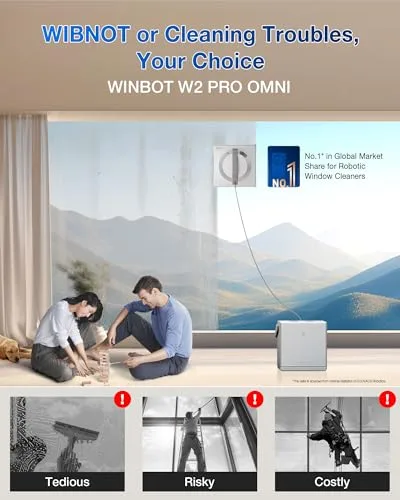
ECOVACS WINBOT W2 PRO OMNI leans into an app-driven experience, which (per editor context) typically means more structured onboarding, clearer step-by-step setup flows, and fewer «what do I do next?» decisions during a multi-window session. That maturity also tends to translate into a more consistent support pipeline over time, since ECOVACS operates a larger ecosystem with a clearer history of firmware/app iteration. In practice, this better matches users who want repeatable operation when moving room-to-room.
HUTT S7, by contrast, is explicitly fully offline with all functions handled via physical buttons, and it also includes a physical remote control (where ECOVACS’ remote is absent). That makes it appealing if you want to avoid accounts, connectivity, or app UX entirely, and it can feel more immediate for manual steering or spot work. The trade-off (per editor context) is fewer guardrails: users may need to rely more on their own routine for starting placement, pad condition, and recovery when conditions aren’t ideal.
Comparative conclusion: On pure control flexibility and «no-app» simplicity, HUTT S7 has the edge thanks to offline operation and an included remote. But for most households—especially where multiple people will use it—ECOVACS’ more guided, mature app workflow is the more defensible advantage because it reduces setup friction and is more likely to receive ongoing software/support refinement.
Winner: ECOVACS WINBOT W2 PRO OMNI
The Bottom Line
After digging into cleaning hardware, autonomy, and day-to-day workflow, the choice comes down to whether you value maximum scrubbing performance or a smoother, more portable cleaning routine.
Best for multi-surface cleaning & convenience: The ECOVACS WINBOT W2 PRO OMNI is the better pick thanks to true cordless operation (up to 110 minutes/55 m²) and a more guided, repeatable workflow when moving room-to-room.
Best for large, single-surface deep cleaning: The HUTT S7 wins when raw cleaning muscle matters, pairing higher suction (6500 Pa) with dual independently driven 70 RPM pads for more aggressive mechanical scrubbing—if you’re fine with plug-in-first use.
Best on a budget: The ECOVACS WINBOT W2 PRO OMNI (Gray) is the easy value choice at $189, combining cordless capability and app support versus the HUTT’s higher $269 pricing and limited availability.
For most buyers,
—it’s simply easier to live with, balancing solid cleaning with cordless autonomy and a user-friendly, low-fuss workflow. The trade-off is that HUTT S7 still does better on pure cleaning performance, with stronger suction headroom and more active scrubbing hardware.If you want the least friction across multiple windows and sessions, go ECOVACS; if your priority is maximum scrubbing on big panes and you don’t mind managing the tethered setup, the HUTT is the specialist pick.
FAQ
Can these robots clean both inside and outside windows?
Do I need to pre-clean windows before using the robot?
How often do cleaning pads need replacement?
Does the HUTT S7 have higher suction than the ECOVACS WINBOT W2 PRO OMNI?
Can the HUTT S7 be used cordlessly?
How long does the emergency battery last on the HUTT S7?
What is the tether load rating for each robot?
Do these robots require a specific cleaning solution?
"Images are used for editorial and informational purposes only. All trademarks and images belong to their respective owners."