
ECOVACS DEEBOT N30 OMNI vs eufy Omni C20: Automation, Mopping, and Low-Clearance Trade-Offs
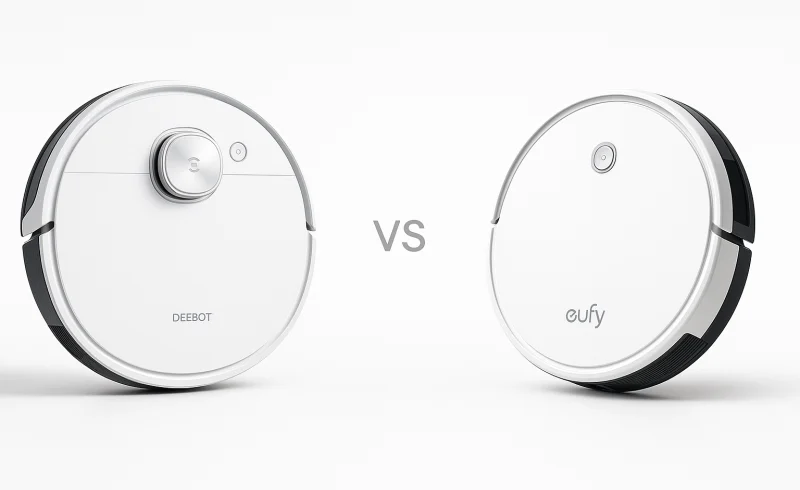
Explore the differences between the ECOVACS DEEBOT N30 OMNI and eufy C20 robot vacuums. This guide covers suction power, battery life, docking reliability, and long-term maintenance to help you choose the best fit for your home cleaning needs.
TL;DR
- For larger homes, frequent mopping, and stronger obstacle handling → ECOVACS DEEBOT N30 OMNI
- For low furniture and mostly hard-floor spaces where robot height matters → eufy Omni C20
- For homes with cables, toys, or other small objects regularly left on the floor → N30 OMNI is the safer fit
- For thick carpet or heavy embedded pet hair → neither is an obvious specialist
The headline numbers—10,000 Pa for the N30 OMNI versus 7,000 Pa for the C20—tell only part of the story. Suction ratings are manufacturer measurements and are not a standardized cross-brand measure of actual debris pickup. The more consequential differences are elsewhere.
The N30 OMNI has a 5200 mAh battery, 40°C hot-air mop drying, larger water tanks, TruEdge extending mopping, and laser-based obstacle avoidance. The C20 counters with an unusually slim 85 mm (3.35-inch) body, a somewhat larger 3.1 L dust bag, and a smaller station.
The biggest weakness in the C20 is easy to miss on a specification sheet: it has no onboard mopping water reservoir. Its station wets the pads, and the robot must return to the dock to refresh them. Independent testing by RTINGS found that this limits stain-cleaning consistency. The C20 also lacks the kind of active object-avoidance system that helps a robot deal with cords and other small hazards.
| Feature | eufy C20 | ECOVACS DEEBOT N30 OMNI |
|---|---|---|
| Power | ||
| Charging Time | 5-6 h | 6.5 h |
| Battery Capacity | 3200 mAh | 5200 mAh |
| General | ||
| Product Type | Robot vacuum and mop | Robot vacuum and mop |
| Robot Height | 3.35 in | 104 mm |
| Mopping | ||
| Mop Drying Type | Room-temperature air drying | 40°C hot air drying |
| Auto-Lifting Mop | Supported | Supported |
| Automatic Mop Washing | Yes | Yes |
| Station | ||
| Dust Bag Capacity | 3.1 L | 2.6 L |
| Self-Empty Station | Yes | Yes |
| Clean Water Tank Capacity | 2.5 L | 3.5 L |
| Dirty Water Tank Capacity | 2.4 L | 3 L |
| Navigation | ||
| No-Go Zones | Supported | Supported |
| Navigation Technology | iPath Laser Navigation / point laser technology | Laser navigation / TrueMapping 2.0 |
| Connectivity | ||
| Companion App | eufy Clean app | ECOVACS HOME App |
| Wi-Fi Connectivity | Supported | Supported |
| Cleaning Performance | ||
| Suction Power | 7,000 Pa | 10,000 Pa |
| Anti-Tangle System | Pro-Detangle Comb | ZeroTangle 2.0 |
📑 Table of Contents
- Vacuuming: Don't Treat the Pa Number as a Test Score
- Mopping: The Dock Architecture Matters More Than It First Appears
- Carpet Handling
- Navigation and Obstacles: One of the Biggest Differences
- The C20's Real Advantage: It Fits Where the N30 Cannot
- Battery Life
- Dock Capacity and Day-to-Day Attention
- App and Controls
- Long-Term Ownership
- Which One Fits Which Home?
- The Bottom Line
- FAQ
Vacuuming: Don't Treat the Pa Number as a Test Score
N30 OMNI: more suction headroom, but 10,000 Pa is not a guarantee
ECOVACS rates the DEEBOT N30 OMNI at 10,000 Pa, while eufy rates the Omni C20 at 7,000 Pa.
That gives the N30 a higher maximum suction specification, but Pa figures from different manufacturers are not directly interchangeable with cleaning scores. Brush design, airflow, floor contact, navigation, and how much debris the side brush scatters can all change the result.
The independent TechHive review found the N30 effective with cat hair, litter, and fine debris, while also noting that its brush could scatter some larger particles on hard floors.
The C20 presents the opposite kind of caution. Its 7,000 Pa rating sounds lower, but independent RTINGS testing found strong debris pickup on bare floors. Carpet was less convincing: fine material embedded in carpet fibers was harder for it to remove, and pet hair could require repeated passes.
What this means in practice: the N30 has the stronger hardware specification and is the more convincing option for mixed flooring, but neither robot's Pa rating should be used as a standalone prediction of carpet performance.
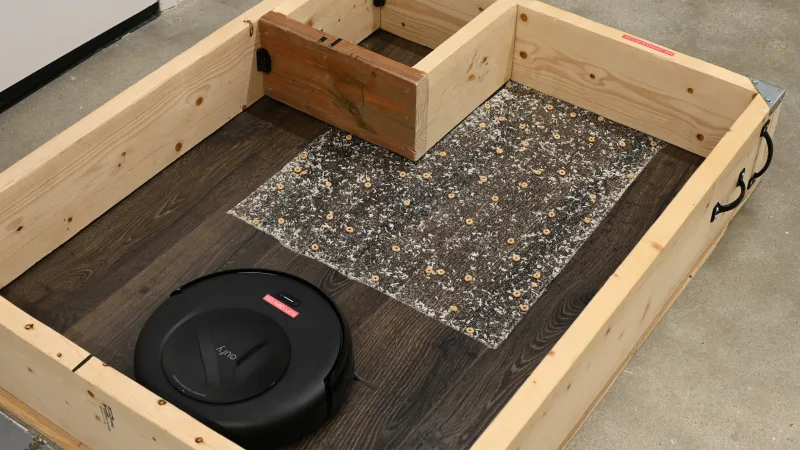
Hair management
The two robots attack brush wrap differently.
The N30 OMNI uses ECOVACS ZeroTangle 2.0, which reshapes the brush and hair path to reduce strands winding around the roller. TechHive reported that long hair and threads did not require manual removal during its testing, though that does not eliminate the need to inspect the brush over time.
The C20 uses eufy's Pro-Detangle Comb, a comb mechanism intended to strip hair from the roller automatically. It can reduce manual brush cleaning, but it does not change the C20's underlying carpet limitations: RTINGS found its pet-hair pickup acceptable rather than exceptional, particularly when hair was embedded deeper in carpet.
Edge: N30 OMNI, primarily because its independently reported hair handling is paired with stronger overall carpet-oriented hardware.
Mopping: The Dock Architecture Matters More Than It First Appears
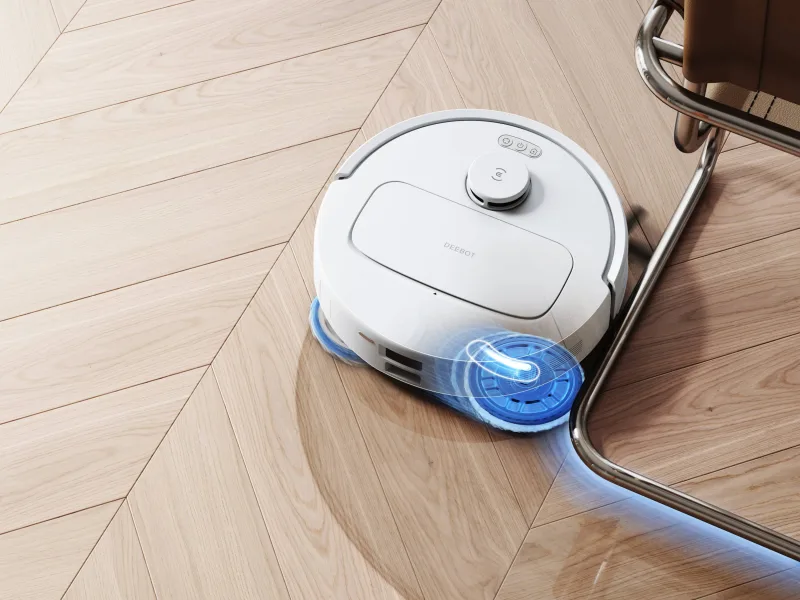
Both models use two rotating mop pads, automatically wash those pads at the station, and lift them when carpet is detected. That makes them look similar on a feature checklist. Their actual mopping systems are not equivalent.
N30 OMNI: better suited to repeated whole-home mopping
The N30 OMNI combines rotating pads with TruEdge, which moves one mop outward to reach closer to walls and furniture edges.
Its station carries:
- 3.5 L clean-water tank
- 3.0 L dirty-water tank
- 2.6 L dust bag
- automatic mop washing
- 40°C hot-air mop drying
The 40°C figure refers to drying, not mop washing. The standard N30 OMNI washes its pads with unheated water. That distinction matters because some higher-tier stations use heated wash water as a separate feature.
Hot-air drying is still useful. Damp pads spend less time sitting wet inside the dock between cleaning cycles, particularly when the robot mops frequently.
TechHive found the N30's mopping useful but not flawless. On particularly dirty hard floors, the reviewer preferred vacuuming first rather than expecting the robot to deal with loose dirt and wet cleaning simultaneously.
C20: clever compact hardware with an important water limitation
The C20's station provides:
- 2.5 L clean-water tank
- 2.4 L dirty-water tank
- 3.1 L dust bag
- automatic mop washing
- room-temperature air drying
eufy specifies 180-rpm rotating pads with 6 N of downward pressure under its Mop Master system.
The problem is not the spinning mechanism. It is water delivery.
The C20 does not carry an internal water reservoir for mopping. The station wets the pads before the robot leaves, and the C20 periodically depends on returning to the dock to refresh them. RTINGS found that this arrangement contributed to inconsistent moisture and weak stain-removal performance compared with robots that can continually manage water while away from the station.
That also makes the C20 unusually dependent on its dock despite its simpler-looking design.
Edge: N30 OMNI. The larger tanks, onboard wet-cleaning architecture, extending edge mop, and heated drying system make it the more complete mopping platform.
Carpet Handling
Both robots can detect carpet and raise their mop assemblies.
ECOVACS specifies approximately 9 mm of mop lift for the N30 OMNI. eufy specifies 10.5 mm for the C20.
Those numbers should not be interpreted as permission to send either robot across every rug. Mop lift is most useful for low-pile carpet and short rugs. With thicker carpet, long fibers can still contact the pads or interfere with movement.
Vacuum performance is another issue. RTINGS found the C20 competent with larger debris on carpet but less effective with fine particles embedded in the fibers. The N30 has the higher suction specification, and TechHive reported good results on soft carpet, but even a 10,000 Pa robot is not equivalent to a strong upright or cordless vacuum for deeply embedded material.
For a home dominated by plush carpet, neither model's dock features solve the fundamental limitations of this robot-vacuum class.
Edge: N30 OMNI, but mainly for mixed hard-floor/carpet homes rather than deep-pile carpet.
Navigation and Obstacles: One of the Biggest Differences
The original comparison between these robots becomes misleading if both are simply described as "laser navigation" models.
They both map with laser-based systems, but their ability to react to objects is different.
N30 OMNI
The N30 OMNI uses TrueMapping 2.0 for mapping plus ECOVACS' laser obstacle-avoidance hardware.
That does not make it immune to cables or awkward furniture. TechHive recorded one incident involving an appliance cord. In the same review, however, the robot generally reacted well to moved furniture and other objects without repeatedly colliding with them.
The app supports mapped rooms, cleaning zones, virtual boundaries, and No-Go Zones.
C20
The C20 uses a static laser mapping sensor, an unusual arrangement that helps keep the robot extremely thin. Instead of having a conventional raised spinning LiDAR turret, it can map while maintaining an 85 mm body height.
There is a trade-off.
RTINGS found the C20's obstacle handling poor. It can bump into furniture, struggle with rugs and tassels, and does not provide the kind of active small-object avoidance found on more sophisticated robots.
That matters much more than a minor app difference. In a home where charging cables, socks, children's objects, or pet accessories are regularly left on the floor, preparation before a scheduled run becomes part of living with the C20.
Edge: N30 OMNI.
The C20's Real Advantage: It Fits Where the N30 Cannot
The strongest argument for the C20 has little to do with suction or software.
The eufy Omni C20 is only 85 mm (3.35 inches) tall.
The N30 OMNI is 104 mm (4.09 inches) tall.
A difference of roughly 19 mm, or three-quarters of an inch, can decide whether a robot cleans underneath a sofa, cabinet, or bed—or never enters that area at all.
That is not a cosmetic specification. Low-clearance furniture is one of the few places where a robot vacuum can meaningfully eliminate a cleaning task that is otherwise awkward to do manually.
The C20's station is also relatively compact at approximately 330 × 289 × 460 mm. ECOVACS lists the N30 OMNI station at 340 × 485 × 540 mm including its detachable base.
Actual placement still requires open space around the dock, but the C20 is easier to accommodate when floor space is constrained.
Edge: C20, decisively, for low furniture and tighter living spaces.
Battery Life
The N30 OMNI has a 5200 mAh battery. ECOVACS rates it for up to 320 minutes in quiet, vacuum-only operation, while TechHive cites up to 220 minutes for standard vacuum-and-mop operation. The same review says a full charge can take approximately 6.5 hours.
The C20 uses a 3200 mAh battery.
Battery capacity should not be converted directly into expected runtime because the two robots have different motors, electronics, navigation behavior, and cleaning modes. The important point is that the N30 has substantially more stored energy and published runtime figures that make it better suited to longer uninterrupted jobs.
This matters less in a small apartment, where either robot may finish before battery capacity becomes relevant. It matters more when several rooms are being vacuumed and mopped in one session.
Edge: N30 OMNI.
Dock Capacity and Day-to-Day Attention
The capacity comparison is unusually balanced.
N30 OMNI
- Clean water: 3.5 L
- Dirty water: 3.0 L
- Dust bag: 2.6 L
C20
- Clean water: 2.5 L
- Dirty water: 2.4 L
- Dust bag: 3.1 L
The N30 therefore gives more buffer for water-heavy routines. The C20 provides more dust-bag volume.
The difference in dust-bag size is unlikely to matter as often as the water-capacity difference in a home where mopping runs several times per week. Bag fill rate also varies dramatically with pets, carpet, floor area, and how much debris the robot collects.
Dirty-water tanks deserve particular attention on either model. Automatic mop washing does not make the station self-maintaining: dirty water still has to be emptied, tanks rinsed, the wash tray cleaned, and consumable parts replaced as they wear.
App and Controls
Both robots provide the expected app-based functions: maps, room or zone cleaning, schedules, suction settings, and restricted areas.
The ECOVACS HOME app exposes a broad set of cleaning and map controls. The N30 also supports third-party voice control including Alexa and Google Assistant.
The eufy Clean app likewise supports map-based cleaning, carpet behavior, suction modes, water-flow settings at the station, schedules, and voice-assistant integration.
There is not enough consistent evidence to characterize one app as inherently "simpler," "more reliable," or "more forgiving." Firmware and app behavior can also change over the lifetime of either product.
The more useful distinction is hardware-driven: the N30 has better obstacle-handling capability, while the C20's thin static-laser design gives it access to lower spaces.
Result: no clear app winner.
Long-Term Ownership
Neither station eliminates maintenance
"Automatic" on both products means that several repetitive jobs move from the robot to the dock. It does not mean maintenance disappears.
Expect to deal with:
- dirty-water disposal
- clean-water refills
- mop-pad cleaning or replacement
- station-tray cleaning
- brush and side-brush inspection
- filter maintenance
- dust-bag replacement
- sensor and charging-contact cleaning
Hair-detangling systems reduce one particular chore, but neither manufacturer says the brush can simply be ignored indefinitely.
C20 is especially dependent on returning to its station
The C20's 250 ml onboard dustbin is small, and its lack of an onboard mopping water reservoir means the dock is fundamental to both debris disposal and sustained mopping.
That makes the description of the C20 as a "less automation-dependent" robot inaccurate. It is actually a highly dock-dependent design.
Its advantage is different: the robot and station are physically compact.
N30's automation is more self-contained
The N30's larger water system, onboard mopping architecture, hot-air drying, bigger battery, and obstacle avoidance make it better suited to longer multiroom routines with fewer returns caused specifically by mop rewetting.
It still needs a sensible dock location and a reasonably navigable floor plan.
Which One Fits Which Home?
Mostly hard floors, frequent mopping, several rooms
ECOVACS DEEBOT N30 OMNI
Its larger water tanks, TruEdge mopping, 40°C pad drying, longer documented runtime, and stronger obstacle handling all become more useful as the cleaning area grows.
Sofa or bed with very little clearance
eufy Omni C20
An 85 mm robot can reach spaces the 104 mm N30 simply cannot enter. Measure the furniture clearance before treating this as a minor specification.
Cables, toys, socks, and clutter often remain on the floor
ECOVACS DEEBOT N30 OMNI
Its obstacle-avoidance hardware gives it an important advantage. Floor preparation is more important with the C20.
Small mostly hard-floor apartment
eufy Omni C20 can make sense
Its slim chassis and smaller station are useful in compact spaces, and independent testing shows strong hard-floor debris pickup. Its weaker stain mopping and obstacle handling matter less if the layout is simple and floors are normally kept clear.
Carpet-heavy home or heavy embedded pet hair
Neither has a decisive case
The N30 is the stronger of these two for mixed flooring, but homes dominated by thick carpet should place more weight on independently measured carpet agitation and pickup than on dock automation or maximum Pa figures.
The Bottom Line
The ECOVACS DEEBOT N30 OMNI is the more capable all-around system. The meaningful advantages are not simply its 10,000 Pa suction claim. It combines a larger battery, larger water tanks, hot-air mop drying, extending edge mopping, and more capable obstacle handling. Those features matter in larger homes and in routines where vacuuming and mopping are expected to happen with limited intervention.
The eufy Omni C20 is more specialized than the original specification comparison suggests. Its defining feature is its 85 mm body, not its larger dust bag or a supposedly simpler ownership model. It can reach unusually low furniture, performs well with ordinary hard-floor debris, and pairs with a relatively compact station.
Its compromises are substantial: weaker obstacle handling, less convincing carpet performance, room-temperature pad drying, smaller water tanks, and a mopping system that relies on returning to the station because the robot has no onboard water reservoir.
The N30 OMNI is therefore the stronger fit for a typical mixed-floor home that values mopping and automated multiroom cleaning. The C20 becomes the more interesting option when low clearance and compact dimensions are the constraints that determine whether a robot can clean important parts of the home at all.
FAQ
Which robot vacuum has better suction?
Which is better for large homes?
Do both vacuums wash and dry mops?
Which is more affordable?
How long does the ECOVACS N30 OMNI run on a single charge?
Does the ECOVACS N30 OMNI have docking issues?
What is the dust bag capacity of each robot?
Is the eufy C20 compatible with Amazon Alexa and Google Assistant?
"Images are used for editorial and informational purposes only. All trademarks and images belong to their respective owners."