
Dyson PC1 vs Shark HP152: The 2-in-1 Purifier Fan vs. The Low-Maintenance Air Purifier
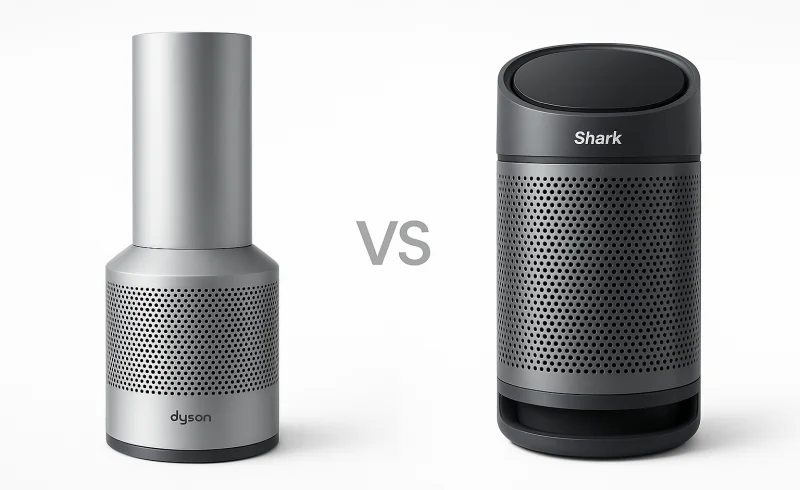
Explore a detailed comparison between Dyson's PC1 and Shark's HP152 air purifiers. Understand their differences in purification performance, maintenance needs, room coverage, and smart control features to determine which model suits your air quality preference...
TL;DR
- If you want a single appliance that scrubs the air and pushes cooling airflow during warmer months → choose Dyson PC1.
- If you care about minimal upkeep and a filter that lasts up to 5 years → choose Shark HP152.
- If you simply need quiet, background purification you can ignore → either can work, but the Shark HP152 gets out of the way more naturally.
The Dyson PC1 is a purifier–fan hybrid that doubles as a comfort device and rewards users who enjoy interactive air-quality feedback and app-based scheduling — but its dual role often forces a trade-off between optimal purification placement and where you want to feel the breeze. The Shark HP152 is a dedicated purifier built for predictable, low-intervention operation, with a filter that can go up to 5 years without replacement; it sacrifices cooling airflow and the deeper smart ecosystem of the Dyson, but in return you get fewer daily decisions and a quieter, more stable ownership experience.
If you need a purifier that also heats, humidifies, or integrates with a whole-home HVAC system, both models fall short — look into a multi-function air treatment unit or an in-duct filtration solution instead.
| Feature | Dyson PC1 | Shark HP152 |
|---|---|---|
| General | ||
| Display | LCD screen | Front display screen |
| Auto mode | Supported | Supported |
| Product type | Air purifier + cooling fan | Air purifier |
| Air quality sensing | Integrated real-time air quality sensors | Built-in real-time air quality sensor |
| Controls | ||
| Airflow speed settings | 10 | 5 |
| Remote control support | Yes | Yes |
| Physical | ||
| Height | 41.3 in | 15.16 in |
| Weight | 10.4 lb | 9.74 lbs |
| Cord length | 5.9 ft | 6 ft |
| Warranty | ||
| Limited warranty | 2-year limited warranty | 2-year limited warranty |
| Filtration | ||
| Primary filter type | Combined Glass HEPA and Activated carbon filter | True HEPA Multi-Filter |
| Particle filtration claim | 99.97% of particles as small as 0.3 microns | 99.98% of large, small, and micro-sized particles (0.1-0.2 microns) |
| Filter replacement interval | Every 12 months | Up to 5 years |
📑 Table of Contents
Product Type & Core Function
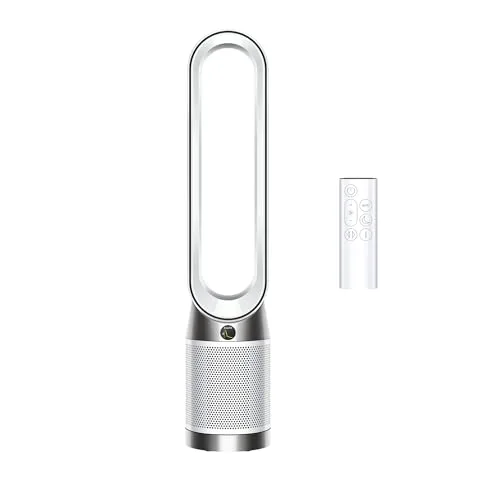
Dyson PC1 is explicitly a 2‑in‑1 «air purifier + cooling fan», designed to both filter air and push noticeable, fan-like airflow. That dual-role shows up in control granularity too, with 10 airflow speed settings and real-world airflow output reported as >290 L/s. In practice, it’s meant to be placed where you’ll feel the air movement (bedroom/living room comfort), not just where it can quietly scrub air.
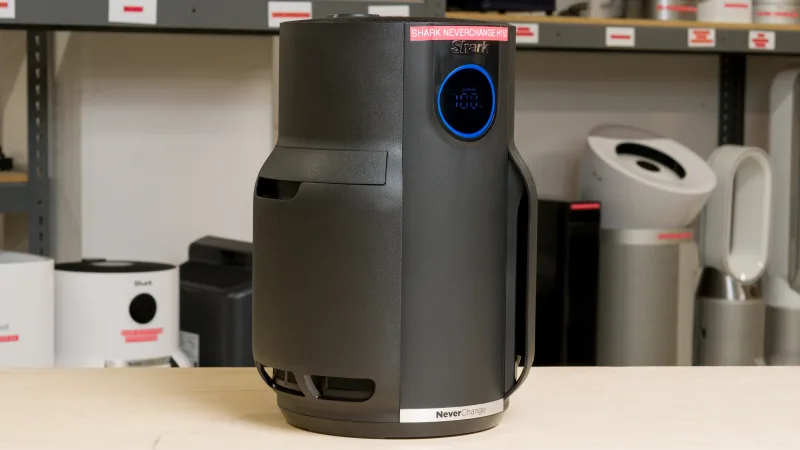
Shark HP152 is a dedicated air purifier, built around straightforward filtration rather than comfort cooling. It still includes core purifier essentials like auto mode and a built-in real-time air quality sensor, but with a simpler control surface—5 airflow settings—aimed at predictable, low-intervention operation. Its spec’d footprint also supports «purifier-first» placement in smaller spaces, with a much shorter chassis at 15.16 in tall (vs Dyson’s 41.3 in).
Conclusion: Neither product «wins» on type—this is a priority choice. Dyson PC1 is the better fit if you want one device to cover purification + cooling airflow (and don’t mind optimizing placement for two goals), while Shark HP152 is the better fit if you want a straightforward, dedicated purifier that’s easier to place and live with day-to-day.
Winner: Tie
Filtration & Purification Performance
Particle + gas filtration claims
Dyson PC1 uses a combined Glass HEPA + activated carbon filter and claims 99.97% capture at 0.3 microns, with Dyson also positioning it as capable of capturing gases/pollutants via the carbon stage. On paper, that’s a classic HEPA + carbon stack that should cover both particulates and some odors/VOCs, and it’s backed by Dyson’s own product messaging around whole-room purification.
Shark HP152 uses a True HEPA Multi-Filter within a four-stage filtration system and claims 99.98% capture down to 0.1–0.2 microns. It also adds a washable pre-filter (per third-party review coverage), which can intercept larger debris before it loads the main HEPA media.
Conclusion: For raw particulate filtration claims, Shark HP152 has the edge (0.1–0.2 microns at 99.98% vs 0.3 microns at 99.97%), while Dyson’s integrated activated carbon remains a meaningful advantage if gas/odor reduction is a priority.
Real-world room cleaning speed (CADR/throughput signals)
Dyson PC1 is cited with airflow output of >290 L/s, but isolated reports suggest Dyson’s CADR feels «subpar,» translating to slower-than-expected room cleaning in practice (a perception issue that can matter more than max airflow on paper). It’s also a hybrid purifier-fan, which can encourage positioning for comfort airflow rather than optimal circulation for purification—potentially undermining real-world cleaning effectiveness depending on the room layout.
Shark HP152 is explicitly marketed for up to 650 sq. ft. coverage, and there are no provided complaints in the SoT about weak CADR or slow cleanup behavior. That doesn’t prove higher CADR outright, but it does reduce risk versus a product that has at least some user skepticism around «how fast it actually cleans.»
Conclusion: Based on the available evidence, Shark HP152 looks more defensible for predictable, purifier-first performance, while Dyson’s mixed feedback introduces more uncertainty around perceived cleaning speed.
Filter longevity and sustained performance
Dyson PC1 recommends filter replacement every 12 months (or when notified by the machine), which implies more frequent media refresh and typically more consistent «like-new» performance—assuming you keep up with the annual cycle. The trade-off is higher maintenance cadence and less forgiveness if you run it hard year-round.
Shark HP152 claims a dramatically longer replacement interval: up to 5 years, and the presence of a washable pre-filter can further reduce the main filter’s particle load over time. The practical risk is that long-life systems can lead to less frequent check-ins and intake cleaning, which may cause performance drift if the unit gets dusty—even if the main filter isn’t «due.»
Conclusion: For low-intervention ownership and sustained filtration without frequent replacements, Shark HP152 wins (up to 5 years vs 12 months), provided users still do basic intake/pre-filter upkeep.
Winner: Shark HP152
Room Coverage & Airflow Effectiveness
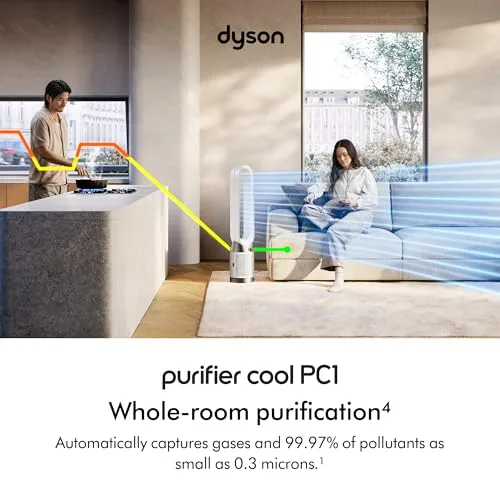
Dyson PC1 is marketed around «whole-room purification,» but it doesn’t provide a clear room-size coverage spec in the provided materials, which makes it harder to match to a specific square footage. It does list an airflow output of >290 L/s, but airflow volume alone doesn’t confirm purification throughput if CADR isn’t disclosed. Some users report subpar CADR and slow air cleaning, which matters most when you’re trying to refresh air quickly in larger rooms.
Shark HP152, by contrast, publishes a defined coverage rating of 650 sq. ft., giving you a concrete planning number for bedrooms, offices, and typical open living spaces. While its compact, dedicated-purifier form factor suggests it’s best used within that stated envelope (rather than treated as a vague «whole-home» solution), the clarity of the spec helps set expectations. Isolated reports suggest the air-quality display can malfunction, but that’s a sensor/UX issue—not a stated limitation of coverage.
Conclusion: On coverage transparency and predictable airflow-to-room matching, Shark’s explicit 650 sq. ft. rating is more actionable than Dyson’s «whole-room» claim plus >290 L/s airflow figure, especially given reports of slower-than-expected cleaning on the Dyson in bigger spaces. Winner: Shark HP152
Noise Levels & Daily Comfort
Dyson PC1 is rated at 61.4 dB max (per an independent review), which is objectively in the same loudness class as most purifiers at top speed. But because it’s a purifier + cooling fan, its comfort profile is tied to how much air you feel—higher airflow and oscillation are part of the everyday «cooling» experience, which can make it harder to ignore in a bedroom. Multiple reviewers report a «whining sound» on some units, including after replacements, which can be more disruptive than the headline dB number suggests (Multiple reviewers report…).
Shark HP152 is rated at 62.4 dBA max, a negligible ~1 dB higher on paper (effectively similar in real-world loudness). In practice, it’s a dedicated purifier meant to run as a background appliance, and the simpler «always-on» usage pattern tends to create fewer comfort conflicts than a hybrid fan/purifier. While some users note air-quality display issues, that’s a functionality concern—not a noise signature that keeps you awake (Some users note…).
Conclusion: Even though max noise is essentially a tie (61.4 dB vs 62.4 dBA), Shark’s more predictable, purifier-first operation—and fewer noise-character complaints—makes it the safer pick for nighttime comfort.
Winner: Shark HP152
Features & Smart Controls
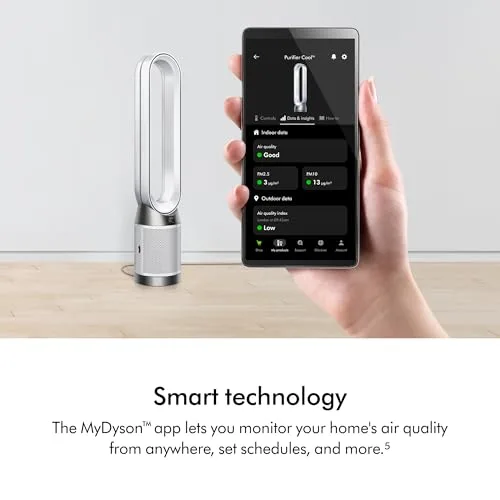
Dyson PC1 is built around more granular control, offering 10 airflow speed settings and positioning itself as both an air purifier + cooling fan. It also supports a remote control and an LCD screen, which tends to pair well with frequent check-ins on readings and mode changes. On the smart side, it’s compatible with the MyDyson app for remote control and deeper air-quality visibility.
Shark HP152 keeps controls simpler with 5 airflow speed settings, plus remote control support for basic across-the-room operation. It’s a dedicated air purifier with a front display screen and is generally designed to run predictably without much tweaking. While an app may exist in some configurations, the provided specs and context don’t position it as an app-forward product in the way Dyson does.
Conclusion: For control granularity and software features, Dyson PC1 has the clear edge (10 speeds + MyDyson ecosystem vs 5 speeds and a more basic control approach on Shark).
Dyson PC1 includes integrated real-time air quality sensors and Auto mode, with the LCD designed to make the device’s decisions and current conditions more interpretable at a glance. That interpretability supports Dyson’s «interactive appliance» style—useful if you want to understand what triggers changes and adjust behavior room-by-room and time-by-time. The trade-off is that being more ecosystem-forward can expose you to app/account and connectivity friction over time (even when the hardware itself is fine).
Shark HP152 also has a built-in real-time air quality sensor and Auto mode, but its overall experience is closer to «set it and forget it,» with fewer decisions to make day-to-day. That reduced reliance on software is a practical benefit if you don’t want another device demanding app attention. Some users note the air-quality display can malfunction, which matters because the display is the main feedback loop when you’re running it hands-off.
Conclusion: Dyson wins on smart ecosystem depth and feedback, while Shark’s advantage is a lower-intervention, less app-dependent ownership style—so the «best» choice depends on whether you value rich controls or minimal fuss.
Winner: Dyson PC1
Maintenance & Filter Costs
Dyson PC1 uses a combined Glass HEPA + activated carbon filter, and Dyson recommends replacement every 12 months (or when the machine notifies you) according to its support guidance. With the commonly cited replacement price of ~$79.99, that works out to roughly $79.99 per year in filter spend if you keep to the schedule. Because the unit is a tall, «in-the-room» appliance (41.3 in), routine wipe-downs and intake cleaning also tend to be more noticeable as dust shows up on the exterior over time.
Shark HP152 is built around a True HEPA Multi-Filter with a stated replacement interval of up to 5 years, and replacements are commonly listed at ~$69.99—about $14/year when averaged over five years. It also adds a washable pre-filter designed to catch larger particles, which can reduce how quickly the main filter loads up. In practice, this design targets lower-intervention ownership: fewer filter purchases and fewer «must-do» maintenance moments.
Conclusion: On maintenance cadence and long-term filter economics, Shark HP152 has a clear, defensible advantage (up to 5 years vs 12 months, plus a washable pre-filter and far lower average annual filter cost).
Winner: Shark HP152
Design & Build Quality
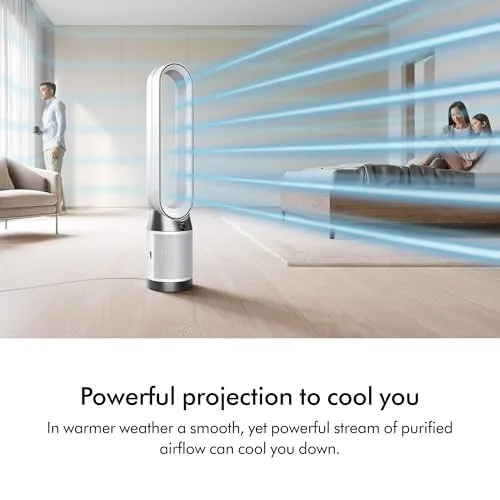
Dyson PC1 is a tall, statement-style tower at 41.3 in high, using Dyson’s recognizable bladeless loop design that’s meant to be seen in the room. At 10.4 lb, it isn’t especially heavy for its size, but its height and footprint make it feel like a permanent fixture rather than something you casually move. Its LCD screen reinforces the «premium appliance» vibe with at-a-glance status and readings.
Shark HP152 goes the opposite direction: a compact, practical purifier body at 15.16 in tall with a simple front display screen. It’s slightly lighter at 9.74 lb, and its small form factor is easier to tuck into corners, under desks, or into smaller rooms without dominating the space. The overall design reads more «utility-first» than decorative.
Conclusion: Dyson PC1 has the clearer advantage in premium, design-forward presence, while Shark HP152 wins for space efficiency and visual discretion—choose based on whether you want a centerpiece or a low-profile box.
Dyson PC1 offers a 5.9 ft cord, which is adequate for most placements but can be limiting if outlets are awkward relative to where you want the airflow. The tall body also means placement matters more—where it sits affects both comfort airflow and how noticeable it is day-to-day.
Shark HP152 includes a slightly longer 6 ft cord, giving it a small edge in «plug flexibility» when you’re trying to place it optimally for circulation. Because it’s short and compact, it’s typically easier to relocate between rooms without rearranging furniture.
Conclusion: Shark HP152 has a minor but real usability edge on placement flexibility thanks to the 6 ft vs 5.9 ft cord and smaller size, even though the difference is incremental.
Winner: Tie — Dyson PC1 leads on premium aesthetics and statement design, while Shark HP152 is more compact and slightly easier to place unobtrusively.
The Bottom Line
After weighing filtration, coverage clarity, noise, controls, and long-term upkeep, the decision comes down to whether you need a true 2‑in‑1 or simply the strongest purifier for the money.
You want a purifier that also cools you down: Choose the Dyson PC1, since it’s the only option here designed to deliver noticeable fan-like airflow alongside purification.
You just need reliable, low-effort air purification: Pick the Shark HP152 for its purifier-first performance, simpler daily operation, and long filter life that minimizes hands-on maintenance.
You prioritize smart-home integration and data insights: Go with the Dyson PC1, as the MyDyson app, scheduling, and richer on-device feedback outclass Shark’s more basic approach.
You want the best long-term value and lowest running costs: The Shark HP152 wins on economics, pairing a lower upfront price with far less frequent filter replacement.
Overall, the Shark HP152 is the more dependable buy for most households: it has clearer room-coverage guidance, more defensible real-world purifier-first performance, and dramatically lower maintenance burden over time. The trade-off is that the Dyson PC1 does more as a comfort appliance, with better smart features and the cooling-fan experience Shark simply doesn’t offer.
If your priority is cleaner air with minimal fuss and predictable long-term costs, choose Shark—only spring for Dyson if a built-in cooling fan (and deeper app controls) is central to how you’ll use it.
FAQ
Does the Dyson PC1 actually cool the room?
Which air purifier has better filtration, Dyson PC1 or Shark HP152?
How often do I need to replace the filters?
Which is quieter for nighttime use?
Does the Shark HP152 remove odors and VOCs?
What size room is the Shark HP152 suitable for?
Can I control the Dyson PC1 with my phone?
📄 Used Manuals & Documentation
Dyson PC1
"Images are used for editorial and informational purposes only. All trademarks and images belong to their respective owners."