
Dreo vs Levoit: Table Fan or Air Purifier for Your Room?
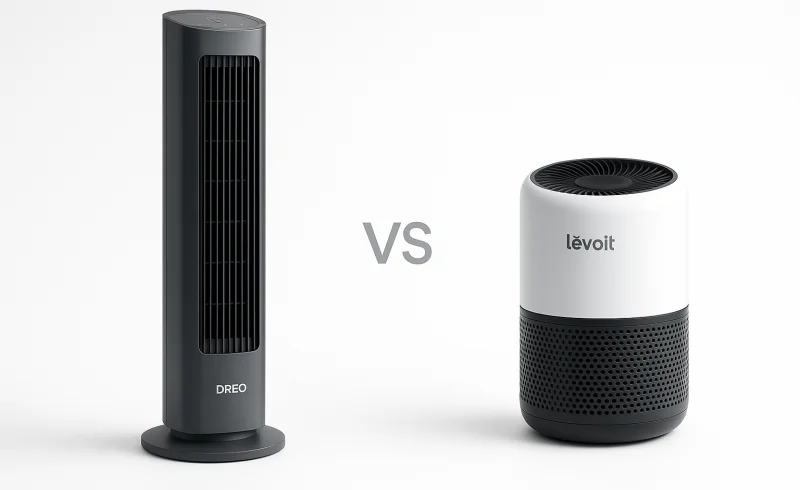
Discover the core differences between Dreo's table fan for personal comfort and LEVOIT's air purifier targeting allergens and smoke. Evaluate which device aligns with your priorities for cooling or improving air quality in various spaces.
TL;DR
These two devices solve different problems, so there is no meaningful overall winner.
- Dreo TurboPoly Table Fan 312 (CF312) is for air movement and perceived cooling. It can make an occupied desk, bedroom, or sitting area feel more comfortable, but it does not lower the room's air temperature and it does not filter airborne particles.
- Levoit Core 300-P is for air filtration. It is designed to capture airborne particles such as fine dust, pollen, pet dander, and smoke particles, but it is not a personal cooling device.
- If a room feels stuffy because of poor ventilation, neither device addresses the root cause. A purifier recirculates indoor air, and a fan moves that air around; neither brings in outdoor air or removes excess carbon dioxide.
- If the problem is heat, Dreo is the relevant tool. If the problem is airborne particulate pollution, Levoit is the relevant tool. If both problems exist, the two devices can complement each other rather than replace one another.
| Feature | Dreo | LEVOIT |
|---|---|---|
| Power | ||
| Voltage | 120V ~ 60Hz | AC 120V, 60Hz |
| General | ||
| Model | CF312 (TurboPoly Table Fan 312) | Core 300-P (Model Core 300) |
| Product Type | Table fan | Air purifier |
| Support | ||
| Warranty | 1 year | 2-Year Limited Warranty |
| Controls | ||
| Control Type | Knob | Touch buttons |
| Speed Settings | 3 | I / II / III |
| Physical | ||
| Weight | 5.49 lb / 2.5 kg | 7.9 lb / 3.6 kg |
| Dimensions | 9.45D x 11.26W x 11.81H in / 240 x 286 x 300 mm | 8.7 x 8.7 x 14.2 in / 22 x 22 x 36 cm |
| Performance | ||
| Noise Level | 25 dB | 24–54.5 dB |
📑 Table of Contents
Start With the Problem, Not the Brand
Putting the Dreo TurboPoly Table Fan 312 and Levoit Core 300-P into a conventional head-to-head creates a false comparison. One is a compact air circulator; the other is a portable air purifier. They both contain fans, but those fans are doing different jobs.
The Dreo's job is to move enough air across a person or through part of a room to change how warm the space feels. Its three-speed knob keeps operation simple, and the fan head can be angled vertically to aim the airflow where it is useful. That makes it relevant at a desk, beside a bed, or in a room where conditioned air needs better circulation.
The Levoit's internal fan is there to pull room air through its filter system and return filtered air to the space. The airflow matters, but the goal is particle removal rather than a strong breeze aimed at a person. That distinction should drive the entire comparison.
There is also a third problem neither device should be asked to solve: ventilation. A purifier can reduce some airborne contaminants, but it does not replace indoor air with outdoor air. A fan can redistribute air, but in a closed room it does not remove carbon dioxide or other pollutants that require source control or ventilation.
Cooling & Airflow
For thermal comfort, Dreo is the relevant device.
A table fan can make a warm room feel more tolerable by moving air across the skin. The effect is immediate when the airflow reaches you, but it is a comfort effect rather than refrigeration: the fan does not remove heat from the room the way an air conditioner does.
The TurboPoly Table Fan 312 uses a three-speed knob and an adjustable fan head. That simplicity is useful when the goal is straightforward directional airflow rather than schedules, sensors, or automation. Its compact form also makes it easy to reposition when the occupied part of the room changes.
The Levoit Core 300-P also moves air, but its airflow is optimized around pulling air through a filter. It should not be treated as a substitute for a desk or bedside fan simply because air exits the top of the purifier. The airflow may be noticeable, especially at higher speed, but personal cooling is not the purpose of the device.
For perceived cooling and deliberate air circulation: Dreo.
Air Purification
For airborne particle removal, Levoit is the relevant device.
The Core 300-P uses a multi-stage filter system intended to capture particles carried through the purifier, including fine dust, pollen, pet dander, and smoke particles. That makes it useful when the concern is particulate air quality rather than temperature.
The Dreo has no filtration stage. It can circulate indoor air, but it has no mechanism for trapping the particles it moves. That does not make it a poor fan; it simply means it cannot perform the core function of an air purifier.
It is also important not to stretch the Levoit's role too far. A portable purifier can reduce airborne particles that pass through its filter, but it cannot remove every contaminant from a room. It does not solve excess carbon dioxide, humidity, or the underlying source of indoor pollution. And while Levoit markets its filtration system for household odors and smoke-related pollutants, odor and gas removal should not be treated as equivalent to particle filtration or as comprehensive removal of gaseous contaminants.
For airborne allergens, the same distinction matters. The purifier can capture particles that are suspended in the air and pass through the filter, but it should not be described as a medical treatment or as a guarantee of symptom relief.
For airborne particle filtration: Levoit.
Noise & Bedroom Use
The original comparison gives Dreo an easy noise win, but the published decibel figures do not justify that conclusion by themselves.
Both manufacturers publish very low minimum-noise figures, while Levoit also specifies a substantially higher upper noise level at faster settings. That is expected for an air purifier: higher fan speed moves more air through the filter and can reduce particle concentrations faster, but it also increases sound. Running the purifier quietly at its lowest setting involves a corresponding reduction in airflow through the filter.
Dreo's noise also rises as fan speed increases. Without an independent test that measures both devices under the same conditions, at comparable distances and useful operating settings, the lowest published decibel number is not enough to declare one universally quieter.
The practical distinction is simpler. For a sleeper who mainly wants a gentle breeze, Dreo can be run at a low fan speed. For a sleeper who needs filtration, Levoit's low-speed or sleep-oriented operation trades maximum cleaning rate for lower sound. In both cases, the useful setting depends on the job the device needs to do overnight.
Noise verdict: no clear overall advantage from the published specifications alone.
Controls & Smart Features
Dreo is deliberately simple: a physical knob controls three fan speeds. There is no need for an app, account, or network connection to use it.
Levoit Core 300-P uses on-device controls for its fan speeds and includes a filter-status indicator. The interface is more maintenance-oriented because filter condition is part of normal purifier ownership.
Neither exact model should be described as a smart-home device. The Core 300-P is not the Core 300S-P, which is a separate connected model, and the Dreo model discussed here is the basic knob-controlled TurboPoly Table Fan 312 rather than one of Dreo's connected fan variants.
For someone who wants app control, remote automation, or voice-assistant integration, this comparison points to different models rather than a hidden feature on either of these two.
Maintenance & Upkeep
The Dreo is simpler to maintain because it has no filter consumable. Routine care is mainly about removing accumulated dust from the grille, blades, and air path so airflow is not restricted.
The Levoit requires more regular attention because filtration performance depends on a clean air path and a usable filter. The exterior and pre-filter area need periodic cleaning, and the main filter eventually needs replacement. The exact interval depends on operating time and the amount of pollution in the room; a filter used during heavy smoke or in a dusty environment can load faster than one used lightly in a cleaner space.
The filter indicator is best understood as a maintenance reminder, not as proof that the filter is still performing perfectly until the light appears. A visibly clogged filter, reduced airflow, unusual odor, or increased operating noise can also be signs that maintenance is needed.
One claim from the original article should be discarded: simply running the purifier at a higher speed is not a substitute for replacing an overloaded filter. Higher speed can increase airflow through a healthy filter, but it does not restore a filter whose loading is restricting performance.
Maintenance advantage: Dreo, because its function does not depend on a replaceable filter. That advantage is inseparable from the reason Levoit exists: filtration requires filter media.
Design, Size & Placement
The Dreo is lighter at 5.49 lb (2.5 kg) and measures 9.45 × 11.26 × 11.81 inches. The Levoit weighs 7.9 lb (3.6 kg) and measures 8.7 × 8.7 × 14.2 inches.
Those numbers do not support the simple claim that Dreo is smaller in every sense. The Dreo is shorter and lighter, which helps when moving it between a desk, nightstand, and other occupied areas. The Levoit is taller but narrower, so it uses less horizontal surface area even though it weighs more.
Placement priorities are also different. Dreo works best when its airflow can be aimed where circulation or personal cooling is needed. Levoit works best when its intake and exhaust are not blocked by walls, curtains, furniture, or clutter. Tucking a purifier tightly into a corner may save visible space while compromising the airflow its filtration depends on.
Portability advantage: Dreo. Footprint advantage: neither across every dimension.
What Neither Device Can Fix
A useful comparison also needs to make the boundaries explicit.
- A genuinely hot room: Dreo can improve perceived comfort, but an air conditioner or another system that removes heat is needed to lower indoor air temperature.
- Poor ventilation or high carbon dioxide: Levoit filters recirculated air and Dreo circulates it. Neither replaces fresh-air ventilation.
- Every kind of odor or gas: Levoit's carbon stage is intended to help with some odors and gaseous compounds, but a compact purifier should not be treated as universal gas removal or as a solution for dangerous combustion gases.
- Whole-home air cleaning: Core 300-P is a room purifier. Its effectiveness depends on room size, placement, operating speed, and how much air actually passes through the filter.
- Connected-home automation: neither exact model is built around app or voice control.
The Bottom Line
There is no defensible single-device winner here because Dreo and Levoit are not competing for the same job.
For a warm desk, bedside, or sitting area where the problem is how the room feels, the Dreo TurboPoly Table Fan 312 is the more relevant tool. It provides direct air movement, simple physical controls, and lower maintenance.
For a bedroom or small living space where the concern is airborne particles such as smoke, pollen, pet dander, or fine dust, the Levoit Core 300-P is the more relevant tool because it actually filters recirculated room air.
For a room that is simply stale or stuffy, first separate air quality from ventilation. If the problem is particulate pollution, Levoit addresses that problem. If the problem is trapped indoor air and rising carbon dioxide, ventilation is the missing function. If the problem is heat, Dreo can improve personal comfort but cannot lower the room's temperature.
The most accurate conclusion is therefore not Dreo versus Levoit. It is air movement versus filtration. Once that distinction is clear, the appropriate device follows directly from the problem in the room.
FAQ
Can I use both a fan and air purifier together?
How often do I replace the LEVOIT filter?
Is the Dreo fan suitable for large rooms?
Which is quieter during sleep?
What warranty does Dreo offer?
Is the LEVOIT Core 300-P effective for allergies?
📄 Used Manuals & Documentation
"Images are used for editorial and informational purposes only. All trademarks and images belong to their respective owners."