
Dreo TurboPoly 714S vs LEVOIT LPF-R432S-AUS: Tabletop Circulator or Convertible Pedestal Fan?
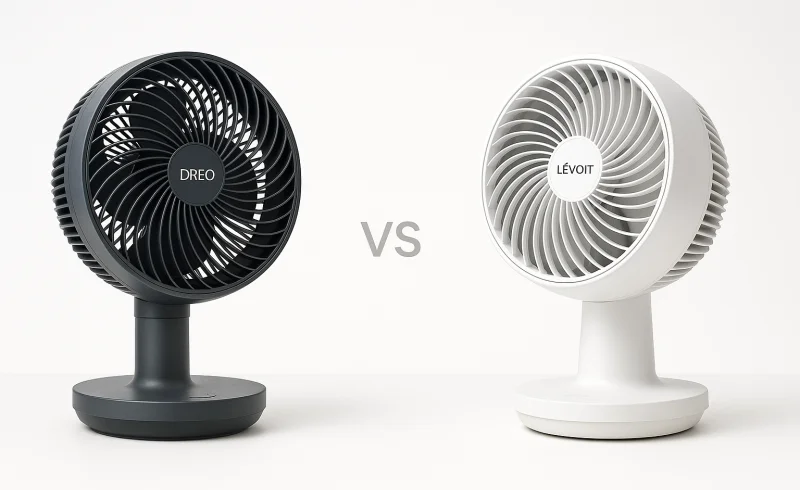
Explore the differences between the Dreo TurboPoly 714S and LEVOIT LPF-R432S fans. This article highlights their airflow capabilities, noise levels, oscillation patterns, and smart features, helping you choose the right fan for your room size and cooling needs...
TL;DR
- Dreo TurboPoly Table Fan 714S makes more sense when the fan will live on a desk, nightstand, counter, shelf, or floor and compactness matters more than adjustable height. It is 16.22 inches tall, weighs 7.27 lb, and requires no pedestal assembly.
- LEVOIT LPF-R432S-AUS is the more adaptable design. Its fan head can sit directly on the base or attach to the included pole, turning the same unit into a short circulator or a 43.6-inch pedestal fan.
- The airflow gap is much smaller than it first appears. Dreo currently lists 1,404 CFM, while Levoit lists 1,451 CFM—only about a 3% difference. Because the manufacturers do not document directly comparable test procedures, that small numerical lead should not drive the decision.
- Dreo has the longer stated air throw at 110 ft vs 98 ft and the wider horizontal sweep at 120° vs 90°. Levoit reverses the geometry with 120° vertical oscillation vs Dreo's 90°, which is useful when circulating air between different heights in a room.
- Levoit has the stronger paper specification for minimum noise: 20–52 dB, compared with Dreo documentation listing roughly 25–51 dB. Those are manufacturer figures rather than results from a controlled head-to-head test.
- Dreo advertises six modes, but Natural, Custom, and Sleep are app-dependent. Levoit's four modes—Normal, Turbo, ECO, and Sleep—can be cycled from its remote, so mode count alone does not tell the whole story.
Neither fan refrigerates or lowers room temperature on its own. Like any conventional fan, each creates a cooling sensation by moving air across the body and can help redistribute conditioned or outdoor air through a room.
| Feature | LEVOIT LPF-R432S-AUS | Dreo TurboPoly Table Fan 714S |
|---|---|---|
| Design | ||
| Motor Type | DC motor | Brushless DC motor |
| Form Factor | 2-in-1 pedestal & tabletop fan | Tabletop fan |
| Features | ||
| Timer | 12 h | 12 h |
| Modes Count | 4 | 6 |
| Operating Modes | Turbo, Normal, Eco, Sleep | Auto, Turbo, Normal, Natural, Sleep, Custom |
| Performance | ||
| Noise Level | 20 dB | 20 dB |
| Airflow Rate | 1451 CFM | 1082 CFM |
| Airflow Reach | 98 ft | 110 ft |
| Speed Settings | 12 | 9 |
| Vertical Oscillation | 120° | 90° |
| Horizontal Oscillation | 90° | 120° |
| Connectivity | ||
| Wi-Fi | Supported | Supported |
| Companion App | VeSync app | DREO App |
| Voice Control | Supported | Supported |
| Remote Control | Included | Included |
📑 Table of Contents
The Biggest Difference Is the Form Factor
The most important distinction between these fans is not CFM, Wi-Fi, or the number of operating modes. It is where each fan can physically sit.
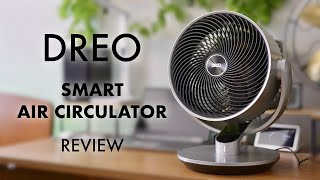
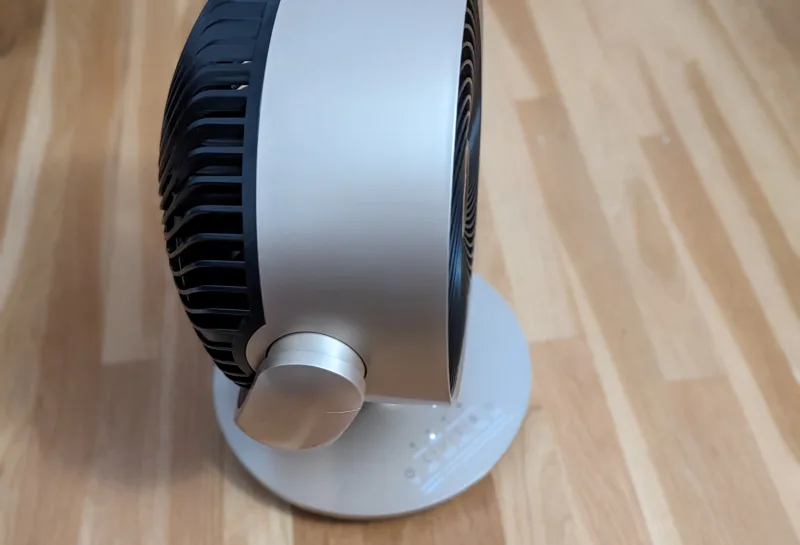
Dreo TurboPoly Table Fan 714S is a compact air circulator measuring 11.42D × 13.7W × 16.22H inches and weighing 7.27 lb. The head, base, and oscillation mechanism arrive as one tabletop-style unit. That makes it straightforward to move between a desk, bedside surface, kitchen counter, or floor without changing its configuration.
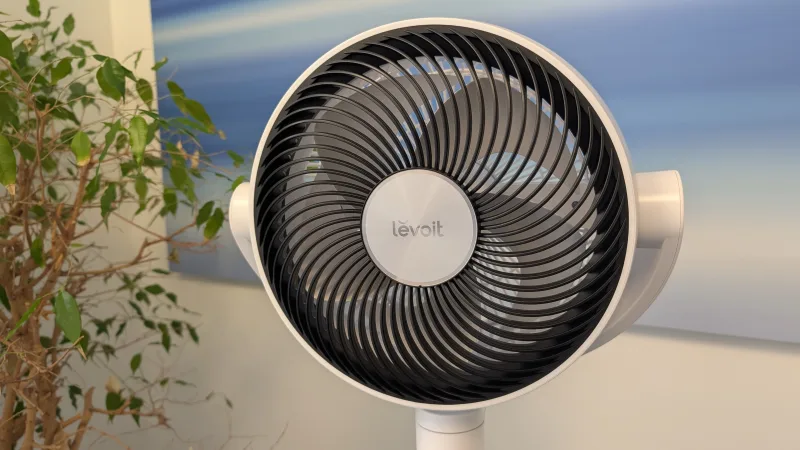
LEVOIT LPF-R432S-AUS is substantially larger in pedestal form at about 14.3 × 12.5 × 43.6 inches and 12.7 lb. Its pole is optional: the manual specifically allows the fan head to attach directly to the base for a shorter configuration. This is better described as a two-height convertible design than a continuously height-adjustable pedestal fan.
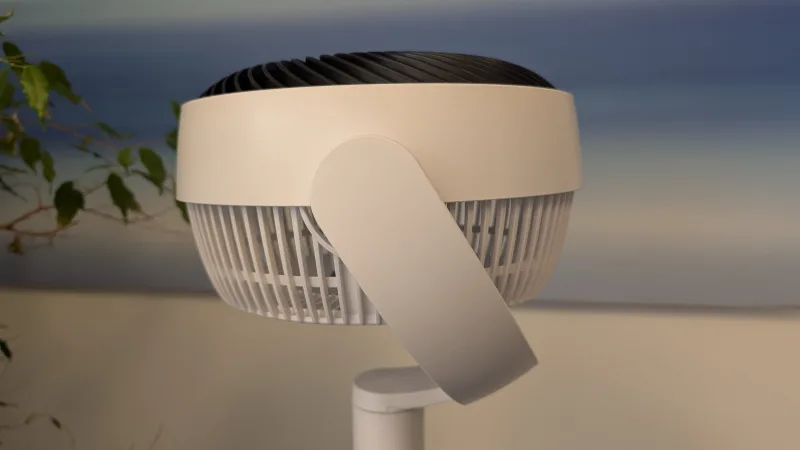
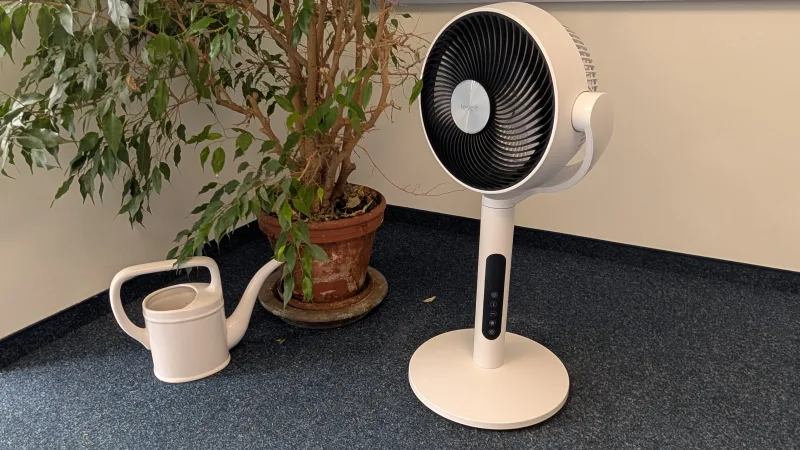
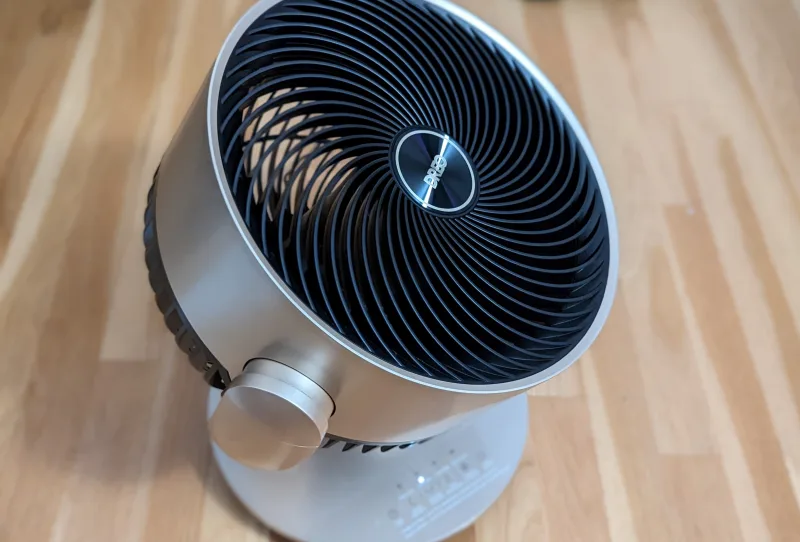
That distinction matters around beds and sofas. With Dreo, the height of the furniture largely determines where the airflow originates. With Levoit, removing or installing the pole gives you two fundamentally different placements without putting the fan on another object.
Verdict: Levoit is more flexible across different rooms and seating heights. Dreo is simpler and considerably more compact when a tabletop-style circulator is specifically what you need.
Airflow: Much Closer Than the Raw Numbers Suggest
The original comparison between these models can easily become misleading if older or mismatched Dreo specifications are used.
Dreo's current comparison materials list the TurboPoly Table Fan 714S at 1,404 CFM, with a maximum air speed of 26 ft/s and a stated maximum throw of 110 ft.
Levoit lists the LPF-R432S-AUS at 1,451 CFM, a maximum speed of 24.6 ft/s, and a maximum throw of 98 ft.
That puts the advertised airflow difference at only 47 CFM, or roughly 3.3%, rather than a large performance gap. More importantly, Levoit states that its 1,451-CFM figure is based on thermal-anemometer measurement, while Dreo does not provide enough corresponding methodology in its consumer specifications to establish that the two CFM ratings are directly comparable.
For that reason, 1,451 CFM vs 1,404 CFM should be treated as effectively close manufacturer ratings, not evidence that one fan moves dramatically more air in the same room.
The throw specifications tell a somewhat different story. Dreo claims 110 ft, compared with 98 ft for Levoit. Maximum throw is not the same thing as total airflow: a fan can produce a relatively concentrated stream that remains detectable farther away without necessarily moving more total air.
The practical takeaway is therefore more nuanced:
- Dreo publishes the longer maximum throw and slightly higher maximum air-speed figure.
- Levoit publishes the slightly higher total-airflow figure.
- The differences are small enough, and the test information limited enough, that placement and oscillation geometry are more useful decision criteria than CFM alone.
Verdict: Effectively a tie on published airflow capability. Dreo has the stronger distance specification; Levoit has the marginally higher CFM rating.
Oscillation & Air Distribution
The two fans take almost opposite approaches to dual-axis movement.
Dreo TurboPoly Table Fan 714S supports up to:
- 120° horizontal oscillation
- 90° vertical oscillation
Its controls allow horizontal ranges of 30°, 60°, 90°, or 120° and vertical ranges of 30°, 60°, or 90°.
That wider horizontal sweep is useful when the fan is sitting fairly close to its users—for example, on a desk covering multiple work positions, at the end of a sofa, or on a dresser sending air across a broad section of a bedroom.
There is an important documentation wrinkle here. Some Dreo promotional copy for the 714S has referenced 120° + 120° movement, but the model's technical specifications and operating manual specify 120° horizontal and 90° vertical. The latter is the more defensible specification for this comparison.
LEVOIT LPF-R432S-AUS provides the reverse:
- 90° horizontal oscillation
- 120° vertical oscillation
The manual allows 30°, 60°, or 90° horizontal ranges and 30°, 60°, 90°, or 120° vertically.
That large vertical arc becomes more relevant because the Levoit can operate at pedestal height. It can direct air forward toward people, upward toward the ceiling, or through a larger vertical section of the room. Levoit's own manual specifically suggests upward positioning for redistributing warm air and forward or elevated positioning for circulating conditioned air.
Neither layout is inherently superior. They emphasize different coverage patterns.
Verdict: Dreo is better suited to broad side-to-side coverage from a compact position; Levoit provides greater vertical range and more placement freedom.
Noise & Sleep Use
The published noise specifications favor Levoit at minimum speed, but not by enough to support sweeping conclusions about how either fan will sound in a particular bedroom.
Levoit's manual specifies a range of 20–52 dB.
Dreo documentation for the 714S lists approximately 25–51 dB, depending on speed.
These figures should not be treated like controlled comparative measurements. Distance from the microphone, room acoustics, airflow speed, measurement weighting, and test setup can all affect a fan's published dB rating. There is no equivalent evidence that both numbers were produced under the same protocol.
What can be compared directly is how the two fans handle nighttime operation.
Dreo's Sleep behavior
Dreo's Sleep Mode is available through the Dreo app. According to its manual, the mode automatically mutes the fan and gradually lowers speed every 30 minutes, dropping by no more than two speed levels before holding steady.
That is useful when you want stronger airflow while falling asleep but less air movement later in the night. The limitation is that Sleep Mode is one of Dreo's app-dependent modes rather than a mode exposed as directly as Normal and Auto on the physical controls.
Dreo also has an auto-brightness display and allows its control sounds to be muted manually.
Levoit's Sleep behavior
Levoit's Sleep Mode can be selected from the remote. After activation, the display turns off and selection sounds are disabled after several seconds. The mode also adjusts fan behavior over time and responds to changes in measured room temperature.
Levoit additionally provides a dedicated Sound/Display Off function independent of Sleep Mode, accessible from the remote or controls.
The original assumption that Dreo is naturally less noticeable because a tabletop fan sits below ear height does not hold up as a general rule. A Dreo placed on a nightstand can actually be closer to a sleeper's head than a pedestal fan positioned farther across the room. Distance, speed, airflow direction, and room acoustics matter more than whether the fan is technically classified as tabletop or pedestal.
Verdict: Levoit has the stronger nighttime specification on paper, with a 20-dB stated minimum and easier no-app access to Sleep Mode. Dreo offers a useful stepped-down Sleep routine, but that particular mode depends on the app.
Modes & Speed Control
At first glance, Dreo appears to have a straightforward advantage because it advertises six modes against Levoit's four. The manuals reveal a more important distinction: where those modes are available.
Dreo TurboPoly Table Fan 714S
Dreo provides:
- Normal — fixed fan speed
- Auto — speed responds to ambient temperature
- Turbo — maximum output
- Natural — alternating airflow speeds
- Custom — configurable behavior based on temperature or time
- Sleep — muted operation with gradual speed reduction
It also has nine manual speed levels.
However, Natural, Custom, and Sleep are app-based modes. On the fan itself, the Mode button switches between Normal and Auto, while Turbo is available through a long press of the speed control.
That makes Dreo's six-mode figure legitimate, but it does not mean six equivalent presets are sitting on the physical control panel.
LEVOIT LPF-R432S-AUS
Levoit provides:
- Normal
- Turbo
- ECO
- Sleep
along with 12 speed levels.
The remote can cycle directly through all four modes. ECO automatically changes fan speed according to measured room temperature, while Turbo runs the fan at speed 12 and enables oscillation by default.
Levoit's extra three speed steps do not necessarily imply dramatically finer airflow control—the spacing between speed levels matters too—but they provide more manual settings to work with.
Verdict: Dreo offers more programmable behavior, especially through its app. Levoit offers simpler access to its full mode set and more manual speed levels.
Smart Features & Automation
Both models are genuinely smart fans rather than conventional fans with only a remote.
Dreo TurboPoly Table Fan 714S connects to the Dreo app and supports Amazon Alexa and Google Assistant. The app is particularly important on this model because it unlocks Natural, Custom, and Sleep modes in addition to remote control, directional adjustment, and automation.
Custom Mode is more substantial than a renamed speed preset: Dreo's manual describes it as allowing fan speed to change according to temperatures or times configured by the user.
The fan also remembers its previous settings after being switched off or disconnected from power, with the timer excluded from memory.
Its physical timer control covers 1–8 hours. Dreo directs users to the app for longer timer settings, while current product materials describe timer support up to 12 hours.
LEVOIT LPF-R432S-AUS uses the VeSync app and can connect through VeSync to Amazon Alexa and Google Assistant. Its ECO mode already provides temperature-responsive operation without requiring a custom routine.
Levoit also offers a conventional 1–12 hour timer directly from the controls, which is more convenient when a phone is not nearby.
Its memory behavior is slightly different from Dreo's. While remaining plugged in, the Levoit remembers previous settings except the timer. After being unplugged, it also drops the previous oscillation setting.
Neither fan requires smart control for basic operation. Power, speed, and oscillation remain available locally, and both include remotes. The distinction is that Dreo places more of its advanced mode system inside the app, while Levoit exposes more of its core behavior through the remote and physical interface.
Verdict: Dreo is the more configurable smart system; Levoit is less dependent on the app for everyday operation.
Cleaning & Maintenance
Air circulators eventually collect dust on the grille and blades, so access for cleaning matters more than it does on many small electronics.
Both models allow deeper disassembly rather than limiting maintenance to vacuuming the exterior.
On the Dreo 714S, the front grille can be removed after taking out its retaining screw. The blade assembly also comes off, and Dreo permits the removable cap, blades, and grille to be rinsed or wiped before they are completely dried and reassembled.
The Levoit LPF-R432S-AUS also allows removal of the front grille, blades, and rear air inlet. Its manual calls for a screwdriver to release the grille and instructs users to wipe removable parts with a damp cloth and dry them immediately.
Neither design is maintenance-free, but both are substantially more serviceable than fans whose blade area is effectively sealed.
Verdict: No meaningful winner. Both provide access to the grille and blades for periodic deep cleaning.
The Bottom Line
The specifications do not support framing this comparison as a compact but substantially weaker Dreo against a dramatically more powerful Levoit. Their current manufacturer airflow ratings are 1,404 CFM and 1,451 CFM, respectively—close enough that the distinction is unlikely to be more important than where the fan sits and how it distributes air.
The Dreo TurboPoly Table Fan 714S is the more coherent fit for a permanent desk, bedside, counter, shelf, or compact floor setup. It is lighter, much shorter, requires no pedestal configuration, has the wider 120° horizontal sweep, and carries the longer 110-ft stated throw. Its app also provides unusually detailed airflow automation. The trade-off is fixed height and greater reliance on the app for several of its advertised modes.
The LEVOIT LPF-R432S-AUS is more useful when one fan needs to alternate between low and elevated positions. Its removable pole changes the role of the product more significantly than any small CFM difference: it can operate as a short circulator near the floor or as a 43.6-inch pedestal fan. It also provides 12 speeds, 120° vertical oscillation, a lower 20-dB stated minimum, and direct remote access to all four operating modes.
For a fixed compact location, Dreo is the cleaner fit. For a fan expected to move between rooms, furniture heights, and circulation roles, Levoit's convertible structure is the more consequential advantage.
FAQ
Which fan moves more air?
Can the Levoit be used as a table fan?
Do both fans support voice control?
Which fan is quieter?
What is the airflow throw distance for the Dreo and Levoit fans?
Is the Dreo fan better for desk use than the Levoit?
What color is the Dreo TurboPoly Table Fan 714S available in?
"Images are used for editorial and informational purposes only. All trademarks and images belong to their respective owners."