
VEVOR C300 vs VEVOR M400C: Simpler Setup or Room to Grow?
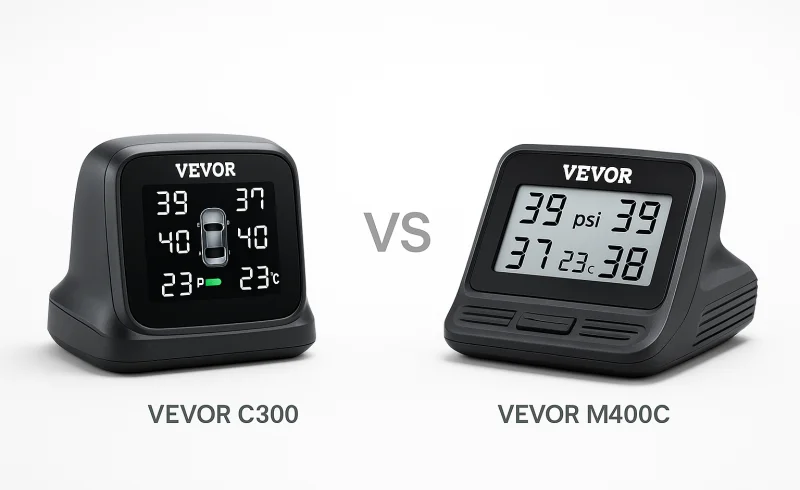
Explore the differences between the VEVOR C300 and VEVOR M400C tire pressure monitoring systems. Learn about their setup, monitoring capacity, accuracy, and design to determine which system suits your needs best.
TL;DR
- If you want the lowest-hassle, cable-free TPMS for a typical 6-tire travel trailer → choose VEVOR C300
- If you need future-proof scalability for a fifth wheel, multi-axle rig, or more than 6 tires → choose VEVOR M400C
- If you’re a weekend tower who values portability and a «set it and forget it» workflow → either works, but the C300’s solar charging and lighter weight make it the more natural fit.
Key differentiators: The C300 wins on day-to-day simplicity with solar/USB power, tighter ±0.1 bar accuracy, and a lighter 0.66 lb monitor that’s easy to move between vehicles. The M400C can monitor up to 22 tires (vs. 6), includes a fast-leak alert, and handles higher pressures up to 199 psi — but requires a cigarette-lighter cable, weighs nearly twice as much, and has looser ±0.3 bar accuracy. Your choice comes down to whether you prioritize effortless deployment or hardware headroom.
Who should skip both: If you need phone-based alerts, cloud logging, or integration with navigation systems, consider a smart TPMS with app connectivity instead — these VEVOR models are strictly monitor-and-sensor kits with no app ecosystem.
Market price overview

 Vevor
Vevor Vevor
Vevor| Feature | VEVOR C300 | VEVOR M400C |
|---|---|---|
| Build | ||
| Sensor protection | Dustproof, waterproof, temperature-resistant | Dustproof, waterproof, temperature-resistant |
| Valve stem material | Brass | Brass |
| Power | ||
| Charging / power method | Solar + USB | DC + cigarette lighter |
| Alerts | ||
| Alert modes | 5 abnormal tire pressure alerts | 7 abnormal tire pressure alerts |
| General | ||
| Display | High-definition real-time display | High-definition real-time display |
| Product type | RV tire pressure monitoring system | RV tire pressure monitoring system |
| Product weight | 0.66 lbs / 0.3 kg | 1.01 lbs / 0.46 kg |
| Sensors | ||
| Sensor type | External cover-style sensors | External cover-style sensors |
| Installation | No tire removal required | No tire removal required |
| Included sensors | 6 sensors | 6 sensors |
| Repeater included | Yes | Yes |
| Monitoring | ||
| Monitored metrics | Tire pressure and temperature | Tire pressure and temperature |
| Max tires monitored | Up to 6 tires | Up to 22 tires |
| Measurement accuracy | ±0.1 bar | ±0.3 bar |
| Pressure detection range | 7.3-116 psi / 0.5-8 bar | 0-199 psi / 0-16 bar |
| Repeater transmission range | 98 ft / 30 m | 82 ft / 25 m |
📑 Table of Contents
Monitoring Capacity
VEVOR C300 is designed around a fixed, straightforward footprint: it monitors up to 6 tires and ships with 6 external cap-style sensors. That aligns with common travel-trailer and basic RV setups where you just want full coverage without planning for expansion. It also includes a repeater rated for 98 ft / 30 m, which helps keep all six positions reliably in range on a typical tow rig.
VEVOR M400C also includes 6 external sensors out of the box, but the system itself scales much further—up to 22 tires total (with additional sensors sold separately). For longer rigs and multi-axle layouts, that headroom is the whole point: the manufacturer and retailer listings explicitly position it as real-time monitoring for up to 22 tires. It includes a repeater as well, though its rated transmission range is shorter at 82 ft / 25 m.
Conclusion: On pure monitoring capacity, M400C is the clear winner—22 tires vs 6 tires is a meaningful gap for fifth wheels, dual-rear-wheel trucks, and multi-axle trailers, even if you start with the same 6-sensor baseline.
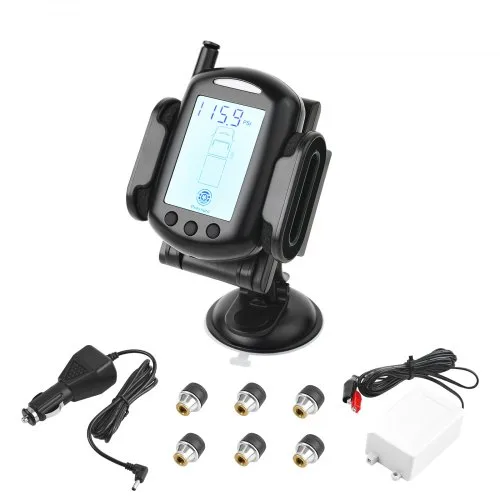
VEVOR C300 is simpler to keep «mentally correct» because it’s commonly used as a basic 6-tire system—fewer wheel positions to label, fewer sensors to manage, and less chance that tire mapping drifts over time. In real use, this tends to support a «set it and forget it» workflow for weekenders or anyone moving the kit between vehicles.
VEVOR M400C is better suited to owners who want one TPMS workflow across evolving setups, but that flexibility comes with more configuration discipline as you expand beyond a baseline. The system’s value grows with more axles and tire positions, yet the practical burden also grows: more sensor assignments to maintain, more opportunities for mis-mapping after tire rotations or trailer swaps.
Conclusion: If your priority is the lowest-effort, stay-correct-by-default experience, C300 has the edge; if your priority is scaling to larger rigs over time, M400C is the better fit.
Winner: VEVOR M400C — its 22-tire maximum is a decisive, use-case-expanding advantage over the C300’s 6-tire cap, even though the C300 can feel simpler for fixed 6-wheel setups.
Accuracy & Pressure Range
Measurement accuracy (how tight the readings are)
The VEVOR C300 specifies ±0.1 bar measurement accuracy for pressure/temperature monitoring, and VEVOR’s own listing repeats that figure for its 6-tire kit. In practical RV use—where you’re often watching for small deltas between tires or verifying a slow leak—tighter accuracy reduces ambiguity when the monitor is your «at-a-glance» decision tool.
The VEVOR M400C is rated at ±0.3 bar accuracy, a spec also echoed across manufacturer/retailer descriptions. That’s still usable for catching big events (rapid leaks, major underinflation), but it’s meaningfully looser if you’re trying to interpret borderline pressure changes around your setpoint.
Conclusion: For pure precision, the C300 wins—±0.1 bar vs ±0.3 bar is a 3× tighter accuracy spec, which is more defensible for «trust the number» monitoring.
Pressure detection range (how high/low it can measure)
The VEVOR C300 lists a 7.3–116 psi (0.5–8 bar) pressure detection range. That ceiling covers many common RV/travel-trailer tire targets (often in the ~80–110 psi band), but it doesn’t leave much headroom for higher-pressure commercial or specialty setups.
The VEVOR M400C expands the measurable range to 0–199 psi (0–16 bar), which is explicitly called out in manufacturer/retailer materials. If you run higher-pressure tires, want more buffer above your operating pressure, or expect to repurpose the system across different rigs over time, that wider range is a tangible capability gain.
Conclusion: For maximum coverage and heavy-duty headroom, the M400C wins—0–199 psi vs 7.3–116 psi is a substantially wider operating range.
Winner: VEVOR C300 — If your goal is more trustworthy, tighter pressure readings within typical RV tire pressures, the ±0.1 bar spec is the more meaningful advantage; the M400C is the better pick specifically when you need the 0–199 psi range.
Power & Setup
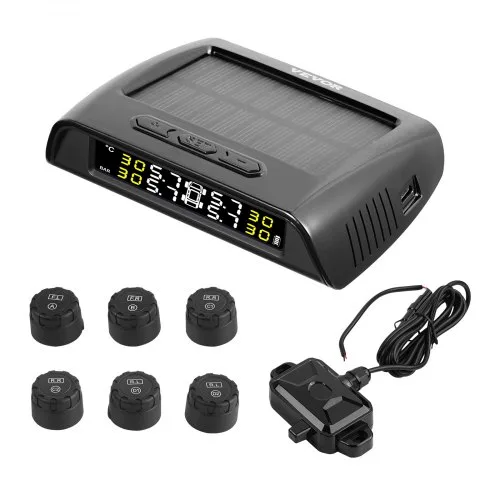
VEVOR C300 is designed around solar + USB power, which supports a more cable-free, move-it-anywhere setup. In practical terms, that makes it easier to treat the monitor as a portable accessory you can transfer between vehicles or quickly position on the dash/windshield without routing a cord. It also aligns with «set it and forget it» weekend/travel use where you want minimal dependence on the tow vehicle’s outlets.
VEVOR M400C uses DC + cigarette lighter power, which tends to be more consistent for always-on operation but also means you’re managing a cable and giving up a 12V socket. For many cabs, that adds friction: you either commit to a permanent mounting/power routine or tolerate a wire run that can compete with other devices on the dash. This more «installed» workflow matches how owners often treat the M400C when they want TPMS to live in the cab full-time.
Conclusion: On pure power flexibility and speed of deployment, VEVOR C300 has the edge thanks to solar + USB (vs. the M400C’s DC/cigarette-lighter dependency). If you prefer a permanent, always-powered cab setup and don’t mind dedicating an outlet, the M400C can be the cleaner long-term routine—but it’s not as inherently portable.
Winner: VEVOR C300
Alert System
VEVOR C300 offers 5 alert modes focused on core TPMS events—typically the basics like high/low pressure, high temperature, and leak detection. For a standard travel-trailer setup (it monitors up to 6 tires), that smaller alert set can be easier to live with because there are fewer conditions to configure and mentally track over time.
VEVOR M400C expands to 7 abnormal tire-pressure alert modes, explicitly including a fast leak warning alongside low/high pressure and high temperature alerts. The monitor behavior is also described in its documentation as using a flashing red warning LED plus an audible alarm to flag pressure variation, reinforcing that it’s designed to be attention-grabbing when something goes wrong.
Conclusion: On alert coverage and early-warning capability (notably fast leak), VEVOR M400C has a meaningful advantage over C300’s 5 modes, especially for more complex or higher-value rigs where extra abnormal-condition detection is worth the added complexity.
Winner: VEVOR M400C
Build & Design
VEVOR C300 uses external cover-style sensors with brass valve stems, and the sensors are rated dustproof, waterproof, and temperature-resistant. At 0.66 lbs (0.3 kg), the kit is notably light for something you may move between vehicles or store between trips. The monitor design also aligns with a low-hassle setup mindset, since it can be powered via solar + USB.
VEVOR M400C also uses external cover-style sensors with brass valve stems and the same dustproof, waterproof, and temperature-resistant sensor protection. It’s heavier at 1.01 lbs (0.46 kg), which can be a non-issue once you treat it as a permanent cab install rather than a portable kit. Its power approach—DC + cigarette lighter—fits that more «installed» workflow, but it’s less oriented around being moved and re-mounted frequently.
Conclusion: C300 has the edge for portability and «move-it-between-rigs» practicality (0.66 lbs vs 1.01 lbs), while M400C’s design choices better suit a more permanent mounting routine. Winner: Tie.
User Experience
Power, mounting, and day-to-day cabin friction
VEVOR C300 is designed to be low-hassle in the cab: the monitor supports Solar + USB charging, which can reduce cable clutter and how often you have to think about power during a trip. It’s also lighter at 0.66 lbs (0.3 kg), which generally makes it easier to move between vehicles or stash when you’re not towing.
VEVOR M400C relies on DC + cigarette lighter power, which tends to be more «always plugged in» and can add one more cable to manage around other dash devices. It’s heavier at 1.01 lbs (0.46 kg), reinforcing the more permanent, «installed» orientation rather than a kit you casually move between rigs.
Conclusion: C300 has the UX edge for minimal-cable, quick-deploy use, while M400C fits better if you’re okay committing a dedicated mount/power routine in exchange for a more fixed setup.
Setup complexity vs scalability (tire mapping and configuration drift)
VEVOR C300 monitors up to 6 tires and ships with 6 external cover-style sensors, which aligns with a straightforward «pair them once and drive» workflow for many travel trailers. In practice, fewer monitored positions means fewer chances of tire-position confusion over time, and its stated accuracy of ±0.1 bar can make the system feel more trustworthy at a glance when readings fluctuate.
VEVOR M400C scales dramatically higher—up to 22 tires—while still including 6 sensors in the box, which implies more pairing and labeling if you expand beyond the basics. That scalability can increase the mental overhead of keeping tire positions mapped correctly (especially if you rotate tires or change configurations), and its spec’d accuracy is looser at ±0.3 bar.
Conclusion: C300 is the simpler, lower-maintenance experience for typical 6-tire towing, while M400C is better if you truly need multi-axle/multi-trailer scaling and are willing to manage the extra configuration discipline.
Alert «chattiness» and clarity
VEVOR C300 lists 5 abnormal tire pressure alerts—a simpler set of alert conditions that can be easier to interpret quickly when you’re using the monitor mainly as a safety backstop. It still provides real-time pressure and temperature monitoring, but with fewer alert categories to tune your attention around.
VEVOR M400C lists 7 abnormal tire pressure alerts, and documentation notes the monitor will flash a red warning LED and sound an alarm when pressure varies. More alert types can be a benefit for early detection (fast leak vs. high temp, etc.), but they can also increase «attention cost» if your priority is a quiet, glance-only monitor.
Conclusion: M400C wins on alert granularity, but C300 may feel less intrusive for drivers who primarily want clear, minimal interruptions.
Shared UX realities (external sensors and ecosystem)
VEVOR C300 uses external cover-style sensors with no tire removal required, which keeps installation simple but means sensors remain exposed to grime and physical knocks over time. It’s also fundamentally a standalone monitor-based kit—there’s no meaningful app ecosystem to reduce manual checks or consolidate alerts elsewhere.
VEVOR M400C uses the same external cover-style sensor approach and likewise avoids tire removal, so the same ongoing friction applies when you add air or verify readings with a handheld gauge. It’s also the same kind of standalone system (monitor + sensors), so you shouldn’t expect software-driven workflows like phone alerts, logging, or integrations.
Conclusion: Neither has a UX advantage on sensor style or «smart» ecosystem—both are hardware-first TPMS kits with similar long-term handling trade-offs.
Winner: VEVOR C300 — It’s meaningfully easier to live with for most RV owners thanks to Solar + USB power, lower weight (0.66 lbs vs 1.01 lbs), and a simpler 6-tire-focused workflow that reduces setup and configuration burden.
The Bottom Line
After breaking down capacity, accuracy, power, alerts, and day-to-day usability, the choice comes down to whether you want a simple 6-tire system or a platform that can grow with a bigger rig.
Best for Simple Trailers (Single Axle, 4-6 Tires): Choose the VEVOR C300, since its fixed 6-tire design and solar-powered monitor deliver the lowest-fuss «set it and forget it» setup.
Best for Large RVs (Multi-Axle, Fifth Wheels, Dual Wheels): Choose the VEVOR M400C, thanks to its 22-tire scalability, wider pressure range, and more robust alert coverage (including fast-leak warning) for higher-stakes, more complex layouts.
Best for Budget-Conscious Buyers: Choose the VEVOR C300, because it undercuts the M400C on price while still covering the most common RV/travel-trailer use cases—just make sure it’s actually in stock.
Overall,
because its scalability, broader pressure range, and stronger alert system make it the more versatile, future-proof pick for most RV owners. The trade-off is that the VEVOR C300 is tighter on accuracy and generally simpler to live with—so if your setup will stay at six tires and you value minimal cabin/power friction, it remains the smarter, cleaner buy.If you’re purchasing for the rig you’ll have a year from now (not just the one you have today), pick the system that matches your tire count and complexity—and commit to a setup routine you’ll actually stick with on every trip.
FAQ
Can I monitor more than 6 tires with the C300?
Which TPMS is more accurate?
Do these systems work with a smartphone app?
Which model is easier to install?
What is the maximum pressure range of the M400C?
Does the C300 support solar charging?
How many alert modes does the M400C have?
📄 Used Manuals & Documentation
VEVOR M400C
"Images are used for editorial and informational purposes only. All trademarks and images belong to their respective owners."