
iMars Car MP5 Player vs YUEHOO YH-D071: Portable Screen or In-Dash Head Unit?
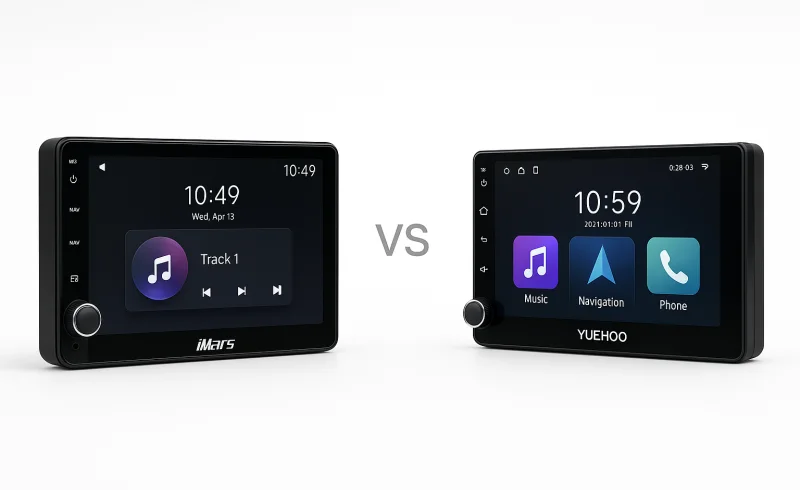
Explore the differences between the portable iMars Car MP5 Player and the integrated YUEHOO YH-D071 head unit. Understand how each device offers distinct advantages in screen quality, hardware capability, installation simplicity, and system integration for var...
TL;DR
- iMars Car MP5 Player is better suited to a car whose factory stereo still works but lacks modern phone projection. It adds an 11.26-inch wireless CarPlay/Android Auto display without replacing the radio.
- YUEHOO YH-D071 is better suited to a deliberate 2DIN head-unit replacement. Its listed hardware is far more substantial, with Android 12, built-in GPS, DSP, up to 8GB of RAM, and up to 256GB of storage—but those advantages depend on successful vehicle integration.
- There is no useful overall winner here. One product is an accessory screen; the other becomes part of the car’s infotainment stack. Feature-count comparisons favor YUEHOO, while installation simplicity and reversibility favor iMars.
The most important difference is not the extra inch of display or the RAM figure. It is where the complexity lives. With iMars, most of the intelligence remains on the phone, while the car keeps its existing stereo and controls. With YUEHOO, more functions move into the new head unit, which creates more capability but also more opportunities for fitment, wiring, camera, audio, and factory-control compatibility issues.
The specifications below are seller-listed unless otherwise noted. Startup times, performance claims, and feature support should not be read as independently measured results.
| Feature | YUEHOO YH-D071 | iMars Car MP5 Player |
|---|---|---|
| Display | ||
| Screen Size | 12.3 inches | 11.26 inches |
| Display Type | 2.5D IPS screen | IPS, 2.5D fully bonded capacitive touch screen |
| General | ||
| Form Factor | 2DIN car stereo radio MP5 player | Portable car MP5 player |
| Hardware | ||
| RAM | 4GB / 6GB / 8GB | 1GB |
| Storage | 64GB / 128GB / 256GB | Expansion card up to 128G (not included) |
| Processor | 8-core 2.5GHz | F133-RISC CPU |
| Startup Time | Within 2 seconds | 6S |
| Connectivity | ||
| Radio | Radio with Radio Data System function | FM transmission |
| Wi-Fi | WiFi | 2.4+5G |
| Bluetooth | Bluetooth 5.0 | Bluetooth 5.0 |
| USB Input | USB | USB |
| Memory Card Support | SD | TF card |
| Smartphone Integration | Wired and wireless CarPlay & Android Auto | Wireless CarPlay / wireless Auto |
| Navigation & Cameras | ||
| Navigation | GPS | GPS navigation supported when connected to CarPlay / Android Auto |
| Camera Support | AHD camera supported; 360 camera supported | 2.5m 4-section AHD rear camera interface |
📑 Table of Contents
- Display: Size Matters Less Than Placement
- Performance & Hardware: Two Very Different Jobs
- Software & Smartphone Integration
- Installation & Form Factor
- Portability & Long-Term Practicality
- Audio: Integration Is Not the Same as Proven Sound Quality
- Navigation & Camera Support
- Which Design Fits Which Car?
- The Bottom Line
- FAQ
Display: Size Matters Less Than Placement
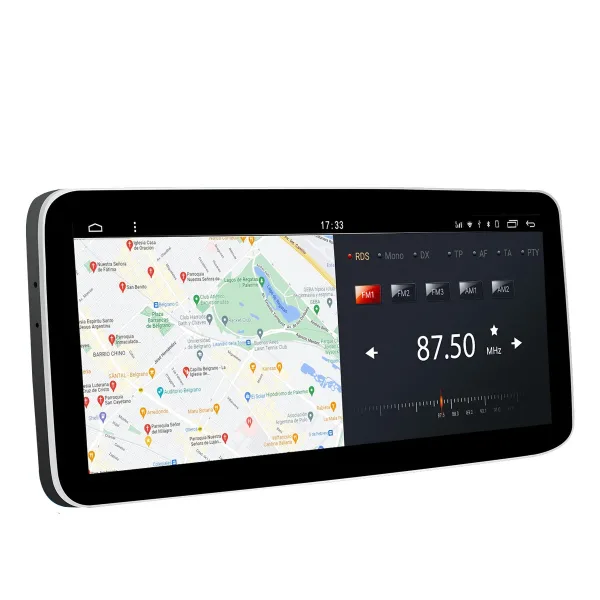
The iMars has an 11.26-inch IPS touchscreen with a listed 1920×720 resolution and a 2.5D fully bonded capacitive construction. That resolution is a useful, concrete specification: CarPlay and Android Auto interfaces have enough horizontal room for maps, media controls, and split layouts without feeling cramped.
The YUEHOO uses a larger 12.3-inch 2.5D IPS display. The extra diagonal space can make touch targets and map information easier to glance at, but the supplied specifications do not establish a comparable resolution, brightness figure, anti-glare treatment, or contrast measurement. That means it is not defensible to call the YUEHOO panel sharper or better simply because it is larger.
The terms IPS and 2.5D also deserve some restraint. IPS describes the panel technology; 2.5D describes the shape of the cover glass around its edges. Neither tells you how readable the screen will be in direct sun. iMars does at least specify a fully bonded display, but without equivalent construction details for YUEHOO, that is not enough for a complete image-quality comparison.
Placement may matter more than either spec sheet. iMars sits on an external mount, so its viewing angle can be adjusted more freely, but the screen also has to live somewhere above the dashboard. A poor position can introduce reflections, block vents or controls, or intrude into the driver’s field of view. The YUEHOO is tied to the vehicle’s stereo location; that can look cleaner when the fit is right, but the dash geometry determines the viewing height and angle.
Display verdict: YUEHOO provides the larger screen. iMars provides the clearer documented resolution. There is not enough evidence to declare a screen-quality winner.
Performance & Hardware: Two Very Different Jobs
iMars is a projection device first
The iMars uses an F133-RISC processor with 1GB of RAM and supports an expansion card of up to 128GB. Those numbers look modest beside a modern Android head unit, but that comparison misses its role. During CarPlay or Android Auto use, the phone is responsible for the apps, navigation data, voice assistant, and most of the computing workload. The iMars mainly has to maintain the connection, draw the interface, handle touch input, and manage local media functions.
That architecture limits what the device can do on its own, but it also means the screen does not need the same hardware headroom as a self-contained Android system.
YUEHOO is a small Android computer in the dashboard
The YUEHOO is listed with an 8-core 2.5GHz processor, 4GB, 6GB, or 8GB of RAM, and 64GB, 128GB, or 256GB of internal storage. On paper, that is a different class of hardware. It gives the head unit room for locally installed apps, offline media, cached maps, and more multitasking without handing every task back to the phone.
There is still an important limit to what the spec sheet can prove. The exact processor model is not identified in the supplied data, and core count plus clock speed do not establish interface smoothness, thermal behavior, storage speed, or long-term responsiveness. The YUEHOO clearly has more hardware resources; that is not the same as having independently demonstrated faster real-world performance.
Startup figures need context
iMars lists a 6-second startup time. YUEHOO claims startup within 2 seconds. The latter sounds dramatically faster, but the available information does not explain whether that figure refers to a full cold boot or waking from a low-power standby state. Without the same test condition for both units, the figures should not be treated as a controlled benchmark.
Hardware verdict: YUEHOO has a large raw-spec advantage because it is designed to run far more software locally. iMars is intentionally lighter because its main job is phone projection.
Software & Smartphone Integration
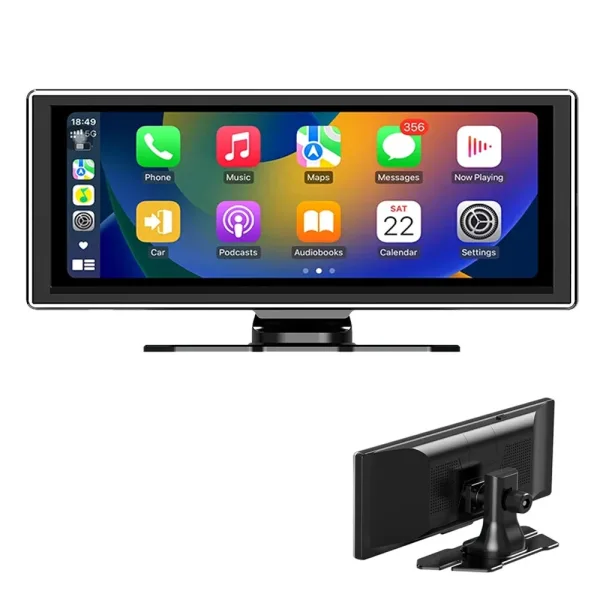
The iMars supports wireless CarPlay and wireless Android Auto. Its navigation function is tied to those phone-projection systems, so maps, traffic data, messaging, podcasts, and voice control remain part of the phone ecosystem.
That can be a practical advantage for a driver who already lives in Apple CarPlay or Android Auto. There is less reason to maintain a separate set of apps on the car screen, and map or streaming-service updates happen primarily on the phone. The trade-off is dependence on the phone connection: if projection fails to connect, most of the modern interface disappears with it.
The YUEHOO is listed as running Android 12 with built-in GPS, while also supporting CarPlay and Android Auto. That gives it two operating models: it can act as a phone-projection display, or it can run functions directly on the head unit.
The second mode is the bigger distinction. A standalone Android head unit can host its own navigation and media software, but that also makes firmware quality and software maintenance more important. The supplied information establishes the Android version and hardware configuration; it does not establish how long firmware or security updates will be provided.
Android 12 therefore should be read as a platform specification, not as evidence of a particular support lifespan.
Software verdict: iMars is simpler and more phone-dependent. YUEHOO is more self-contained and flexible, but its onboard software becomes another system that has to remain reliable over time.
Installation & Form Factor
This is the section that should drive the decision more than CPU numbers.
iMars: add a screen, leave the factory stereo alone
The iMars is a portable display. Its basic installation is external: mount the screen, provide power, pair the phone, and route audio through the available path. There is no need to remove the factory head unit simply to use CarPlay or Android Auto.
That makes the retrofit much easier to reverse. It also means the car keeps its original radio, factory menu structure, and whatever vehicle-specific systems are already tied to that hardware.
The cost of that simplicity is visible hardware. An 11.26-inch screen needs a stable mounting point, and power or audio cables still have to go somewhere. If a rear camera is added, the project stops being purely plug-in because the camera and its wiring must also be routed through the vehicle.
Mount location deserves more thought than these products usually get in marketing material. The display should not obstruct the road view, cover critical controls, interfere with airbags, or sit where vibration makes touch input difficult.
YUEHOO: replacing the head unit is a vehicle-integration project
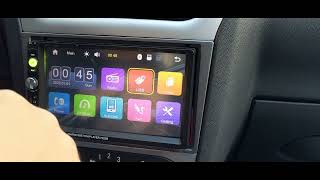
The YUEHOO is a 2DIN head unit, so the installation starts with removing the factory stereo and connecting the replacement to the car’s power, speakers, antenna, cameras, and control interfaces as applicable.
“2DIN” does not mean “universal” in the practical sense. It describes a common chassis format, but a 12.3-inch front display can extend well beyond the opening. Dash trim, screen clearance, vents, physical controls, wiring harnesses, factory amplifiers, steering-wheel buttons, and OEM cameras can all affect whether the finished installation works as intended.
That distinction matters because a feature can be supported by the head unit without being automatically compatible with a particular vehicle. Camera support, steering-wheel integration, or other factory functions may still require adapters, interface modules, or vehicle-specific wiring.
Installation verdict: iMars is substantially easier to add and remove. YUEHOO can be much more integrated, but only after the car-specific part of the project is solved.
Portability & Long-Term Practicality
The iMars makes the most sense when permanence is not the goal. It can move to another vehicle without repeating a full stereo installation, and the original dashboard remains largely untouched. That is useful for a leased vehicle, a car likely to be replaced soon, or a household where the display may occasionally move between cars.
Portability is not completely frictionless. A mount can leave adhesive behind, cable routing has to be redone, and a wired rear camera would remain vehicle-specific. Still, the core screen is much easier to relocate than an in-dash head unit.
The YUEHOO is effectively semi-permanent once installed. Removing it means reopening the dashboard, undoing the harness work, and potentially sourcing a different trim kit or interface for the next vehicle. Its value is therefore tied more closely to the car in which it is installed.
That makes the ownership question straightforward: iMars separates the screen from the car; YUEHOO makes the screen part of the car.
Audio: Integration Is Not the Same as Proven Sound Quality
The original comparison overstates what can be concluded from the audio specifications.
The iMars lists FM transmission and a small built-in speaker. FM transmission is convenient because it can feed audio into an existing car radio without replacing anything, but it is not the same thing as a direct head-unit connection. Reception conditions and local FM congestion can affect the result.
What cannot be established from the supplied specification set is that every iMars configuration is limited to FM for normal listening, so it is safer to treat the audio path as a configuration detail rather than assume one universal setup.
The YUEHOO lists a DSP and, as a replacement head unit, sits directly in the vehicle’s audio chain. A DSP can provide tools such as equalization, filtering, level adjustment, or time alignment depending on the implementation. But the presence of DSP does not prove cleaner output, lower noise, stronger amplification, or better sound than another device.
Factory amplified systems add another complication. A replacement head unit may need the correct adapter or interface to work properly with an OEM amplifier or speaker system. More direct integration creates more tuning potential, but also more installation dependency.
Audio verdict: YUEHOO offers the more capable audio architecture on paper. There is not enough measured evidence to make a sound-quality or “audiophile” claim.
Navigation & Camera Support
The iMars handles navigation primarily through CarPlay or Android Auto, so the phone provides the mapping platform. That is consistent with the rest of its design: the screen is an interface for the phone rather than an independent navigation computer.
It also lists an AHD rear-camera interface, which is enough for a conventional reversing-camera setup when the required camera and wiring are present.
The YUEHOO lists built-in GPS and runs Android 12, so navigation can operate on the head unit without an active CarPlay or Android Auto session, assuming appropriate mapping software is installed. It also lists support for both AHD cameras and 360-degree camera systems.
The important word is support. A head unit that can accept a 360-degree system does not automatically provide a complete, calibrated surround-view installation. Cameras, wiring, trigger signals, placement, and calibration remain part of the vehicle setup.
For a simple rear view, iMars covers the basic use case. For a head unit intended to become the central display for a more elaborate camera system, YUEHOO has the broader listed capability.
Which Design Fits Which Car?
The iMars fits the cleaner scenario when the factory stereo is still satisfactory and the missing feature is mainly a modern phone interface. It adds a large screen while leaving most of the car untouched. The compromises are the external mount, visible cabling, phone dependence, and less direct integration with the vehicle.
The YUEHOO fits a different scenario: the existing stereo is already a candidate for replacement, the dashboard can physically accommodate the 2DIN chassis and oversized screen, and the required wiring or adapters are understood before installation. In that context, Android 12, built-in GPS, DSP, additional memory, storage, and expanded camera support become relevant advantages rather than just a longer spec list.
Neither design is automatically suitable for a car whose factory infotainment controls climate settings, vehicle configuration, parking systems, or other deeply integrated functions. In those vehicles, preserving OEM behavior can matter more than any feature listed here.
The Bottom Line
This comparison becomes much clearer once the products stop being treated as direct substitutes.
iMars Car MP5 Player is the less invasive route to CarPlay and Android Auto. Its strongest arguments are reversibility, minimal dashboard work, and the fact that the phone remains the main computing platform. Its weaknesses are equally structural: the screen sits outside the dash, cabling is harder to hide, navigation depends on phone projection, and audio integration is less direct.
YUEHOO YH-D071 is the more capable system on paper. Its larger screen, much stronger listed hardware, Android 12 platform, built-in GPS, DSP, and broader camera support give it far more scope as a central infotainment unit. But all of that sits behind a prerequisite that the spec table cannot solve: the vehicle has to accept the hardware and integrate correctly with the systems already in the car.
So the decision is not “simple device versus better device.” It is external phone interface versus replacement infotainment system.
For a functioning factory stereo that mainly lacks CarPlay or Android Auto, iMars is the more proportionate solution. For a vehicle where the stereo is already being replaced and compatibility has been verified, YUEHOO offers substantially more integration headroom.
FAQ
Can the iMars Car MP5 Player be installed without tools?
Does the YUEHOO YH-D071 support wireless CarPlay?
Which product has better audio quality?
Is the iMars screen large enough for navigation?
How fast does the YUEHOO YH-D071 start up?
Does the iMars Car MP5 Player have built-in GPS?
Which product supports 360-degree cameras?
"Images are used for editorial and informational purposes only. All trademarks and images belong to their respective owners."