CP025 vs LAESD: Wireless Adapter or Android Box for Your Car?
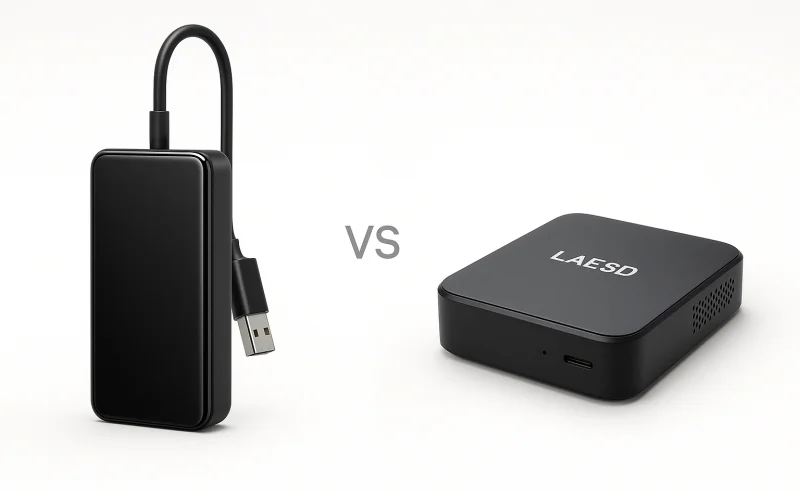
Explore the differences between CP025 and LAESD for enabling wireless connectivity in your car. Understand the benefits of CP025's simple, reliable wireless bridge versus the advanced capabilities of LAESD's standalone Android box. Delve into setup ease, daily...
TL;DR
- If you want the simplest, most reliable way to ditch the cable while keeping your car’s factory look and feel → choose CP025 Wireless CarPlay/Android Auto Adapter
- If you want to run apps directly on the screen (video streaming, web browsing, full Android apps) and don’t mind extra setup and occasional tweaking → choose LAESD CarPlay to Android Box
- If you mainly need navigation, calls, and music without surprises → either works, but CP025 is the safer bet for predictable daily use
Key differentiators: CP025 is a pure wireless bridge — it keeps everything phone-driven and predictable, with Bluetooth 5.3 and dual-band Wi‑Fi 6 for solid connectivity. LAESD adds a standalone Android 13 system that expands what you can do, but that extra capability comes with longer initial setup, more app-management overhead, and higher risk of long-term software hiccups (unknown Bluetooth version, slower update cycle). For most drivers who just want wireless CarPlay/Android Auto to «work» every time, CP025’s simplicity wins; LAESD only makes sense if you actively want a car tablet experience and can tolerate extra complexity.
Who should skip both: If your car’s infotainment is already buggy or you have zero tolerance for occasional reconnects or boot delays, consider upgrading to a modern head unit with built-in wireless CarPlay instead of adding an aftermarket adapter.
| Feature | LAESD CarPlay to Android Box | CP025 Wireless CarPlay/Android Auto Adapter |
|---|---|---|
| Power | ||
| Input Power | 5V | 5V/1A |
| Connectivity | ||
| Wi-Fi | Wi-Fi 6 | Wi-Fi 6 (802.11ax), 2.4GHz + 5GHz |
| Bluetooth | Bluetooth | Bluetooth 5.3 |
| Functionality | ||
| Device Role | CarPlay to Android AI box with wireless CarPlay/Android Auto support | Wired CarPlay/Android Auto to wireless CarPlay/Android Auto adapter |
| Wireless CarPlay | Supported | Supported |
| Wireless Android Auto | Supported | Supported |
| Factory Control Retention | Supports original car MIC, buttons, and touch screen | Retains original controls and interface |
| Standalone Android System | Android 13 Open System | Not supported |
| Factory System Requirement | Requires original car CarPlay | Requires factory wired CarPlay or wired Android Auto |
📑 Table of Contents
Functionality & Use Case
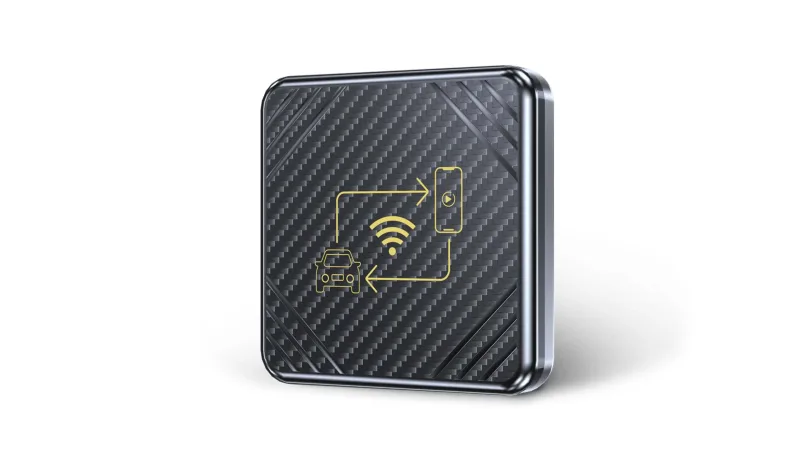
CP025 Wireless CarPlay/Android Auto Adapter is strictly a wired-to-wireless adapter: it takes your car’s existing wired CarPlay/Android Auto and converts it to wireless CarPlay and wireless Android Auto. Because it retains the original controls and interface, your daily experience stays phone-driven and close to factory behavior (including app availability and UI limits). It also explicitly supports Wi‑Fi 6 (2.4GHz + 5GHz) and Bluetooth 5.3, aligning with its «pair once, then forget it» role.
LAESD CarPlay to Android Box is a different category: it’s a CarPlay-to-Android AI box that still supports wireless CarPlay and wireless Android Auto, but also runs a standalone Android 13 Open System. In practice, that means the head unit can behave more like an in-car tablet running apps directly on the box—while still supporting original inputs (it «supports original car MIC, buttons, and touch screen»). It uses Wi‑Fi 6 (Bluetooth version unspecified) and, like CP025, plugs into the USB port intended for wired CarPlay/Android Auto.
Conclusion: LAESD has the clear functional advantage because it adds a full Android 13 environment on top of wireless CarPlay/Android Auto, enabling use cases CP025 can’t (standalone apps and a dedicated «car computer» experience). Winner: LAESD CarPlay to Android Box.
Setup & Connectivity
Onboarding complexity (time-to-first-use)
CP025 Wireless CarPlay/Android Auto Adapter is designed as a wired-to-wireless bridge, so setup is primarily «plug into the factory wired CarPlay/Android Auto USB port, then pair once.» It uses Bluetooth 5.3 plus Wi‑Fi 6 (802.11ax) dual-band 2.4GHz/5GHz to establish the wireless link, and it’s meant to keep the car’s interface and controls unchanged.
LAESD CarPlay to Android Box also plugs into a car’s CarPlay USB path (it requires original car CarPlay) but behaves more like a separate device because it runs a standalone Android 13 open system. That typically means additional first-run steps (Android setup, permissions, app logins) before it feels «ready,» even though it still supports wireless CarPlay/Android Auto.
Conclusion: CP025 has the clear edge for fastest, simplest setup, while LAESD’s extra configuration is the trade-off for its standalone Android experience.
Wireless link basics (what you must enable, radios provided)
CP025 Wireless CarPlay/Android Auto Adapter explicitly depends on having Bluetooth and Wi‑Fi enabled on the phone for proper operation, matching how most wireless projection adapters negotiate and then hand off to Wi‑Fi. On-paper connectivity is strong for this category with Wi‑Fi 6 (2.4GHz + 5GHz) and Bluetooth 5.3, which should help with pairing speed and resilience in busy RF environments.
LAESD CarPlay to Android Box likewise expects the phone side to have Bluetooth and Wi‑Fi enabled when using wireless CarPlay/Android Auto, but its Bluetooth spec is listed only as «Bluetooth» (no version stated). It does match CP025 on Wi‑Fi 6, but without a Bluetooth version it’s harder to predict pairing performance or interoperability in edge cases.
Conclusion: CP025 is better-specified for connectivity (Bluetooth 5.3 + dual-band Wi‑Fi 6); LAESD matches on Wi‑Fi 6 but is less transparent on Bluetooth capability.
Winner: CP025 Wireless CarPlay/Android Auto Adapter
Daily User Experience
CP025 Wireless CarPlay/Android Auto Adapter is designed to make your existing system feel like native wireless projection: it converts wired CarPlay/Android Auto to wireless while retaining original controls and interface. Because it’s fundamentally a bridge to your phone’s UI, the day-to-day experience tends to stay consistent with whatever Apple CarPlay/Android Auto already looks and behaves like on your device. In connectivity terms, it pairs via Bluetooth 5.3 and runs over dual-band Wi‑Fi 6 (2.4GHz + 5GHz), which supports the «connect once, then mostly forget it» intent.
LAESD CarPlay to Android Box shifts daily use toward a «car tablet» model, because it includes a standalone Android 13 open system while also supporting wireless CarPlay and wireless Android Auto. That means your routine is more dependent on the box’s launcher, app behavior, and sleep/wake handling rather than just your phone’s projection session. Connectivity is modern on paper with Wi‑Fi 6, but the spec sheet doesn’t clarify bands, and Bluetooth is listed only as «Bluetooth» (no version), which makes the expected pairing behavior less predictable.
Conclusion: CP025 has the edge for predictable day-to-day behavior because it keeps you inside the familiar CarPlay/Android Auto experience, while LAESD trades consistency for capability by adding a full Android layer that can introduce more UI and app-management variability.
CP025 Wireless CarPlay/Android Auto Adapter also tends to have fewer «moving parts» in daily operation: you’re relying on your phone for apps, updates, and performance, and the adapter mainly needs your phone’s Bluetooth + Wi‑Fi enabled to function. The main practical friction point in this category is short-stop behavior—wireless adapters can be sensitive to ignition cycles and may occasionally need a quick reconnect or re-pair if the handshake gets stuck (a known failure mode for wireless projection bridges). Because CP025 draws 5V/1A, it’s also more explicit about the power budget it expects from the vehicle’s USB port.
LAESD CarPlay to Android Box requires more «device-like» upkeep during regular use: beyond initial Android setup, you’re effectively maintaining an Android computer that must resume smoothly every time the car wakes. Documentation for boxes in this category also flags that connection problems can come from head-unit compatibility and insufficient power supply (even when the car supports wired CarPlay), and LAESD only lists 5V input without an amperage target. That combination makes daily reliability more dependent on your specific car’s USB power delivery and infotainment behavior.
Winner: CP025 Wireless CarPlay/Android Auto Adapter
Audio & Call Quality
CP025 Wireless CarPlay/Android Auto Adapter keeps audio and calls inside the standard CarPlay/Android Auto pipeline—your phone runs the apps, and the adapter mainly bridges wireless connectivity (notably Wi‑Fi 6 dual-band 2.4GHz + 5GHz plus Bluetooth 5.3). In practice, that tends to preserve the «known» behavior of your existing setup, but it can still expose edge cases versus wired—especially around microphone selection, echo cancellation, or call routing—that are often resolved with a restart or re-pair.
LAESD CarPlay to Android Box shifts more responsibility to the box because it’s a standalone Android 13 open system, which can change how audio is managed compared with phone-mirroring. While it claims to support the original car mic and controls, the bigger risk is audio focus conflicts (music vs navigation prompts vs calls) between Android apps and the car’s system, and these issues can be subtle and highly app-dependent. Its connectivity specs are less specific here (Wi‑Fi 6 and generic Bluetooth listed), so it’s harder to infer whether link-layer behavior will be more consistent than CP025.
Comparative conclusion: Neither has a defensible, across-the-board advantage on audio and calls from the available data—CP025 is typically more predictable because it relies on your phone’s CarPlay/Android Auto stack, while LAESD can be more variable because it’s effectively an in-car Android computer. Winner: Tie
Software & Updates
The CP025 Wireless CarPlay/Android Auto Adapter largely «outsources» software to your phone: it converts wired CarPlay/Android Auto to wireless and then runs whatever Apple CarPlay or Android Auto your device provides. Its compatibility floor is explicitly tied to the phone OS—iOS 10+ and Android 11+—so app behavior and feature changes generally arrive through Apple/Google and your handset updates rather than the adapter itself. With Wi‑Fi 6 (2.4GHz + 5GHz) and Bluetooth 5.3, the CP025’s software surface area is relatively small, which reduces the number of moving parts that can go stale over time.
The LAESD CarPlay to Android Box shifts the software burden onto the accessory by adding a standalone «Android 13 Open System» on top of wireless CarPlay/Android Auto support. That can expand what the head unit can do, but it also makes long-term experience more dependent on the vendor’s update cadence, security patching, and how well the Android build/launcher ages as apps evolve (especially for streaming/DRM-protected services). While it also uses Wi‑Fi 6, its Bluetooth spec is listed only as «Bluetooth» (no version), and—crucially—more of the daily experience is controlled by the box’s OS rather than your phone’s mature update pipeline.
Comparative conclusion: For predictable software behavior and longer-term app compatibility, CP025 has the edge because it stays inside the established Apple/Google CarPlay/Android Auto ecosystem and minimizes vendor-dependent software risk. LAESD can be more capable if you specifically want an Android «car computer,» but that flexibility comes with higher uncertainty around updates and future app compatibility.
Winner: CP025 Wireless CarPlay/Android Auto Adapter
Long-term Reliability
CP025 Wireless CarPlay/Android Auto Adapter is fundamentally a converter—turning a wired CarPlay/Android Auto port into wireless projection—so long-term reliability is mostly about whether it continues to connect cleanly and consistently. On the hardware side, it’s clearly positioned as low-draw USB accessory gear (5V/1A input), with Wi‑Fi 6 (2.4GHz + 5GHz) and Bluetooth 5.3 intended to keep pairing and wireless handshakes stable over time. In practice, its «maintenance» profile is usually minimal: if it misbehaves, the typical fix is unplug/replug or re-pair rather than ongoing device management.
LAESD CarPlay to Android Box behaves more like an always-in-the-car computer: it runs a standalone Android 13 open system and then provides wireless CarPlay/Android Auto on top of that. Even with modern connectivity (Wi‑Fi 6 and Bluetooth), long-term reliability depends not just on connection handshakes but also on the Android software layer—updates, background apps, storage/caches, and how well it resumes after ignition cycles. That added complexity means it may need periodic «device hygiene» (updates, cache clears, occasionally factory resets) to prevent slowdowns or weird state issues that can accumulate over months.
Conclusion: CP025 is the more defensible pick for long-term reliability because its simpler «adapter-only» role creates fewer ongoing failure points than maintaining an Android box environment in a heat/vibration/power-cycle-heavy car setting. Winner: CP025 Wireless CarPlay/Android Auto Adapter.
The Bottom Line
After digging into functionality, setup, day-to-day behavior, and long-term reliability, the choice comes down to whether you want a simple wireless bridge or a full Android «car computer.»
For daily commuters who want simple wireless CarPlay/Android Auto: The CP025 Wireless CarPlay/Android Auto Adapter is the better pick thanks to its fast plug-and-pair setup, predictable phone-driven experience, and lower-cost, lower-friction design.
For power users who want a full Android infotainment system: The LAESD CarPlay to Android Box is the right call because it adds a standalone Android 13 environment with app flexibility that an adapter like CP025 simply can’t provide—at the cost of more setup and ongoing complexity.
Overall,
for most drivers: it was consistently stronger on simplicity, well-specified connectivity, day-to-day predictability, and long-term reliability. The trade-off is clear: LAESD wins on capability if your priority is running Android apps directly on the head unit.If you want wireless CarPlay/Android Auto to «just work,» choose CP025; if you’re intentionally upgrading your dashboard into an Android platform and accept the extra upkeep, LAESD is the more ambitious option.
FAQ
Which is easier to set up: CP025 or LAESD?
Can I watch video apps like YouTube on these adapters?
Do both retain original car controls?
What connectivity specifications does the CP025 adapter offer?
What can cause connection problems with the CP025 or LAESD adapters?
Do I need to have an existing wired CarPlay system to use either adapter?
"Images are used for editorial and informational purposes only. All trademarks and images belong to their respective owners."