
Blink Video Doorbell (2nd Gen) vs Wyze Battery Video Doorbell: Which One Fits Your Setup?
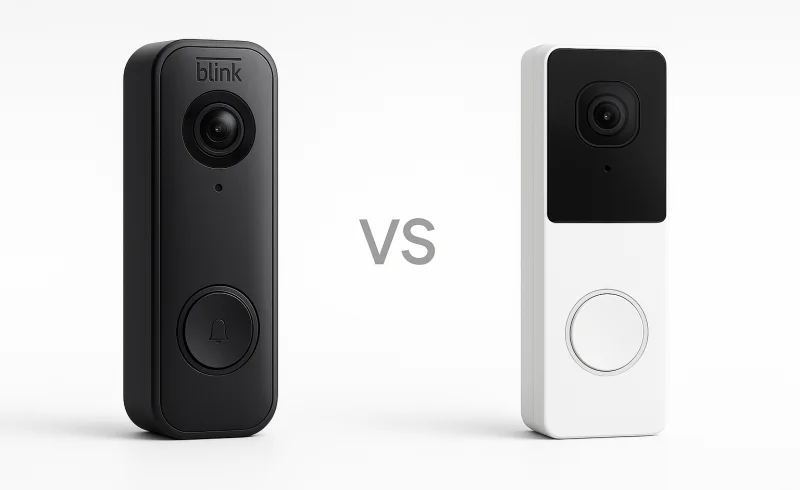
Explore the differences between Blink Video Doorbell and Wyze Battery Video Doorbell. Find out which offers better video quality, battery life, and smart-home compatibility, and discover which suits your needs for smart home integration and ease of installatio...
TL;DR
- For the longest manufacturer-rated interval between battery changes: Blink Video Doorbell (2nd Gen) is the stronger fit. Blink rates its three AA lithium batteries for up to two years under default settings and typical use, although actual life varies with settings, activity, Wi-Fi conditions, and environment. A Sync Module is required. :contentReference[oaicite:0]{index=0}
- For rechargeable power, direct local storage, and broader smart-home compatibility: Wyze Battery Video Doorbell has the more flexible design. It uses a built-in 6,400 mAh rechargeable battery, supports microSD storage in the doorbell, and lists Alexa, Google Assistant, and IFTTT integration. :contentReference[oaicite:1]{index=1}
- For porch coverage: there is no meaningful winner on specifications alone. Blink lists a square 1:1 image with a 150° horizontal and vertical field of view; Wyze lists roughly 150° in both directions. Both are designed for head-to-toe framing. :contentReference[oaicite:2]{index=2}
- For continuous local recording: Wyze has an important advantage when hardwired. Its microSD system can record continuously with wired power; on battery, microSD recording is limited to events. Blink's local-storage system is based on event clips rather than continuous recording. :contentReference[oaicite:3]{index=3}
One clarification matters before comparing them: this article refers to the Blink Video Doorbell (2nd Gen). Blink's original first-generation Video Doorbell is no longer available, while the company introduced a newer Battery Doorbell 2K+ in May 2026. The second-generation model remains part of Blink's supported lineup, but it should not be confused with either of those products. :contentReference[oaicite:4]{index=4}
| Feature | Blink Video Doorbell | Wyze Battery Video Doorbell |
|---|---|---|
| Audio | ||
| Two-Way Audio | Supported | Supported |
| Power | ||
| Battery Life | Up to 2 years with default settings and normal use when paired with a Sync Module | Up to 3-6 months with normal use |
| Battery Type | 2 x AA 1.5V lithium non-rechargeable batteries | 6400 mAh non-removable lithium-ion battery |
| Rechargeable Battery | Not supported | Supported |
| Hardwired Power Requirement | 16-24V AC, 50-60Hz, 40VA maximum | 12-24V AC, 50/60Hz |
| Video | ||
| Night Vision | Black and white night vision with 850 nm infrared LED | Color night vision with 850 nm IR lights |
| Field of View | 135° horizontal, 80° vertical | 180° diagonal, 148° horizontal, 148° vertical |
| Video Resolution | 1440 x 1400 | 1536 x 1536 HD+ |
| General | ||
| Installation Modes | Wired or wire-free | Wire-free or wired |
| Storage | ||
| Local Storage Support | Supported via Sync Module 2 and USB flash drive | Supported via microSD card (8-32 GB FAT32; up to 256 GB exFAT) |
| Physical | ||
| Weight | 3.2 oz (91 g) | 7.58 oz (215 g) |
| Dimensions | 5.1 x 1.7 x 1 in (130 x 42 x 27 mm) | 5.71 x 1.85 x 1.14 in (145 x 47 x 29 mm) |
| Smart Home | ||
| Alexa | Supported | Supported |
| IFTTT | Supported | Supported |
| Google Assistant | Not supported | Supported |
| Connectivity | ||
| Wi-Fi | 2.4 GHz 802.11b/g/n | 802.11 b/g/n 2.4 GHz, Wi-Fi 4/5/6 |
| Environmental | ||
| Weather Resistance | IP54 | IP65 |
| Operating Temperature | -4 to 113°F (-20 to 45°C) | -4 to 122°F (-20 to 50°C) |
📑 Table of Contents
Video Quality & Field of View
Resolution matters less here than the original numbers suggest
The Blink Video Doorbell (2nd Gen) records in up to 1440p HD with a 1:1 aspect ratio, a head-to-toe format designed to keep both a visitor's face and the area near the doorstep in the same frame. Blink specifies a 150° horizontal and 150° vertical field of view and a frame rate of up to 30 fps. :contentReference[oaicite:5]{index=5}
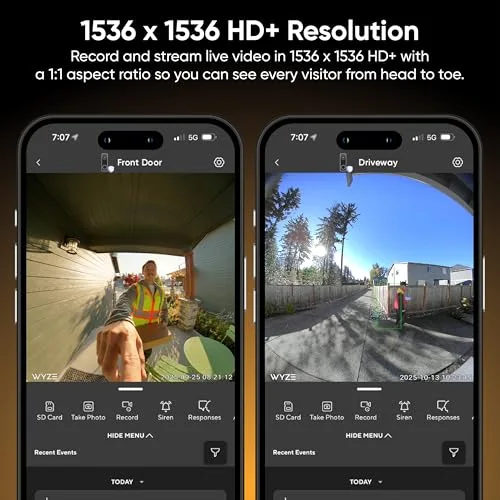
The Wyze Battery Video Doorbell records at 1536 × 1536, also in a square format. Wyze's detailed technical documentation lists 180° diagonal coverage and 148° horizontal and vertical coverage, while some of its product materials round the horizontal and vertical figure to 150°. It records at up to 20 fps during the day and 15 fps at night and supports 8× digital zoom. :contentReference[oaicite:6]{index=6}
That makes Wyze's nominal resolution slightly higher, but this is not the dramatic image-quality gap suggested by comparing Wyze against the older Blink doorbell. The current second-generation Blink model also uses a square, head-to-toe image. Without controlled side-by-side image testing, the specifications alone do not justify claiming that one consistently produces more useful facial or package detail.
Porch coverage is essentially a tie
Both cameras cover roughly 150° horizontally and vertically, so neither has a major paper advantage for seeing a package placed near the threshold while keeping a visitor in frame. Exact mounting height, door-frame angle, stairs, railings, and the use of an angled mount can matter more than a difference of a few degrees between published specifications. :contentReference[oaicite:7]{index=7}
Edge: Tie
Night Vision
Wyze has the clearer documented advantage after dark. The Wyze Battery Video Doorbell explicitly supports Color Night Vision along with 850 nm infrared illumination. Color night vision still depends on the available light, so extremely dark scenes may rely more heavily on infrared, but the feature can preserve useful color information when conditions allow. :contentReference[oaicite:8]{index=8}
Blink's current technical documentation for the Video Doorbell (2nd Gen) does not make an equivalent color-night-vision claim. That means the defensible distinction is not that Blink necessarily performs poorly at night, but that Wyze specifically documents color night capability while Blink does not.
Edge: Wyze Battery Video Doorbell
Battery Life & Power
Blink minimizes how often the batteries need attention
Blink uses three Energizer AA 1.5V non-rechargeable lithium batteries and rates them for up to two years with default settings. Usage, customized settings, signal quality, and environmental conditions can shorten that figure, so it should be treated as a manufacturer maximum rather than an expected replacement schedule for every doorway. The second-generation doorbell also requires a Sync Module to operate. :contentReference[oaicite:9]{index=9}
Wyze uses a 6,400 mAh built-in lithium-ion battery rated for up to three to six months under normal use. It recharges over USB-C, and Wyze specifies approximately six hours for a 0–100% charge. High event volume, long live-view sessions, weak Wi-Fi, higher streaming resolution, and local microSD recording can all increase battery drain. :contentReference[oaicite:10]{index=10}
The practical trade-off is straightforward. Blink potentially needs battery attention far less often, but it consumes disposable lithium cells. Wyze requires more frequent charging, and because its battery is not removable, a battery-only installation has downtime while the doorbell is charging.
Wiring changes the experience differently
Both models can be installed without existing doorbell wiring, and both support wired installations. Their power architectures are not identical.
Blink still requires its three AA batteries even when wired. Blink describes a wired installation as providing supplemental power, supporting the in-home chime, and extending battery life rather than eliminating the batteries. :contentReference[oaicite:11]{index=11}
Wyze's wired mode can provide continuous power, which matters for households that do not want periodic charging and is also required for continuous microSD recording. :contentReference[oaicite:12]{index=12}
Edge for battery-only operation: Blink Video Doorbell (2nd Gen)
Edge for continuous wired power: Wyze Battery Video Doorbell
Local Storage, Cloud Recording & Subscriptions
This is one of the most consequential differences between the two systems.
Blink: local storage lives at the Sync Module
Because the Blink Video Doorbell (2nd Gen) already requires a Sync Module, its storage architecture is built around that component. Local clips can be stored using a Sync Module 2 with a USB flash drive or a Sync Module XR with a microSD card. The Sync Module Core does not support local storage, an important distinction when evaluating different Blink bundles. :contentReference[oaicite:13]{index=13}
A Blink subscription is not required for basic Live View, motion alerts, or two-way audio. With compatible Sync Module storage, motion clips can also be saved locally without a subscription. Blink reserves features such as Person Detection for an active subscription or trial. :contentReference[oaicite:14]{index=14}
Wyze: the microSD card goes in the doorbell
Wyze places its local-storage slot directly in the doorbell. It supports 8–32 GB FAT32 cards and up to 256 GB exFAT cards. On battery power, the doorbell can save event recordings to microSD; continuous microSD recording requires the doorbell to be hardwired. :contentReference[oaicite:15]{index=15}
Wyze's cloud behavior needs separate consideration. Its support documentation states that cloud event videos require an active Wyze service. Without one, cloud events are limited to thumbnail images and are subject to a five-minute cooldown between detections. That limitation does not eliminate the separate microSD recording path. :contentReference[oaicite:16]{index=16}
For someone specifically trying to keep recordings local, Wyze's design requires fewer additional storage components. Blink can also operate with local recordings, but the storage device sits behind the required Sync Module infrastructure.
Edge: Wyze Battery Video Doorbell
Motion Detection & Notification Controls
The difference here is smaller than it first appears.
Blink supports Activity Zones for excluding parts of the frame from motion detection and Privacy Zones for preventing selected areas from being recorded. Sensitivity can also be adjusted. These controls mean the second-generation Blink doorbell is not simply an all-or-nothing motion detector. :contentReference[oaicite:17]{index=17}
Wyze similarly provides a Detection Zone and motion-sensitivity controls. With Cam Plus, it can classify events such as people, pets, and packages and use those categories for alerts. :contentReference[oaicite:18]{index=18}
Blink supports Person Detection with an active Blink plan or trial, while Wyze places its more granular AI classifications behind Cam Plus. There is not enough controlled evidence here to claim that one platform is inherently more accurate at detecting visitors, so the meaningful distinction is the feature set rather than assumed detection performance. :contentReference[oaicite:19]{index=19}
Edge: Tie for basic motion-zone control; Wyze offers more documented AI event categories with its subscription service.
Smart Home, Chimes & Everyday Interaction
Blink's documented integrations for the Video Doorbell (2nd Gen) include Alexa, IFTTT, and Siri Shortcuts. Alexa can also be used with compatible devices for Live View and two-way communication. :contentReference[oaicite:20]{index=20}
Wyze lists Amazon Alexa, Google Assistant, and IFTTT support. It also includes pre-made responses and a 90 dB siren, giving the doorbell a few additional interaction options beyond conventional two-way talk. :contentReference[oaicite:21]{index=21}
There is another practical difference if an existing house chime matters. A wired Blink Video Doorbell (2nd Gen) can work with a compatible in-home chime system. Wyze supports existing mechanical chimes too, but its installation documentation specifies a Wyze Chime Controller, sold separately, for that configuration. :contentReference[oaicite:22]{index=22}
For an Alexa-centered Blink household, the Blink integration path is straightforward. For a Google Assistant household or a mixed-platform smart home, Wyze has the broader documented compatibility.
Edge: Wyze Battery Video Doorbell for cross-platform integration
Weather Resistance
There is no longer a meaningful IP-rating advantage between these models.
The Blink Video Doorbell (2nd Gen) is IP65, with an operating range of -20°C to 45°C (-5°F to 113°F). :contentReference[oaicite:23]{index=23}
The Wyze Battery Video Doorbell is also IP65 and is specified for -20°C to 50°C (-4°F to 122°F). :contentReference[oaicite:24]{index=24}
Wyze therefore has a modestly higher maximum operating-temperature rating, which may be relevant on an exposed, sun-heated entryway. For ordinary rain and dust exposure, however, the published ingress-protection ratings are equivalent.
Edge: Tie for ingress protection; slight specification advantage to Wyze in high temperatures
Installation & System Architecture
Both doorbells support wired and wire-free mounting, but the supporting hardware changes the setup.
The Blink Video Doorbell (2nd Gen) requires a Sync Module before the doorbell can be set up and used. That requirement can be unobtrusive in an existing Blink system, but it is an additional component for a household starting from scratch. :contentReference[oaicite:25]{index=25}
The Wyze Battery Video Doorbell connects through the Wyze app using Bluetooth during setup and then joins a 2.4 GHz Wi-Fi network, without a separate camera hub. Its additional hardware becomes relevant mainly when an existing house chime is part of the installation. :contentReference[oaicite:26]{index=26}
Neither architecture is universally preferable. Blink centralizes multiple devices and local storage around its Sync Module. Wyze keeps the basic doorbell and microSD storage more self-contained.
Edge: Depends on the existing smart-home system
The Bottom Line
The current comparison is much closer than a simple checklist of resolution and field-of-view numbers suggests. Blink Video Doorbell (2nd Gen) and Wyze Battery Video Doorbell both provide square, head-to-toe framing around 150° horizontally and vertically, and both carry an IP65 weather-resistance rating. Those are not meaningful reasons on their own to favor one over the other. :contentReference[oaicite:27]{index=27}
The strongest case for Blink Video Doorbell (2nd Gen) is its power strategy. Its manufacturer-rated battery life reaches up to two years, making it better suited to a doorway where minimizing battery service is more important than rechargeability. It also fits naturally into an existing Blink/Alexa system. The trade-offs are the mandatory Sync Module and reliance on non-rechargeable AA lithium batteries. :contentReference[oaicite:28]{index=28}
The strongest case for Wyze Battery Video Doorbell is flexibility. It combines a rechargeable battery, direct microSD storage, documented Color Night Vision, Google Assistant support, more AI event categories through Cam Plus, and continuous local microSD recording when hardwired. None of those features guarantees better detection or image quality in every installation, but together they give Wyze more ways to adapt the doorbell to different recording and smart-home setups. :contentReference[oaicite:29]{index=29}
Overall,
. The advantage comes primarily from storage flexibility, rechargeable power, color night capability, and broader integrations—not from a dramatic difference in field of view. Blink remains the more appropriate fit when long battery intervals and an Alexa/Blink-centered system matter more than those additional options.For 24/7 recording, the distinction is also important: Wyze can record continuously to microSD when hardwired; Blink remains an event-clip system. Neither provides continuous recording from battery power. :contentReference[oaicite:30]{index=30}
FAQ
Which doorbell has better battery life?
Which doorbell works with Google Assistant?
Which doorbell has color night vision?
Which is cheaper?
Do both doorbells support wired installation?
Which doorbell has a wider field of view?
Can I use a microSD card for local storage with both doorbells?
"Images are used for editorial and informational purposes only. All trademarks and images belong to their respective owners."