
Aqara Temperature and Humidity Sensor (WSDCGQ11LM) vs Sonoff SNZB-02P: Which Fits Your Zigbee Setup?
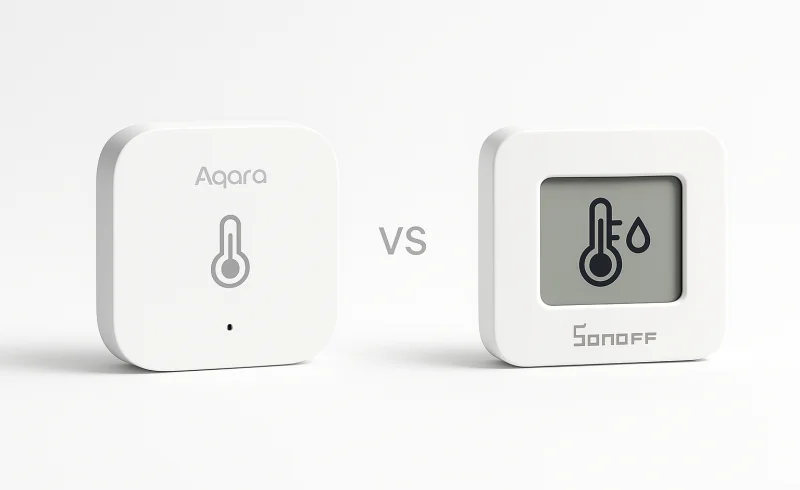
Explore the features, compatibility, and performance of the Aqara Temperature and Humidity Sensor versus the Sonoff SNZB-02P, highlighting their roles in smart home ecosystems. Understand each model's strengths in accuracy, battery life, and ecosystem integrat...
TL;DR
- Aqara Temperature and Humidity Sensor makes the most sense in an existing Aqara setup, especially if you want its smaller body or its additional atmospheric-pressure reading.
- Sonoff SNZB-02P is the more straightforward fit for a mixed-brand Zigbee network because Sonoff officially supports several third-party Zigbee 3.0 hubs.
- Sonoff publishes tighter accuracy specifications: ±0.2°C and ±2% RH, compared with ±0.3°C and ±3% RH for Aqara. The difference is real on paper but small for ordinary room-comfort automations.
- Sonoff rates its CR2477 battery for up to four years, while Aqara advertises up to two years from a CR2032. Both figures are manufacturer claims, and actual runtime depends on reporting activity, signal conditions, temperature, and the Zigbee network.
- Neither sensor is a native Matter-over-Thread device. Both remain Zigbee sensors even when a compatible hub or bridge exposes them to a Matter ecosystem.
Model note: This comparison covers the original Aqara Temperature and Humidity Sensor, model WSDCGQ11LM. Aqara also sells the similarly named Temperature and Humidity Sensor T1 (TH-S02D), which uses Zigbee 3.0. The two should not be treated as the same model when comparing protocol specifications.
| Feature | Aqara Temperature and Humidity Sensor | Sonoff SNZB-02P Temperature & Humidity Sensor |
|---|---|---|
| Power | ||
| Battery Life | Up to 2 years | Up to 4 years |
| Battery Type | CR2032 | CR2477 |
| Sensors | ||
| Humidity Monitoring | Supported | Supported |
| Temperature Monitoring | Supported | Supported |
| Atmospheric Pressure Monitoring | Supported | Not supported |
| Physical | ||
| Dimensions | 36 × 36 × 9 mm | 45x45x17.7mm |
| Environment | ||
| Installation Location | Indoor | Indoor |
| Connectivity | ||
| Hub Requirement | Requires Aqara Hub | Requires Zigbee 3.0 hub; supports third-party hubs |
| Wireless Protocol | Zigbee | Zigbee 3.0 (IEEE802.15.4) |
| Measurement Performance | ||
| Humidity Range | 0 – 100% RH | 5-95%RH, non-condensing |
| Humidity Accuracy | ±3% RH | ±2% RH |
| Temperature Range | -20° – +50°C | -10°C ~ 60°C |
| Temperature Accuracy | ±0.3°C | ±0.2°C |
📑 Table of Contents
- Ecosystem Compatibility Is the Biggest Difference
- Accuracy: Sonoff Has the Tighter Published Specification
- Sonoff's 5-Second Figure Needs Context
- Aqara Measures One Thing Sonoff Does Not: Air Pressure
- Battery Life Favors Sonoff on Paper
- Aqara Is Much Easier to Hide
- App Experience Depends on the Hub
- Neither Sensor Is Native Matter or Thread
- The Bottom Line
- FAQ
Ecosystem Compatibility Is the Biggest Difference
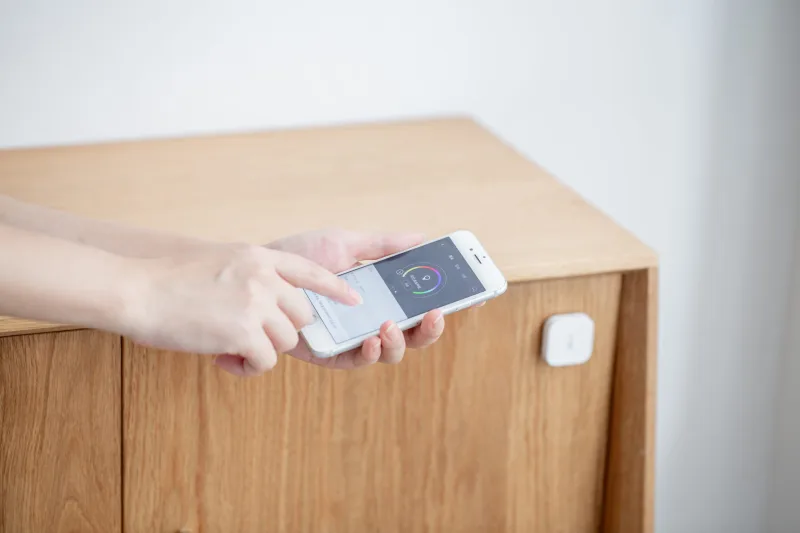
Aqara's official setup path is deliberately narrow. The WSDCGQ11LM requires an Aqara hub according to Aqara, and the company does not officially present the sensor as compatible with third-party hubs. Inside that supported environment, Aqara Home provides sensor history, alerts, and automations, while compatible Aqara hubs can connect the sensor to other smart-home ecosystems.
That does not mean the Aqara sensor is technically restricted to Aqara hardware. Zigbee2MQTT supports the WSDCGQ11LM and exposes temperature, humidity, atmospheric pressure, battery level, and battery voltage. This makes direct use in platforms such as Home Assistant possible without an Aqara hub.
There is an important caveat, though. Zigbee2MQTT's documentation notes that some older Xiaomi/Aqara devices do not fully conform to expected Zigbee behavior and can disconnect when routed through certain Zigbee repeaters. In a carefully built network they can work well, but third-party operation is not the same thing as Aqara officially supporting that configuration.
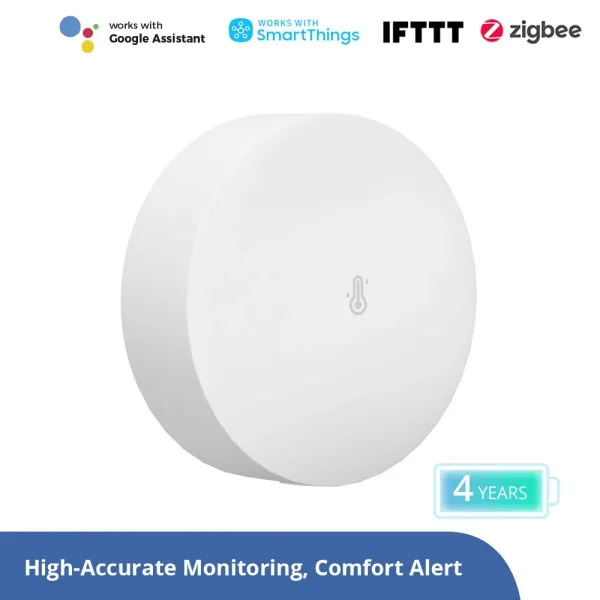
Sonoff takes a more conventional route with the SNZB-02P's Zigbee 3.0 implementation. Sonoff officially lists its own gateways along with third-party options including selected Amazon Echo and SmartThings/Aeotec hubs. Zigbee2MQTT also supports the SNZB-02P.
That distinction matters more than simply calling one sensor "closed" and the other "open." Both can participate in enthusiast-oriented Zigbee systems. The difference is that Sonoff explicitly supports a broader range of gateways, while Aqara's official path remains centered on Aqara hardware.
For an existing Aqara home, that limitation may be irrelevant. For a mixed-brand Zigbee network, Sonoff presents fewer compatibility caveats from the outset.
Accuracy: Sonoff Has the Tighter Published Specification
Aqara specifies the WSDCGQ11LM at:
- Temperature accuracy: ±0.3°C
- Humidity accuracy: ±3% RH
- Temperature range: -20°C to 50°C
- Humidity range: 0–100% RH, non-condensing
Sonoff specifies the SNZB-02P at:
- Temperature accuracy: ±0.2°C
- Humidity accuracy: ±2% RH
- Temperature range: -10°C to 60°C
- Humidity range: 5–95% RH, non-condensing
Sonoff therefore has the tighter manufacturer-rated tolerance for both measurements.
The practical difference is smaller than those numbers can make it sound. A tenth of a degree Celsius or one percentage point of relative humidity is unlikely to transform an ordinary bedroom, nursery, office, or living-room automation. Sensor placement can have a larger effect: a unit beside a radiator, air-conditioning vent, window, direct sunlight, or another heat source may produce a less representative room reading regardless of its nominal accuracy.
The tighter Sonoff specification becomes more relevant when several sensors are being compared against one another or when an automation operates around a relatively narrow threshold. Even then, climate automations generally benefit from a sensible hysteresis range rather than switching equipment every time a reading crosses a single number.
There is also no meaningful indoor advantage to treating Aqara's 0–100% RH range or Sonoff's 60°C upper temperature limit as a reason to place either device in harsher environments. Both are specified for indoor use, and both humidity specifications are explicitly non-condensing.
Neither should be treated as a weatherproof outdoor sensor merely because its measurement range extends beyond normal room conditions.
Sonoff's 5-Second Figure Needs Context
One of the more easily misunderstood SNZB-02P specifications is its 5-second reporting figure.
Sonoff does not say that the sensor continuously transmits a new Zigbee reading every five seconds. Its current documentation states that when a value changes, the shortest reporting interval is five seconds. If there is no relevant change, the sensor reports at least once every 60 minutes.
That is a much more useful description of how a battery-powered Zigbee sensor operates: it can react quickly to changing conditions without continuously transmitting unchanged data.
Aqara describes its sensor as monitoring environmental conditions in "real time," but does not provide an equally specific minimum reporting interval for the WSDCGQ11LM in its published specifications.
That makes a direct responsiveness comparison difficult. Sonoff is more transparent about its reporting rules, but the 5-second number should not be interpreted as a guaranteed fixed update cadence in every installation.
Aqara Measures One Thing Sonoff Does Not: Air Pressure
The WSDCGQ11LM measures atmospheric pressure from 30 to 110 kPa with a stated precision of ±0.12 kPa in addition to temperature and humidity.
The SNZB-02P does not measure atmospheric pressure.
For most room automations, this is a secondary feature. Temperature and humidity are directly useful for controlling HVAC equipment, fans, humidifiers, or dehumidifiers; atmospheric pressure usually serves more as an environmental trend than as a primary comfort metric.
It can still be useful in a detailed home-environment dashboard, particularly when pressure trends are being logged alongside other sensor data. Zigbee2MQTT, for example, exposes the Aqara sensor's pressure measurement directly.
If atmospheric pressure has no role in the intended setup, Sonoff's lack of it should not carry much weight. If pressure data is specifically required, Aqara provides a capability the SNZB-02P simply does not have.
Battery Life Favors Sonoff on Paper
Aqara powers the WSDCGQ11LM with a CR2032 coin cell and advertises up to two years of battery life.
Sonoff uses the physically larger CR2477 and advertises up to four years.
The Sonoff figure comes with an important qualification from the manufacturer: its long-runtime estimate is based on internal laboratory testing, and actual battery life varies with operating conditions, firmware, environmental conditions, and device behavior.
The same general caution applies to any multi-year battery estimate. A weak Zigbee connection, unusual temperatures, frequent reporting, or repeated reconnection attempts can change real-world runtime substantially.
Even with that caveat, the difference matters when sensors are spread across many rooms. A four-year manufacturer target reduces maintenance compared with a two-year target if actual runtime follows the same general relationship.
Aqara's smaller CR2032 also helps explain why its enclosure can be substantially thinner.
Aqara Is Much Easier to Hide
The physical difference is larger than the accuracy difference.
The Aqara sensor measures 36 × 36 × 9 mm and weighs about 11 g. The Sonoff measures 45 × 45 × 17.7 mm and weighs 26.7 g.
Aqara is therefore not just slightly smaller; it is roughly half as thick. On a wall, side of a cabinet, shelf, or other visible surface, the WSDCGQ11LM is noticeably less prominent.
Sonoff's larger enclosure accommodates the CR2477 battery that supports its longer runtime claim. That is a reasonable trade-off rather than a design flaw, but it makes the SNZB-02P harder to visually disappear.
Placement matters more than appearance for measurement quality. Neither sensor should sit directly beside a heating or cooling outlet, in direct sunlight, or where a nearby appliance creates a local pocket of warm air. Both are indoor sensors, so their stated temperature ranges should not be confused with weather resistance.
For installations where the sensor will remain visible, Aqara has the clearer physical-design advantage.
App Experience Depends on the Hub
Aqara's first-party software story is straightforward. With an Aqara hub, the Aqara Home app provides environmental monitoring, historical data, alerts, and automations. Aqara also supports Apple Home integration through compatible hubs.
That approach is cohesive because the sensor, hub, and app come from the same platform. It is also less flexible if the goal is to avoid vendor-specific infrastructure.
Sonoff's first-party route runs through compatible Sonoff Zigbee gateways and eWeLink. For the SNZB-02P, Sonoff advertises up to six months of cloud-based temperature and humidity history, along with data export.
Those software features should not be confused with capabilities built into the sensor itself. When the SNZB-02P is paired to a third-party coordinator, history, dashboards, notifications, and automations are provided by that platform instead. A Home Assistant installation, for example, does not need eWeLink simply because the sensor carries the Sonoff name.
The same distinction applies to Aqara under Zigbee2MQTT: once the sensor is connected directly to that Zigbee network, Home Assistant or another platform becomes the software layer.
So the app comparison is really two different questions:
- For a first-party setup: Aqara offers a tightly integrated sensor-hub-app path, while Sonoff combines eWeLink with a broader set of officially supported gateways.
- For a self-managed Zigbee setup: both can work without their respective first-party apps, although the older Aqara model carries more third-party-network caveats.
Neither Sensor Is Native Matter or Thread
Both products are still fundamentally Zigbee end devices.
The SNZB-02P uses Zigbee 3.0. Sonoff currently provides ways to expose supported Zigbee devices to Apple Home through compatible Matter bridges, including supported Sonoff bridge platforms.
Aqara likewise offers hubs with Matter-bridge functionality. Aqara's Hub M3, for example, can expose supported Aqara Zigbee devices to Matter ecosystems.
In both cases, however, the bridge is doing the protocol translation. The sensor itself has not become a Matter-over-Thread device.
That distinction matters when planning a smart home around Thread specifically. A household trying to eliminate Zigbee coordinators entirely should be looking at a different class of sensor rather than choosing between these two.
The Bottom Line
The original comparison looks simple if reduced to specifications: Sonoff has tighter stated accuracy, a longer battery-life claim, Zigbee 3.0, and broader official hub compatibility; Aqara adds atmospheric pressure and fits into a much smaller enclosure.
The ecosystem details make the decision more nuanced.
Aqara Temperature and Humidity Sensor fits an existing Aqara system well. Its supported configuration is clear, it is extremely compact, and pressure sensing adds a data point Sonoff lacks. There is little reason to replace an established Aqara setup solely because Sonoff's published temperature tolerance is 0.1°C tighter.
Sonoff SNZB-02P is the stronger fit for a new mixed-brand Zigbee network. Its third-party gateway support is explicit rather than community-dependent, and its Zigbee 3.0 implementation is easier to align with a conventional multi-vendor mesh. Its tighter published accuracy and longer battery-life claim reinforce that advantage.
Home Assistant users have another option: both models are supported by Zigbee2MQTT. In that environment, the distinction is not "Sonoff works and Aqara does not." It is that Sonoff has the cleaner official compatibility story, while the older Aqara WSDCGQ11LM may require more care around router compatibility and network behavior.
For an Aqara-centered home or a setup that specifically needs atmospheric pressure, the Aqara sensor remains the more logical fit. For a broader Zigbee network where official third-party compatibility and lower maintenance matter more, the SNZB-02P has the stronger overall specification set.
FAQ
Do these sensors require a hub?
Which sensor is more accurate?
Can the Aqara sensor work without an Aqara hub?
What is the battery life of each sensor?
Which sensor is best for Home Assistant?
Do these sensors measure atmospheric pressure?
How often do the sensors update their readings?
Images are used for editorial and informational purposes only.
All trademarks and images belong to their respective owners.