
Aqara RTCGQ13LM vs Mi Motion Sensor: Narrow, Tunable Detection or Wide Room Coverage?
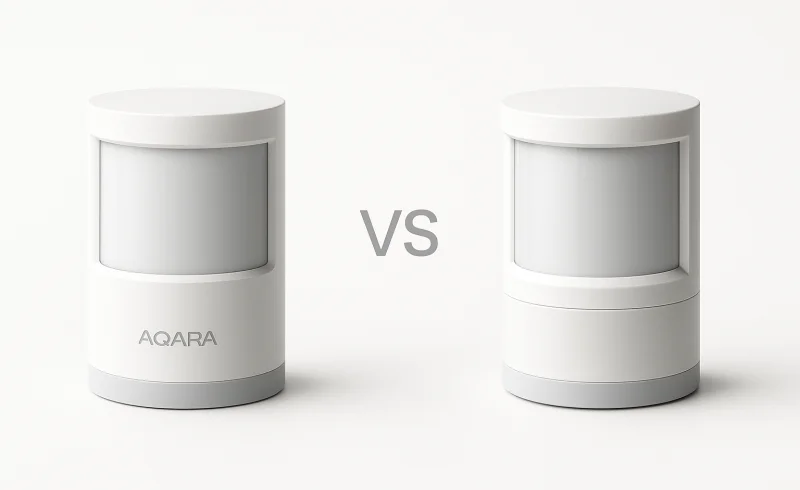
Explore the differences between Aqara RTCGQ13LM and Mi Motion Sensor. Understand their detection precision, installation flexibility, and ecosystem integration to make an informed decision for your specific smart home needs.
TL;DR
The Aqara RTCGQ13LM and the original Mi Motion Sensor solve different motion-detection problems despite using the same basic Zigbee-sensor concept.
- Aqara RTCGQ13LM is better suited to a defined detection zone. Its approximately 60° conical field, 5 m range, adjustable sensitivity, and configurable detection interval give an automation system more control over what counts as useful motion and how frequently the sensor can report it.
- Mi Motion Sensor favors simple, broad indoor coverage. Its approximately 170° field and ≤7 m range can cover more of a room from one position, but its normal reporting behavior is much less configurable.
- The Aqara is a comparatively large, ceiling-oriented device. The Mi is a tiny puck that can simply sit on a surface or be attached with adhesive.
- Neither is a true presence sensor. The Aqara can be configured for high sensitivity to small movements, but it should not be treated as equivalent to a mmWave sensor that can reliably maintain occupancy while someone sits almost motionless.
- Neither sensor provides an illuminance value through its documented Zigbee2MQTT expose set, so motion-plus-darkness automations need another source of light-level information.
One naming detail matters: this article covers the original Zigbee Mi Motion Sensor with the ~170° field and ≤7 m range, not the newer Xiaomi Motion Sensor 2S, which is a different Bluetooth 5.0 product with different specifications.
Market price overview

 Banggood
 Gshopper
| Feature | Aqara RTCGQ13LM | Mi Motion Sensor |
|---|---|---|
| Power | ||
| Battery Type | CR2450 | CR2450 |
| General | ||
| Model | RTCGQ13LM | RYCGQ01LM |
| Product Type | Motion sensor | Motion sensor |
| Physical | ||
| Dimensions | 74 × 74 × 43.3 mm | 30 × 30 × 32.8 mm |
| Detection | ||
| Detection Angle | Approx. 60° conical | Approx. 170° |
| Detection Interval | Customizable detection periods | 1 min default; once every 5 sec during the first hour after joining the network |
| Detection Technology | Passive infrared (PIR) | Pyroelectric infrared (PIR) |
| Maximum Detection Distance | 5 m | ≤7 m |
| Protection | ||
| Water Resistance Rating | IPX5 | No IP rating specified |
| Connectivity | ||
| Hub Required | Yes, requires a device with Zigbee 3.0 gateway functionality | Yes, requires a device with Zigbee gateway functionality |
| Wireless Protocol | Zigbee 3.0 | Zigbee |
| Installation | ||
| Recommended Installation Height | 2 m or above | 1.2 m to 2.1 m |
| Environmental | ||
| Operating Humidity | 0~95% RH, non-condensing | 0% to 95% RH, non-condensing |
| Operating Temperature | -10℃~+35℃ | -10°C to +45°C |
📑 Table of Contents
- The Main Difference Is Detection Geometry
- Aqara Gives You More Control Over Motion Reporting
- Neither Sensor Is True Presence Detection
- Installation Is More Different Than the Product Photos Suggest
- Hub and Smart-Home Integration
- False Triggers Depend More on Placement Than Branding
- One Important Feature Both Sensors Lack
- The Bottom Line
- FAQ
The Main Difference Is Detection Geometry
The most useful distinction between these sensors is not that one is inherently more accurate. It is how much of the room each sensor is designed to see.
The Aqara RTCGQ13LM has an approximately 60° conical detection field with a specified range of 5 m. At that distance, Aqara specifies a roughly 6 m-diameter detection area. That relatively narrow cone makes the sensor easier to use when motion in one particular part of a room should matter more than motion everywhere else.
A doorway is a good example. If the automation should react to someone crossing that doorway but not to people moving through an adjacent part of an open-plan room, a narrower field can make the physical layout of the automation easier to control.
The Mi Motion Sensor works from the opposite premise. Xiaomi specifies an approximately 170° detection angle and a range of up to 7 m. Positioned appropriately, it can watch a much broader portion of a hallway, entrance, bedroom, or living space without requiring such a carefully defined detection zone.
That wider field is not automatically a disadvantage. For a straightforward rule such as activating hallway lighting when someone approaches from either direction, broad coverage may be exactly what is needed.
It does, however, mean that placement matters near doors, adjoining rooms, and open spaces. A sensor that can see more of the room can also include movement that the automation designer did not intend to use as a trigger.
The practical distinction: the Mi favors coverage, while the Aqara favors spatial control.
Aqara Gives You More Control Over Motion Reporting
Detection angle is only half of the Aqara's advantage in more complex automations.
The RTCGQ13LM exposes three sensitivity levels — low, medium, and high — plus a configurable detection interval. Official implementations document an adjustable detection period, while Zigbee2MQTT also exposes motion_sensitivity and a writable detection_interval.
That matters because sensitivity and reporting cadence solve different problems.
Sensitivity affects how readily the sensor reacts to movement. A high setting can help when the relevant movement is small rather than a person walking across the room. A lower setting can be useful when only more substantial movement should trigger the automation.
The reporting interval controls how quickly another motion event can be registered after the previous one. This can matter in automations that depend on repeated activity rather than a single room-entry event.
The Mi Motion Sensor has much less flexibility here. Xiaomi's documentation states that it normally detects once per minute and enters a sleep interval after a trigger. During the first hour after it has been added to the network, it can report as frequently as once every five seconds; afterward it returns to its normal one-minute behavior.
For a simple entrance-light automation, that one-minute interval may have little practical consequence. For more elaborate occupancy logic, however, it is a real constraint: the automation has to work around the sensor's reporting schedule rather than changing it.
There is an important qualification to the Aqara advantage. More sensitivity does not automatically mean fewer unwanted events. Aqara's own documentation warns that very high sensitivity can produce unintended detections and specifically recommends keeping the detection area away from heat-producing appliances and objects such as curtains heated by direct sunlight.
So the RTCGQ13LM is not inherently a quieter sensor. It is a more adjustable one.
Neither Sensor Is True Presence Detection
The name "High Precision" can make the RTCGQ13LM sound closer to a modern presence sensor than it really is.
Aqara describes the device as capable of detecting relatively small body movements, and its high-sensitivity mode is intended for situations where a person may be moving less than someone walking through a room. That is meaningfully different from a conventional motion sensor configured only for large movements.
It still should not be treated as reliable stationary-person detection.
Someone reading, working at a desk, watching television, or sleeping may eventually become still enough that a motion-based sensor has no new event to report. Increasing sensitivity can reduce that problem in some situations, but it does not turn the RTCGQ13LM into a radar-based occupancy sensor.
The Mi is more straightforward: it is a conventional motion sensor intended to detect the movement of people or pets within its detection area.
For automations where continued occupancy must remain known while a person is almost motionless, a mmWave presence sensor such as the Aqara FP2 or another dedicated presence detector is the more appropriate class of device.
This distinction is especially important for lights-off logic. Motion sensors are very good at answering "did something move?" They are much less definitive at answering "is the room empty?"
Installation Is More Different Than the Product Photos Suggest
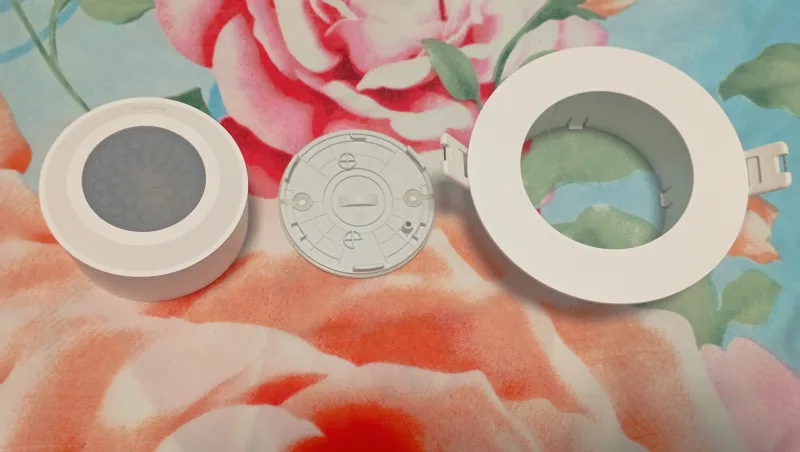
The physical designs reflect the two sensors' different purposes.
The RTCGQ13LM measures about 74 × 74 × 43.3 mm, with a substantially larger mounting sleeve. Aqara's installation documentation describes screw-mounted ceiling installation as well as recessed installation using the supplied sleeve, and specifies installation at 2 m or higher. The manual explicitly warns against securing the sensor with double-sided tape because of the risk of it falling.
That is very different from the small adjustable-stand design associated with some other Aqara motion sensors. The RTCGQ13LM should not be described as having a 360° rotating desktop-style mount.
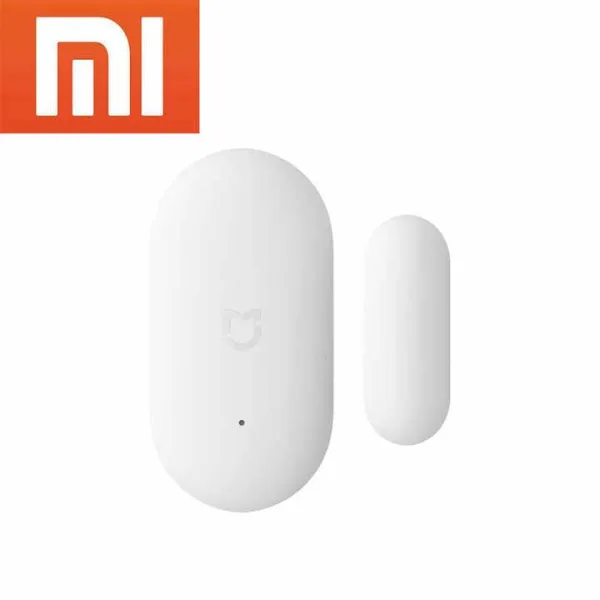
The Mi Motion Sensor is much less demanding physically. Xiaomi lists it at roughly 30 × 30 × 32.8 mm, and its instructions allow it to be placed directly on a suitable surface or attached with the supplied adhesive. Xiaomi recommends an installation height of roughly 1.2 to 2.1 m and advises positioning the lens toward the intended detection area.
For a rental apartment, shelf, cabinet, or other location where drilling is undesirable, the Mi's physical design is considerably easier to accommodate. The Aqara makes more sense when a permanent ceiling or wall position is acceptable.
What about moisture and outdoor use?
The RTCGQ13LM is sometimes specified with IPX5 splash resistance, which gives it a stronger moisture-resistance specification than the Mi sensor.
That should not be interpreted as an outdoor rating.
The RTCGQ13LM manual describes the product as indoor-use equipment, requires appropriate ceiling installation, and warns against incorrect exposure and installation. IPX5, where specified for the model, describes resistance to water jets or splashing under defined test conditions; it does not establish protection from weather, condensation inside an enclosure, prolonged humidity, temperature cycling, or direct outdoor exposure.
The Mi Motion Sensor is also documented as an indoor device and has no comparable published IP rating.
For a bathroom or another damp indoor location, the Aqara's additional splash-resistance specification may be relevant, but installation should still follow the documentation for the exact regional version of the device.
Hub and Smart-Home Integration
Both sensors depend on another device to make their Zigbee events useful.
The Aqara RTCGQ13LM uses Zigbee 3.0, and Aqara's documentation requires a gateway with Zigbee 3.0 gateway functionality. Depending on region and hub, it can be used through supported Aqara or SmartThings configurations.
The Mi Motion Sensor also uses Zigbee and was designed around Xiaomi's gateway-based smart-home system.
Neither should be described as universally compatible with every generic Zigbee hub simply because it uses Zigbee.
For more open smart-home systems, however, Zigbee2MQTT currently supports both models directly.
The difference is in the details. Zigbee2MQTT exposes the RTCGQ13LM's occupancy state, sensitivity setting, detection interval, battery information, and several diagnostic values. Its documentation also specifies minimum firmware versions for some Zigbee coordinator families.
For the Mi Motion Sensor, Zigbee2MQTT exposes occupancy and battery-related information but not the Aqara's sensitivity and interval controls. Zigbee2MQTT also documents a broader caveat for older Xiaomi Zigbee devices: because some do not fully follow standard Zigbee behavior, network topology and router compatibility can affect reliability.
The sensible integration comparison is therefore not "Aqara works everywhere while Mi is fragmented" or the reverse.
Inside a manufacturer's supported ecosystem, compatibility depends on the exact hub, region, and software version. In a Zigbee2MQTT installation, both are supported, but the RTCGQ13LM exposes substantially more configuration.
False Triggers Depend More on Placement Than Branding
The original comparison between "stable Aqara" and "trigger-happy Mi" is too simplistic.
Both sensors can produce unwanted events when their detection area includes the wrong things.
Xiaomi specifically warns that the Mi Motion Sensor may be triggered when placed close to heat sources, microwave ovens, air conditioners, or areas exposed to strong light. Xiaomi also confirms that pets entering its detection area can trigger it.
Aqara gives similar installation guidance for the RTCGQ13LM. Its manual recommends keeping heat-producing appliances and sun-heated objects outside the detection zone, and it explicitly notes that high sensitivity can increase the chance of unintended detection. Aqara also states that pets can trigger the sensor.
The Aqara's narrow cone can still be useful here, but for a different reason: it lets the installation define a smaller monitored area. If adjacent foot traffic falls outside that cone, the sensor cannot react to it.
The Mi's 170° field naturally includes more surrounding space, so isolating one doorway or one section of a room can be harder.
That is a geometry trade-off, not evidence that the Mi's sensing electronics are inherently less reliable.
One Important Feature Both Sensors Lack
For motion-controlled lighting, there is another limitation that is easy to miss: neither model exposes illuminance through its documented Zigbee2MQTT device interface.
That matters if the desired rule is:
activate the light when motion is detected and the room is dark.
With either sensor, that automation needs a separate source for ambient light level, such as another illuminance sensor or an appropriate value already available elsewhere in the smart-home system.
This is worth checking because several similarly named Aqara motion sensors do include illuminance sensing. The RTCGQ13LM is not interchangeable with those models simply because the housings and product names are similar.
The Bottom Line
These are not two versions of the same sensor with one simply outperforming the other.
The Mi Motion Sensor is better suited to broad, uncomplicated indoor motion coverage. Its approximately 170° field and ≤7 m range make sense in hallways, entrances, and rooms where seeing movement from many directions is more important than defining a narrow trigger zone. Its very small enclosure also makes placement comparatively easy.
The Aqara RTCGQ13LM is better suited to more deliberate automation design. The approximately 60° detection cone limits the monitored area, while adjustable sensitivity and detection interval provide significantly more control over how motion events are generated. The trade-offs are a larger, more installation-oriented enclosure and greater dependence on controller support for its advanced settings.
For this comparison,
because it provides more control over both the physical detection zone and reporting behavior. That does not make it the stronger fit for every room: where one compact sensor needs to cover as much indoor space as possible, the Mi's wider field remains its defining advantage.For stationary occupancy, neither is the right sensing technology. For light-level-aware automation, neither supplies everything required on its own. And for outdoor exposure, neither should be treated as an outdoor sensor solely on the basis of the RTCGQ13LM's reported splash-resistance specification.
FAQ
Which sensor is better at avoiding false triggers from pets?
Do both sensors require a Zigbee hub?
Can the Mi Motion Sensor be used outdoors?
Which sensor lasts longer on a battery?
Can the Aqara RTCGQ13LM be installed in a bathroom or outdoor area?
What is the detection range of the Mi Motion Sensor?
Does the Aqara RTCGQ13LM support sensitivity adjustment?
How easy is it to mount the Aqara RTCGQ13LM?
📄 Used Manuals & Documentation
Aqara RTCGQ13LM
"Images are used for editorial and informational purposes only. All trademarks and images belong to their respective owners."