
Airthings View Pollution vs GoveeLife H5106: Continuous Monitoring or Instant Room Awareness?
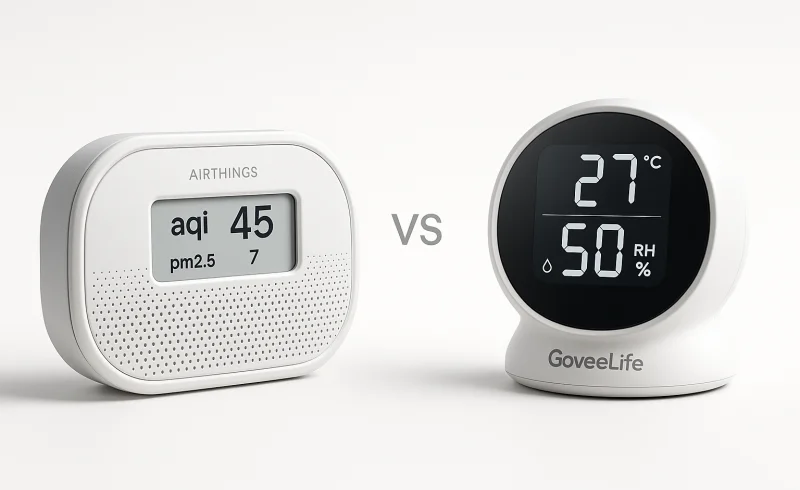
Compare the Airthings View Pollution with the GoveeLife H5106 to understand their differences in pollution monitoring capabilities, power options, and data insights. Learn which device suits long-term environmental analysis or instant room assessments for air...
TL;DR
Quick Decision
- If you want long‑term trend tracking, battery‑powered placement freedom, and a web dashboard → choose Airthings View Pollution.
- If you care about a glanceable, always‑on display and simple instant feedback without dealing with batteries → choose GoveeLife H5106.
- If accurate low‑range PM2.5 and visibility into the finest particles (PM1) matter most → Airthings has the edge.
Key Differentiators
The Airthings View Pollution runs on 6 AA batteries (up to 2 years) or USB, so you can place it where it measures best, not where an outlet is. The GoveeLife H5106 is cord‑only and puts a bright live readout front and center—great for quick glances but limiting for placement. Airthings adds PM1 monitoring (dashboard‑only) and more precise low‑range PM2.5 accuracy, while GoveeLife sticks to PM2.5 with a coarser ±15 µg/m³ spec.
Who Should Skip Both
If you need multi‑gas monitoring (VOCs, CO₂, or carbon monoxide), neither device covers that—look at a more comprehensive indoor air quality monitor with those sensors instead.
| Feature | GoveeLife H5106 | Airthings View Pollution |
|---|---|---|
| Power | ||
| Battery Life | No built-in battery | Up to 2 years |
| Power Source | AC 100-240V 50/60Hz adapter; 5V DC 2A monitor input | 6 AA batteries or USB cable |
| Battery Operation | Not supported | Supported |
| General | ||
| Product Type | Smart air quality monitor | Indoor air pollution monitor |
| Accuracy | ||
| PM2.5 Accuracy | 0-100 μg/m³: ±15 μg/m³; 100-1000 μg/m³: ±15% | 0-150 μg/m³: ±(5 μg/m³ + 15%); 150-500 μg/m³: ±(5 μg/m³ + 20%) |
| Humidity Accuracy | ±3% | ±3% |
| Temperature Accuracy | ±0.54°F / ±0.3°C | ±0.5°C / ±1°F |
| Physical | ||
| Weight | 5.44 oz | 336 g / 11.85 oz |
| Dimensions | 5.31 x 1.57 x 2.47 in | 17 cm x 9 cm x 3.3 cm |
| Monitoring | ||
| PM1 Measurement | Not supported | Supported (Airthings Dashboard only) |
| PM2.5 Measurement | Supported | Supported |
| Humidity Measurement | Supported | Supported |
| Temperature Measurement | Supported | Supported |
| Connectivity | ||
| Wi-Fi Connectivity | Wi-Fi (2.4GHz) | 802.11 b/g/n (2.4GHz) |
| App / Dashboard Access | Govee Home app | Airthings app + web dashboard |
| Bluetooth Connectivity | Bluetooth | Bluetooth Low Energy |
| Operating Conditions | ||
| Operating Temperature | -10°C to 40°C / 14°F to 104°F | 4°C to 40°C / 39.2°F to 104°F |
📑 Table of Contents
Sensor Accuracy & Measurement Range
Particle sensing (PM1/PM2.5 coverage)
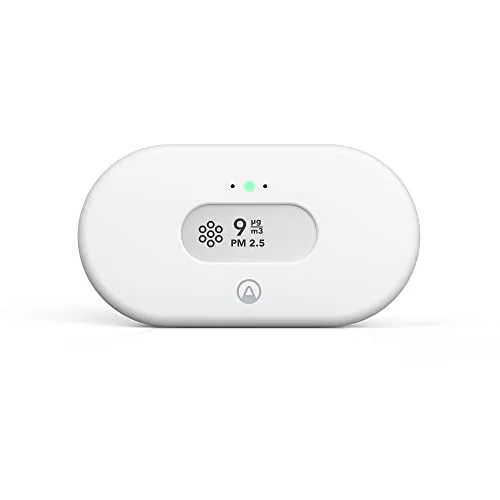
Airthings View Pollution measures PM2.5 and also adds PM1 monitoring (supported via the Airthings Dashboard only). That extra PM1 channel can help you track changes in the finest particles that often move sharply during cooking, cleaning, or smoke events, even when PM2.5 looks stable.
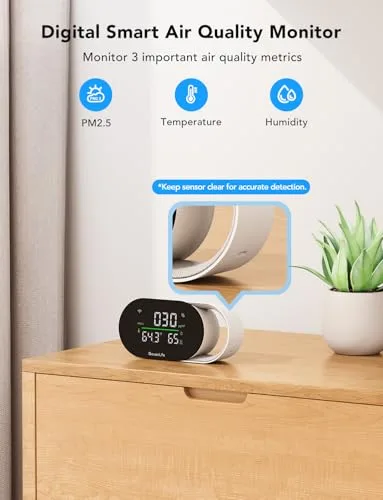
GoveeLife H5106 measures PM2.5 but does not support PM1 measurement. In practice, that keeps the device focused on the most commonly cited particle metric, but it can’t provide the finer-grained view of very small particulates.
Conclusion: Airthings wins on measurement coverage because it includes PM1 + PM2.5, while GoveeLife is PM2.5-only.
PM2.5 accuracy (low vs high concentrations)
Airthings View Pollution specifies PM2.5 accuracy of ±(5 µg/m³ + 15%) from 0–150 µg/m³, and ±(5 µg/m³ + 20%) from 150–500 µg/m³. The added ±5 µg/m³ term is meaningful when indoor air is in the low-to-moderate range, because it avoids the large fixed-error penalty you can see in simpler specs.
GoveeLife H5106 lists ±15 µg/m³ from 0–100 µg/m³, then ±15% from 100–1000 µg/m³. That fixed ±15 µg/m³ band at typical indoor levels can be comparatively coarse—especially if you’re trying to detect smaller improvements from ventilation or a purifier.
Conclusion: Airthings wins on PM2.5 precision at typical indoor concentrations, with ±(5 µg/m³ + 15%) (0–150) versus ±15 µg/m³ (0–100) on the GoveeLife.
Temperature & humidity accuracy
Airthings View Pollution lists temperature accuracy of ±0.5°C (±1°F) and humidity accuracy of ±3%. Those are solid baseline specs for pairing comfort metrics with pollution readings, but temperature is not its strongest numerical edge here.
GoveeLife H5106 is slightly tighter on temperature at ±0.3°C (±0.54°F), while matching humidity at ±3%. If you care about using it as a small «room conditions» reference next to PM2.5, that temperature spec advantage is straightforward.
Conclusion: GoveeLife wins on temperature accuracy, while humidity is effectively a tie at ±3% for both.
Winner: Airthings View Pollution — It has two meaningful sensor advantages (adds PM1 monitoring and offers more precise PM2.5 accuracy at low-to-mid ranges), while GoveeLife’s main counter is a modest edge in temperature accuracy (±0.3°C vs ±0.5°C).
Power & Placement Flexibility
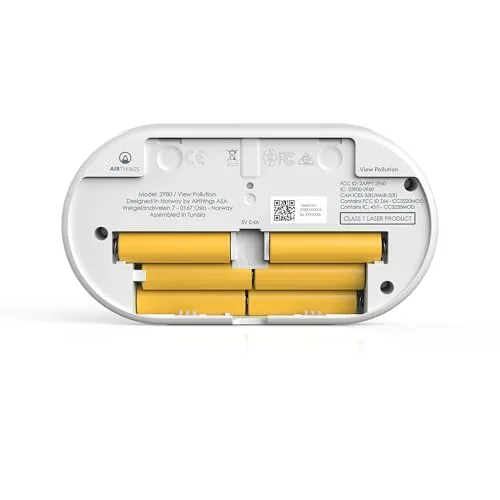
Airthings View Pollution is built for untethered placement: it can run on 6 AA batteries for up to 2 years (or use a USB cable as an alternative power option). That battery-first design supports a «set it and forget it» workflow and makes it easier to position the monitor where it samples air best—away from vents and drafts—rather than where a cord reaches. It also supports wall mounting or table placement, which helps you choose the most representative height and location.
GoveeLife H5106, by contrast, has no built-in battery and requires constant power via an AC 100–240V adapter with 5V DC 2A monitor input. In practice, that makes outlet proximity and cable routing a primary constraint, which can force compromises in placement (e.g., nearer to walls, power strips, or furniture). The upside is predictable always-on operation as long as it’s plugged in—but it behaves more like a plug-in room device than a flexible sensor you can place anywhere.
Comparative conclusion: For power independence and «put it where it should measure» placement, Airthings View Pollution clearly wins with up to 2 years of battery life plus a USB fallback, while GoveeLife H5106 is fundamentally limited by being cord-only.
Winner: Airthings View Pollution
Software & Data Insights
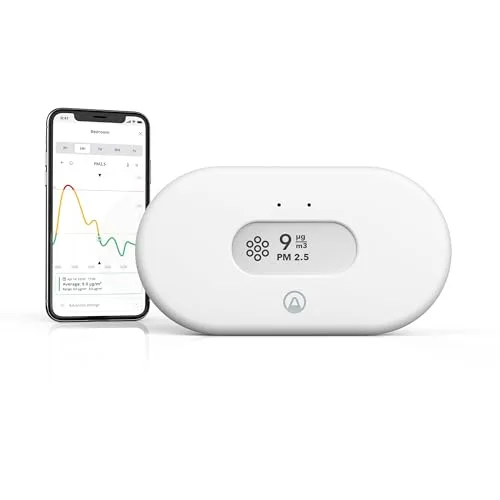
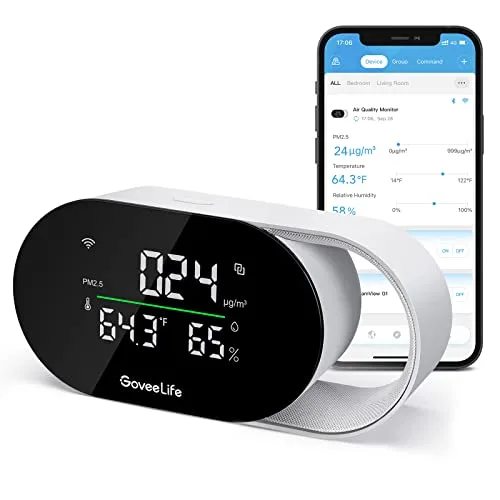
Airthings View Pollution is built around structured monitoring: it supports the Airthings app + a web dashboard, which lends itself to longer-term trend analysis across days and seasons. It also supports PM1 measurement, but notably only in the Airthings Dashboard, reinforcing that its «full value» is tied to software and historical views rather than just the on-device snapshot.
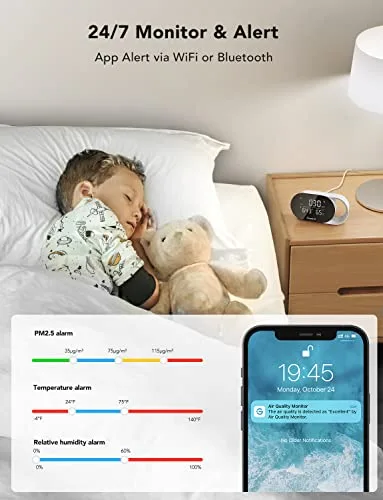
GoveeLife H5106 keeps the experience simpler: you get the Govee Home app (no web dashboard listed) alongside the device’s always-on readout. Its strength is immediacy—SoT notes a 2-second refresh rate, which encourages «glance and react» use rather than periodic deep dives into history.
Conclusion: For users who want deeper data context and a dashboard-style workflow, Airthings View Pollution has a defensible edge; GoveeLife H5106 is better optimized for instant, room-level awareness.
Airthings View Pollution is also better positioned for low-maintenance, continuous monitoring because it can run on 6 AA batteries (up to 2 years) or USB power. That matters for software-driven insights: consistent placement and uninterrupted logging make it easier to spot slow changes (seasonal ventilation habits, extended smoke events) without treating the monitor like a «plug-in gadget.»
GoveeLife H5106 is explicitly not battery-capable and uses an AC adapter (5V DC 2A input), which can push placement toward outlet-convenient spots rather than the most representative sampling location. In practice, that can reduce the usefulness of long-term comparisons because the device is more likely to live where it’s easy to power, not where it best captures whole-room air trends.
Conclusion: If your priority is consistent, low-fuss long-term datasets, Airthings View Pollution is the stronger fit; if you’re fine with outlet-bound placement in exchange for a «status display» experience, GoveeLife H5106 still works well.
Winner: Airthings View Pollution
Display & Physical Design
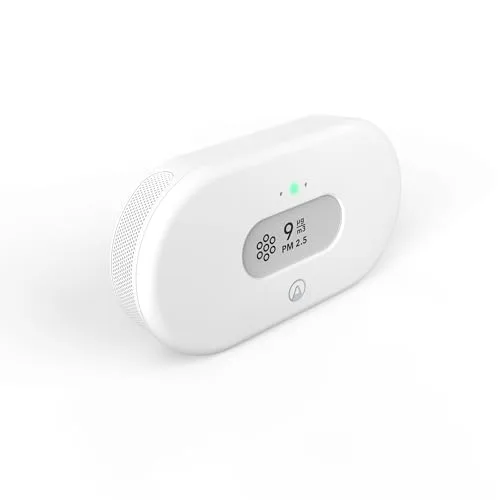
Airthings View Pollution uses an eInk display (per SoT) that’s designed to be subtle and battery-friendly, aligning with its up to 2-year battery operation on 6 AA batteries (or USB). That «infrastructure» approach also shows up in placement flexibility: it supports wall mounting or tabletop placement.
GoveeLife H5106 leans the other way: it’s intended to act like a visible room readout, and it’s fundamentally a plug-in device with no built-in battery and an AC adapter (5V DC 2A) requirement. In practice, that makes it better suited to spots where you want an always-available glanceable screen, but it also means placement is constrained by outlet access.
Conclusion: GoveeLife’s design wins for at-a-glance, always-visible room status, while Airthings wins for low-maintenance, battery-friendly «set-and-forget» monitoring—a clear trade-off rather than a universal winner.
Airthings View Pollution is physically larger and heavier at 17 × 9 × 3.3 cm and 336 g / 11.85 oz (with batteries), which reinforces the idea of a more permanent install (especially if wall-mounted). That extra mass is largely in service of battery operation and a more «place it once» workflow.
GoveeLife H5106 is more compact and lighter at 5.31 × 1.57 × 2.47 in and 5.44 oz, making it easier to move between rooms or perch on a desk or shelf. The smaller footprint pairs well with its plug-in «appliance» behavior—simple to position, as long as power is nearby.
Conclusion: GoveeLife has the edge on compactness and portability (5.44 oz vs 11.85 oz), while Airthings has the edge on installation versatility thanks to wall-mount support plus battery power.
Winner: Tie
Smart Features & Ecosystem
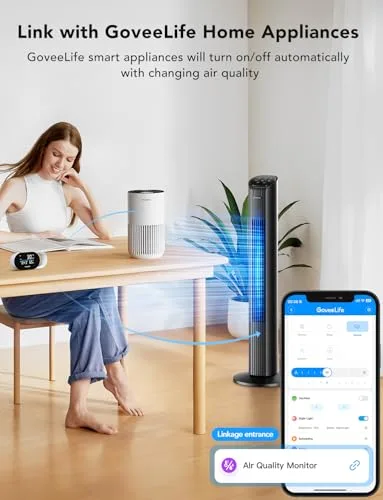
Airthings View Pollution is built around a more dedicated monitoring platform: you get the Airthings app plus a web dashboard (not just mobile), which better supports multi-device organization and longer-term interpretation. It also adds monitoring depth beyond the basics with PM1 support (Dashboard only) alongside PM2.5, temperature, and humidity. It further supports Alexa integration per the provided SoT compatibility note.
GoveeLife H5106 centers on the Govee Home app and is designed to sit inside Govee’s broader smart-home catalog, which tends to favor simpler, consumer-style interactions. It supports Wi‑Fi (2.4GHz) and Bluetooth, but the provided facts position it more as a straightforward monitor that focuses on PM2.5, temperature, and humidity (and explicitly notes it does not detect VOCs, CO, or CO2). Editor context also frames its ecosystem strength as basic automations with other Govee devices rather than deep environmental analytics.
Conclusion: Airthings View Pollution has the stronger ecosystem for structured, long-term air monitoring—mainly because of the web dashboard and broader monitoring depth (including PM1), while GoveeLife H5106 is the better fit if you primarily want simple, app-driven smart-home triggers within the Govee ecosystem. Winner: Airthings View Pollution
The Bottom Line
After digging through sensors, power, software, and day-to-day usability, the choice comes down to whether you want deeper air-quality analysis or simpler, instant visibility.
For simple, at-a-glance monitoring: The GoveeLife H5106 is the better pick because its always-on screen and quick, immediate readouts make it easy to check the room without relying on the app.
For long-term environmental insights: The Airthings View Pollution is the clear choice thanks to its web dashboard and trend-focused workflow, which is where its added depth (including PM1 via the Dashboard) actually pays off.
For placing a monitor anywhere, wire-free: The Airthings View Pollution wins on flexibility since its battery power (with USB as a fallback) lets you put it where it measures best—not where an outlet happens to be.
For the tightest budget: The GoveeLife H5106 is the smart buy because it delivers the core PM2.5 experience and a more immediately readable display for a fraction of the price.
Overall,
—it’s the more technically capable monitor with broader particle coverage (PM1 + PM2.5), tighter PM2.5 accuracy at typical indoor levels, and stronger long-term insights via the web dashboard and app. The trade-off is that GoveeLife H5106 is simply better at being a «room status» device: it’s more glanceable, more straightforward, and far cheaper.If you want to understand trends and make data-driven changes over time, buy Airthings View Pollution; if you mainly want to know what’s in the air right now with minimal fuss, the GoveeLife H5106 is the more practical everyday choice.
FAQ
Which monitor is better for detecting wildfire smoke?
Do I need a smartphone to use these monitors?
Can these devices measure carbon monoxide or VOCs?
Which is more accurate for PM2.5?
Can I place these monitors anywhere in the room?
Which monitor works with Alexa?
What type of display does each monitor have?
📄 Used Manuals & Documentation
Airthings View Pollution
GoveeLife H5106
"Images are used for editorial and informational purposes only. All trademarks and images belong to their respective owners."