
Air Oasis iAdaptAir 2.0 vs IQAir HealthPro Compact XE: Small-Room Smarts or Big-Room Brawn?
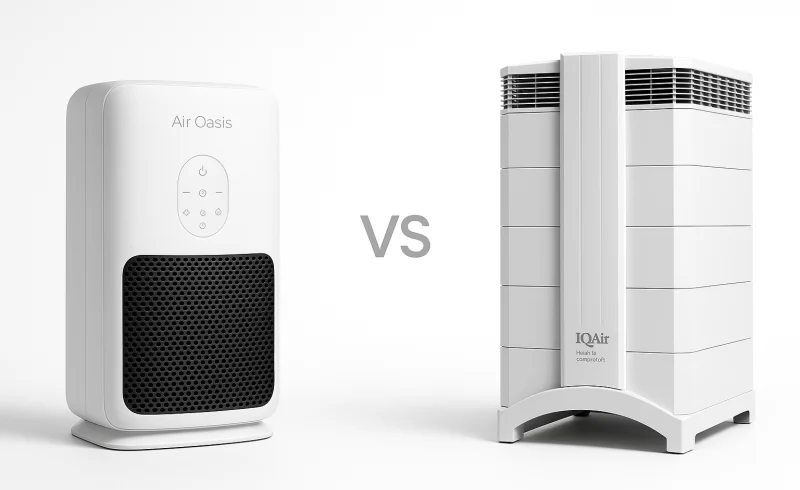
Explore the differences between the Air Oasis iAdaptAir 2.0 and IQAir HealthPro Compact XE. Understand which air purifier suits your needs, whether it be smart technology for smaller rooms or superior particle filtration for larger spaces. Delve into features...
TL;DR
Quick Decision
- If you want a lightweight, app-connected purifier that handles odors and everyday pollutants in a bedroom or home office → choose Air Oasis iAdaptAir 2.0.
- If you care about best-in-class ultrafine particle capture and need whole-room coverage for a large living space → choose IQAir HealthPro Compact XE.
- If you value on-unit air-quality feedback and a modern touchscreen, the iAdaptAir delivers; if you prefer a no-nonsense appliance that runs reliably without a smartphone, go with the IQAir.
Key Differentiators
The iAdaptAir 2.0 blends HEPA, carbon, UV, and ionization into a 7.7‑lb package rated for 265 sq ft, sips just 8–35 W, and works best when you embrace its smart sensor modes. The HealthPro Compact XE is a 26‑lb stationary workhorse built around HyperHEPA filtration (0.003 microns) and 330 CFM airflow for spaces up to 1,125 sq ft, but it’s far louder at top speed, draws up to 215 W, and trades sleek feedback for industrial durability. This is a battle of convenience and multi-approach purification versus uncompromising particle performance at scale.
Who Should Skip Both
If you need genuinely heavy-duty carbon filtration for large-area VOCs or smoke odors, look toward a dedicated high‑carbon‑weight purifier — neither model offers that kind of chemical removal at high airflow.
| Feature | Air Oasis iAdaptAir 2.0 | IQAir HealthPro Compact XE |
|---|---|---|
| General | ||
| Referenced Model / Variant | AOIA-2S (Small) | 121.AA.11.02 |
| Warranty | ||
| Base Warranty | 2 year limited | 1 year |
| Extended Warranty Program | Lifetime with active filter subscription | 10 year with registration and filter subscription or proof of genuine IQAir filters |
| Filtration | ||
| Filtration Stages | 5 | 2 |
| Filtration Technologies | H13 Medical Grade HEPA, Activated Carbon (140g), Silver Antimicrobial Filter, UVC LEDs, Bi-Polar Ionization | Pleated HyperHEPA filter with activated carbon post-filter |
| Primary Particulate Filter | H13 Medical Grade HEPA | HyperHEPA |
| Smallest Claimed Particle Size | 0.05 microns | 0.003 microns |
| Smart Features | ||
| Automatic Mode | Auto mode | Smart mode for sensor-based operation |
| Control Methods | Touch Screen and app with removable WiFi chip | Device control panel and IQAir AirVisual app |
| Air Quality Sensor | Yes | Integrated particle sensor (PM2.5) |
| Timer / Scheduling | 1 - 12 hrs | Schedule(s) in the app |
| Wi-Fi Connectivity | Yes; removable WiFi chip | Wi-Fi 802.11 b/g/n, 2.4 GHz |
| Coverage & Airflow | ||
| Fan Speeds | 4 | 6 |
| Airflow / CADR | Low 91 / Medium 115 / High 151 / Max 177 CFM | 40 / 75 / 140 / 180 / 220 / 330 cfm |
| Room Size Rating | 265 sq. ft. with 5 air exchanges per hour | 1,125 ft² (based on 2 air changes/hour, 8 ft ceiling) |
| Published Coverage | 265 sq. ft. in 12 minutes | 99.9% room purification up to 1,240 sq ft |
| Dimensions & Weight | ||
| Weight | 7.7 lbs | 26 lbs. |
| Dimensions | 10.75" L x 10.04" W x 13.50" H | H 24 x W 15 x D 16 in |
| Performance & Power | ||
| Sound Level | Low 25 / Medium 38 / High 47 / Max 51 dB | 25 / 36 / 44 / 50 / 54 / 59 dB(A) |
| Power Consumption | 8 - 35 Watts based on fan speed | 27 / 53 / 92 / 121 / 154 / 215 Watt; Standby <1 Watt |
| Power Requirements | 100 - 240VAC, 50/60Hz | 100-120 V, 50-60 Hz |
📑 Table of Contents
Filtration & Particle Removal

Particulate filtration (how small a particle each claims to capture)
Air Oasis iAdaptAir 2.0 uses an H13 medical-grade HEPA as its primary particulate filter and claims capture down to 0.05 microns, with the manufacturer specifically calling out allergens, dust, mold spores, bacteria, and viruses at that size. That’s paired with additional stages intended to broaden coverage beyond just particles.
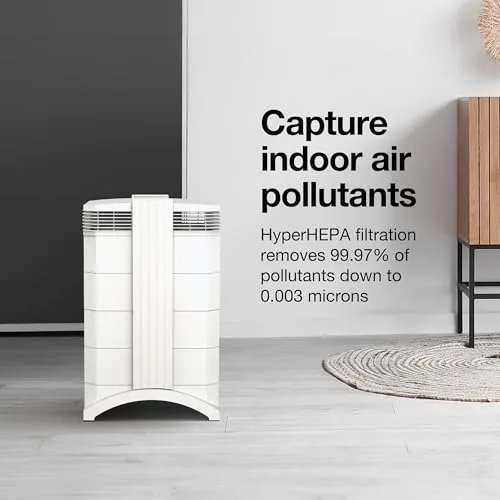
IQAir HealthPro Compact XE centers on HyperHEPA and claims 99.5% capture down to 0.003 microns (retailer-listed performance). Numerically, that’s a much smaller particle threshold than 0.05 microns, which aligns with a particles-first design goal for fine particulate exposure.
Conclusion: For ultrafine particle capture on paper (0.003 µm vs 0.05 µm), IQAir HealthPro Compact XE has the clear, defensible edge.
Breadth of filtration technologies (particles vs «everything else»)
Air Oasis iAdaptAir 2.0 is explicitly a multi-stage system: 5 stages including activated carbon (140 g), a silver antimicrobial filter, UVC LEDs, and bi-polar ionization alongside its H13 HEPA. That mix is geared toward a broader pollutant set—especially odor/microbial narratives—rather than only mechanical particle trapping.
IQAir HealthPro Compact XE is simpler at 2 stages: a pleated HyperHEPA filter plus an activated carbon post-filter. The design is more mechanically focused, which can be appealing if you want particle removal without extra «active» technologies, but it’s less explicitly positioned as a multi-technology odor/microbe system.
Conclusion: For filtration breadth and «more tools in the box,» Air Oasis iAdaptAir 2.0 has the advantage; for a simpler, mechanically led approach, IQAir is the more minimalist option.
Carbon/odor emphasis (as specified)
Air Oasis iAdaptAir 2.0 includes 140 g of activated carbon, which is a concrete, disclosed amount and signals that odor/VOC reduction is part of the intended design (even if 140 g is still not «heavy-duty» carbon by mass). Combined with the rest of its stages, it’s positioned as an all-in-one response to mixed indoor air complaints.
IQAir HealthPro Compact XE lists carbon as an activated carbon post-filter but doesn’t provide a carbon weight in the provided specs. It may still help with odors, but its headline performance claims and filtration architecture are more clearly about particle capture efficiency.
Conclusion: For odor/VOC-oriented intent and transparency (140 g carbon disclosed), iAdaptAir 2.0 reads stronger from the spec sheet; IQAir’s carbon stage looks more auxiliary here.
Winner: IQAir HealthPro Compact XE — It takes the particle-removal point decisively with 99.5% down to 0.003 microns versus iAdaptAir’s 0.05 microns, even though iAdaptAir counters with a broader multi-stage stack for mixed-pollutant goals.
Coverage & Airflow
Room-size ratings (how much space each is designed to handle)
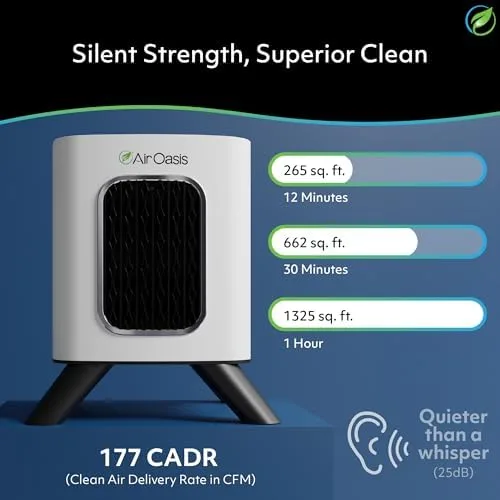
The Air Oasis iAdaptAir 2.0 (AOIA-2S Small) is rated for 265 sq ft at 5 air exchanges per hour, and it’s also described as covering 265 sq ft in 12 minutes. That points to a «fast-cycling in a smaller room» design rather than whole-floor coverage.
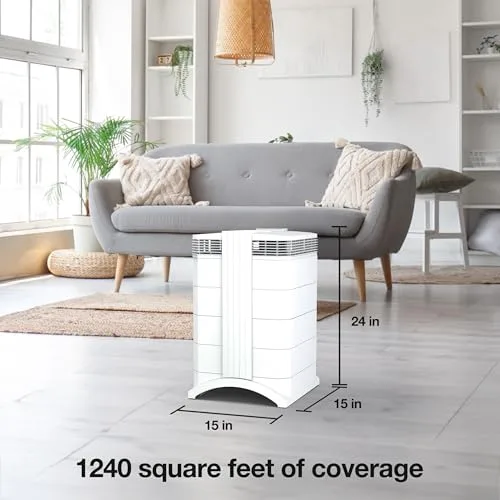
The IQAir HealthPro Compact XE (121.AA.11.02) is rated for 1,125 ft² (based on 2 air changes/hour with an 8 ft ceiling) and has a published claim of 99.9% room purification up to 1,240 sq ft. Even using the more conservative 1,125 ft² figure, it’s operating in a very different room-size class than the iAdaptAir Small.
Conclusion: On coverage, IQAir clearly wins—its 1,125–1,240 sq ft ratings vs 265 sq ft make it the more credible choice for large rooms and open-plan areas.
CADR / airflow (how quickly it can move and clean air)
The iAdaptAir 2.0 (Small) lists airflow from 91 CFM (Low) up to 177 CFM (Max) across 4 fan speeds. In practice, that ceiling is enough to turn over air quickly in the ~265 sq ft range it’s rated for, but it limits how aggressively it can clean when the room gets bigger or pollution spikes.
The HealthPro Compact XE spans 40 → 330 CFM across 6 speeds, topping out at 330 CFM. That maximum airflow is about 1.86× higher than the iAdaptAir’s 177 CFM, which is a meaningful jump when you’re trying to reduce particle levels quickly in larger volumes of air.
Conclusion: For raw air-moving capability and «time to clean,» IQAir wins with 330 CFM max and a wider speed range versus 177 CFM max.
Fan-speed granularity (control over airflow)
With 4 speeds, the iAdaptAir 2.0 offers simpler manual control, but fewer steps can make it harder to find a precise balance between noise and cleaning rate—especially if «Medium» is too weak and «High» is louder than you want.
With 6 speeds, the HealthPro Compact XE provides finer airflow tuning (e.g., 180/220 CFM steps before hitting 330 CFM). That extra granularity is useful in bigger rooms where you may want sustained moderate airflow rather than an all-or-nothing ramp to max.
Conclusion: For airflow control flexibility, IQAir has the edge thanks to 6 speeds vs 4.
Winner: IQAir HealthPro Compact XE — It’s decisively stronger on the core metrics that determine room coverage and cleaning speed: much larger published coverage (1,125–1,240 sq ft vs 265 sq ft) and higher max airflow (330 CFM vs 177 CFM), plus more fan-speed steps (6 vs 4) for better tuning.
Smart Features & Automation
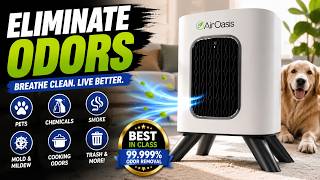
Air Oasis iAdaptAir 2.0 is built around a more «smart device» control scheme: it offers an on-unit touchscreen plus app control, and its Wi‑Fi chip is physically removable. That removable module is a rare option if you want automation sometimes but also want a true hardware-level disconnect (including for EMF-sensitive households). It also includes a 1–12 hour timer and an Auto mode driven by an internal air-quality sensor.
IQAir HealthPro Compact XE takes a more appliance-first approach: you get a device control panel plus the IQAir AirVisual app for remote control and scheduling. It supports Smart mode (sensor-based automatic operation) and lists an integrated PM2.5 particle sensor, but at least one review notes it does not include an air-quality indicator on the unit—so you may not get «at-a-glance» feedback without opening the app.
Conclusion: For smart features and automation depth, iAdaptAir 2.0 has the clear edge thanks to the touchscreen-centric UX and the unique removable Wi‑Fi hardware option, while IQAir’s smart features feel more supplemental than central.
App dependence vs «still works great without the app»
Air Oasis iAdaptAir 2.0 leans more heavily on connectivity as part of the intended experience: the spec sheet positions control as «Touch Screen and app», and the «connected vs local-only» decision is baked into the removable Wi‑Fi design. In practice, that can be a benefit if you want sensor-driven automation with visible feedback—but it also means Wi‑Fi reliability matters more to day-to-day satisfaction (especially on finicky networks like mesh or band-steering setups).
IQAir HealthPro Compact XE is easier to treat as «set the speed and forget it» even if you never touch the app, because its operation is less software-mediated. While it does support app scheduling and Smart mode, the broader ownership experience is designed to stay functional and predictable without relying on phone OS updates, accounts, or ongoing connectivity.
Conclusion: If you want a purifier that feels like a connected gadget, iAdaptAir 2.0 is stronger; if you want to minimize app dependency risk, HealthPro Compact XE has the advantage.
Winner: Air Oasis iAdaptAir 2.0
Design & Portability
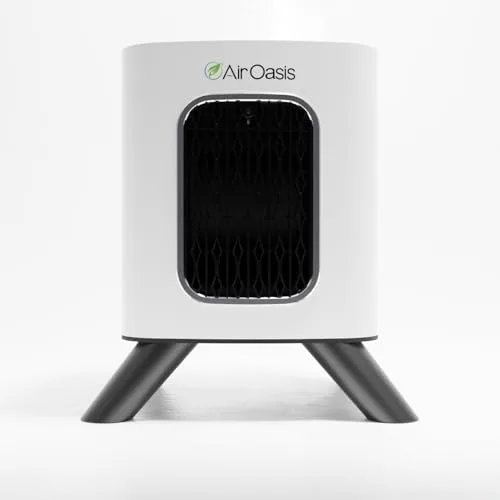
Air Oasis iAdaptAir 2.0 is meaningfully easier to move around because it’s just 7.7 lbs and physically compact at 10.75" L × 10.04" W × 13.50" H. That size makes it realistic to carry between a bedroom, office, and living room without treating it like a permanent fixture.
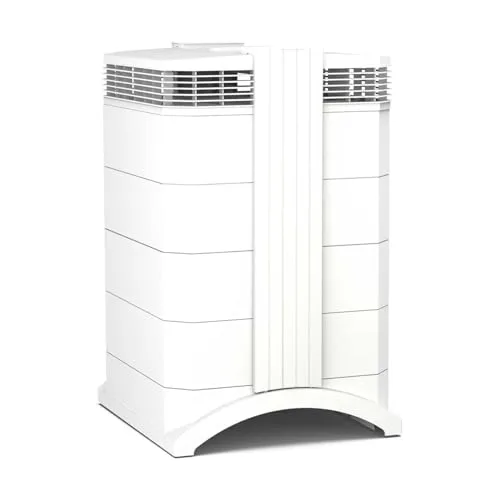
IQAir HealthPro Compact XE is built more like a stationary appliance: it weighs 26 lbs and measures 24" H × 15" W × 16" D, so it asks for dedicated floor space. That bulk aligns with the «pick a spot and leave it» reality noted in the editorial context—convenient for a single primary room, less so for frequent room-to-room use.
Conclusion: For portability and smaller-space fit, the iAdaptAir 2.0 has a clear, defensible advantage—it’s roughly 18.3 lbs lighter and dramatically smaller in footprint than the HealthPro Compact XE.
Air Oasis iAdaptAir 2.0 also leans into a more «consumer device» design language with touchscreen + app control (and a removable Wi‑Fi chip), which supports quick interactions at the unit. In practice, that UI-forward approach fits the «set-and-forget automation with visible feedback» positioning in the provided context.
IQAir HealthPro Compact XE is comparatively utilitarian: you get a device control panel plus the IQAir AirVisual app, but the product experience is less centered on guided on-device feedback. The editorial notes describe it as more «appliance-like,» favoring predictable operation over a modern, interactive interface.
Conclusion: If you prioritize a modern, touch-driven interface and a smaller, more «gadget-like» physical presence, iAdaptAir 2.0 has the edge, while IQAir’s advantage is the more industrial, stationary-appliance design that suits long-term placement.
Winner: Air Oasis iAdaptAir 2.0
Noise & Power Efficiency
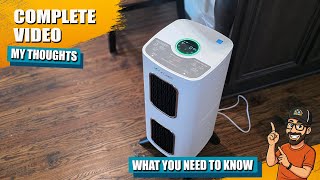
Noise (low vs. max)
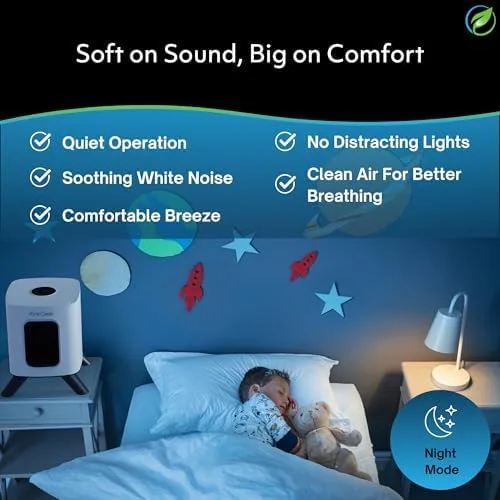
Air Oasis iAdaptAir 2.0 is rated at 25 dB on Low and tops out at 51 dB on Max. That low-speed spec puts it in the «nearly inaudible» category for typical rooms, while the 51 dB ceiling suggests it avoids the harsher fan noise some purifiers develop at full blast.
IQAir HealthPro Compact XE is also rated at 25 dB(A) on its lowest setting, but it climbs to 59 dB(A) at its highest speed (with intermediate steps listed at 36/44/50/54 dB(A)). In practice, that means it can get meaningfully louder when pushed to maximum airflow.
Conclusion: Tie on the quietest setting (25 dB vs 25 dB), but iAdaptAir 2.0 is quieter at the top end (51 dB vs 59 dB)—an advantage for noise-sensitive users who may need higher speeds.
Power draw (and what it implies)
Air Oasis iAdaptAir 2.0 lists 8–35 W depending on fan speed. That’s a low ceiling for continuous use, supporting an «all-day» operating style without turning your purifier into a noticeable electricity load.
IQAir HealthPro Compact XE is specified at 27–215 W across its six speeds (with <1 W standby). That high maximum draw aligns with its much higher peak airflow capability, but it also raises the cost of running the unit hard for long stretches; one review source estimates ~$161.28/year in electricity cost.
Conclusion: iAdaptAir 2.0 clearly wins on energy efficiency (35 W max vs 215 W max), while IQAir’s higher draw is the trade-off you accept to access its stronger top-end airflow.
Winner: Air Oasis iAdaptAir 2.0
Maintenance & Running Costs
Air Oasis iAdaptAir 2.0 is built around more frequent consumables: Air Oasis recommends filter replacement every 6–24 months depending on usage and environment. Its base warranty is 2 years, but it can extend to a lifetime warranty with an active filter subscription, which can materially change long-term cost/value if you plan to keep the unit for many years.
IQAir HealthPro Compact XE typically asks for fewer filter purchases—its filter lifespan is cited as up to 4 years, which can reduce the hassle (and budgeting spikes) of frequent replacements. Warranty-wise, it starts at a 1-year base warranty, but offers 10 years with registration and qualifying filter subscription or proof of genuine IQAir filters, which is a substantial long-term coverage window.
Conclusion: IQAir wins on replacement frequency (up to 4 years vs 6–24 months), while iAdaptAir wins on «coverage-for-subscription» if you value the lifetime warranty tied to staying current on filters.
Air Oasis iAdaptAir 2.0 is dramatically lighter on electricity for always-on use: it’s rated at 8–35 W depending on speed. Even allowing for real-world variability, that wattage range supports very low annual energy spend compared with high-draw purifiers.
IQAir HealthPro Compact XE is much more power-hungry at higher speeds, listed at 27–215 W across its settings (with <1 W standby). In third-party analysis, continuous operation can work out to about $161.28/year in electricity costs, which is a meaningful recurring expense for 24/7 users.
Conclusion: iAdaptAir 2.0 clearly wins on running cost from energy use—its 8–35 W rating versus 27–215 W for IQAir aligns with a large real-world annual cost gap.
Winner: Air Oasis iAdaptAir 2.0 — despite more frequent filter changes, its much lower power draw and the option of a lifetime warranty via subscription create a stronger long-term cost story for most always-on owners.
Warranty & Peace of Mind
Air Oasis iAdaptAir 2.0 includes a 2-year limited base warranty. Its standout is the ability to extend coverage to a lifetime warranty—but only with an active Air Oasis filter subscription, which effectively ties long-term «peace of mind» to ongoing official consumables.
IQAir HealthPro Compact XE starts with a shorter 1-year base warranty. It can be extended to 10 years with product registration and a requirement to maintain genuine IQAir filter purchases (via a subscription or proof), adding a documentation/eligibility step to keep the long warranty intact.
Conclusion: On pure duration, Air Oasis iAdaptAir 2.0 offers the bigger upside because lifetime coverage (with subscription) meaningfully exceeds 10 years. The trade-off is that both brands’ best warranty terms are conditional on sticking with official filter purchasing, but Air Oasis still delivers the stronger long-horizon safety net.
Winner: Air Oasis iAdaptAir 2.0
The Bottom Line
After breaking down filtration, coverage, features, and long-term ownership costs, the choice comes down to whether you’re optimizing for absolute particle performance or the best all-around package.
Best for Allergy & Asthma Sufferers: Choose the IQAir HealthPro Compact XE for its HyperHEPA claim of 99.5% capture down to 0.003 microns, which is the most defensible edge in ultrafine particle filtration in this comparison.
Best for Smart Home Enthusiasts: Choose the Air Oasis iAdaptAir 2.0 thanks to its touchscreen-centric experience, app control, and the standout removable Wi‑Fi module that supports automation without permanent connectivity.
Best for Large-Space Coverage on a Budget: Choose the Air Oasis iAdaptAir 2.0 (large variant) because, in the article’s framing, it delivers higher stated whole-home coverage and airflow for less money than IQAir’s top-end alternative.
Best Low-Maintenance Appliance Mindset: Choose the IQAir HealthPro Compact XE since its filter lifespan is cited at up to 4 years and it’s easier to run as a «set the speed and forget it» purifier without leaning on app-based operation.
For most households, the best buy is
—it stacks up as the more complete value with stronger smart features, dramatically lower max power draw (35 W vs 215 W), and the potential for a lifetime warranty via subscription. The trade-off is clear: IQAir remains the pick if your top priority is maximum ultrafine particle capture and big-room airflow/coverage.If you’re buying one purifier to live with day in and day out, prioritize the model that fits your room size and operating style first—then decide whether you’d rather pay for IQAir’s particles-first performance or iAdaptAir’s broader feature set and lower-cost 24/7 ownership.
FAQ
Does the Air Oasis iAdaptAir 2.0 produce ozone?
Can I use the IQAir HealthPro Compact XE without the app?
How often do I need to replace filters?
Which purifier is quieter?
Does the IQAir HealthPro Compact XE have an air quality display?
What room size is the IQAir HealthPro Compact XE designed for?
What warranty does the IQAir HealthPro Compact XE come with?
Is the Air Oasis iAdaptAir 2.0 or the IQAir HealthPro Compact XE better for large rooms?
📄 Used Manuals & Documentation
Air Oasis iAdaptAir 2.0
"Images are used for editorial and informational purposes only. All trademarks and images belong to their respective owners."